4W Fleet Momentum Won't Save VinFast in India's e2W Market


Between November 16 and 19, 2026, VinFast flew Indian journalists and creators to Nha Trang, Vietnam, for its V-Creator All Star Summit. The hospitality, executive briefings, and preview of three electric scooters the Evo, Kyo, and Kinet generated a predictable wave of enthusiastic walkaround videos and price conversions across Indian feeds. Forget the Nha Trang hospitality for a second not a single Indian journalist has actually swung a leg over an India-spec version of these scooters. Every spec sheet circulating this week reflects Vietnamese domestic reference models, not homologated Indian products.
Speaking plainly as someone who tracks Indian showrooms and service bays daily, the Nha Trang hype misses the core strategic vulnerability of VinFast’s two-wheeler entry. Outside one very specific urban wedge, these previewed scooters look dated resembling older Chinese-style commuter shells that lack the styling appeal or specification value required to win over Indian EV buyers head-on. Walk into 2027 trying to out-spec TVS, Bajaj, or Ather on showroom floors, and VinFast will get crushed on value perception alone.
Yet writing VinFast off would be equally naive. Its genuine commercial opportunity lies in an entirely different fight: winning over skeptical petrol scooter buyers in India’s most congested cities who still fear running out of charge and have nowhere to plug in a wire at night.
4W Fleet Cushion vs. India’s 2W Fortress
Because VinFast climbed India’s electric car charts rapidly, casual observers assume the Vietnamese automaker has already decoded Indian retail demand. Pure Vahan retail registration data strips away that illusion.
In October 2026, VinFast registered 2,582 electric cars across India solid traction for a newcomer, except roughly two-thirds of that volume came from commercial fleet buyers. Combined registrations of the VF MPV7 and Limo Green reached 1,823 units, representing 70.6% of VinFast’s monthly tally with 95.2% going to commercial fleets.
More revealing is the sequential trajectory: combined MPV7 and Limo Green registrations fell 27.2% month-on-month from 2,503 units in September, with Limo Green alone sliding 29.2% from 2,450 units in September down to 1,735 in October. Private retail SUV volume stayed modest, with the VF 7 at 436 units and the VF 6 at 323 units (up 11% from 291 in September). In India’s nascent four-wheeler EV market, commercial cab absorption of 1,700-plus units a month puts a brand squarely on the leaderboard.
In Indian electric two-wheelers, 2,500 units a month barely moves the needle.
From January through October 2026, India’s electric two-wheeler retail market averaged roughly 1.79 lakh units a month (~17.9 lakh registrations year-to-date) before surging during the October festive peak to a record 2,23,847 Vahan registrations up 48% year-on-year and 7% month-on-month over September’s 2,08,705 units. Treating October’s festive spike as a flat baseline would be sloppy, yet even at the steady 1.79-lakh monthly run-rate, domestic incumbents hold an iron grip over Indian showrooms. October Vahan retail shows just how concentrated that power has become:
- TVS Motor: 60,429 units (27.0% share the first e2W brand in India to cross 60,000 monthly retail registrations)
- Bajaj Auto: 49,067 units (21.9%)
- Ather Energy: 31,796 units (14.2%)
- Hero Vida: 29,901 units (13.4%)
- Ola Electric: 12,096 units (5.4%)
- Greaves / Ampere: 10,838 units (4.8%)
- River Mobility: 6,796 units (3.0%)
India’s top four domestic players now control roughly 76.5% of all retail registrations. Meanwhile, legacy global two-wheeler giants with decades of Indian trust and massive dealership footprints have hit a wall. Between January 1 and October 8, 2026, Honda (5,536 units), Suzuki (4,133 units), and Yamaha (1,066 units) combined for just 10,735 Vahan retail registrations out of 16,10,854 total e2Ws sold a combined market share of 0.67%. Even in September 2026, when Yamaha’s EC-06 hit its highest monthly retail tally at 232 units, all three Japanese brands together managed just 1,996 registrations out of 2,07,850 (0.96% share). If Honda, Suzuki, and Yamaha can’t crack 1% of this market with decades of dealer loyalty behind them, a big logo alone won’t save anyone.
Where the Vietnam Baseline Collides With 2026 India
Before accepting raw currency conversions from Nha Trang headlines, compare VinFast’s 2026 Vietnamese swappable-battery baseline directly against what Indian buyers can walk into showrooms and buy today:
| Model (Baseline) | Battery & Pack Setup | Motor Output | Claimed Range (Cycle) | Under-Seat Boot | Wheels & Charger | Reference / Showroom Price |
|---|---|---|---|---|---|---|
| VinFast Evo (VN Ref) | 1×1.5 kWh LFP std + 1× opt (3.0 kWh max; 12 kg/pack; 86/98 kg curb) | 1.5 kW rated / 2.45 kW peak hub | ~85 km (1 pack) / 165 km (2 packs, VN 30 km/h) | 12 L (2 packs in) | 12-inch / LCD / 400 W (4 hr 30 min/pack) | 18.8M VND ex-batt / 24.1M VND (1 pack incl.) |
| VinFast Kyo (VN Ref) | 1×1.5 kWh LFP std + 1× opt (3.0 kWh max; 12 kg/pack) | 3.0 kW peak hub | ~75–80 km (1 pack) / 160 km (2 packs, VN 30 km/h) | 21 L (2 packs in) | 14-inch / TFT, Smart Key, Hill Hold / 400 W (4 hr 30 min/pack) | 30.0M VND ex-batt / 35.3M VND (1 pack incl.) |
| VinFast Kinet (VN Ref) | Dual 1.5 kWh LFP (3.0 kWh total; 12 kg/pack; 98/110/122 kg curb) | 3.0 kW rated / 5.2 kW peak hub | 145 km (2 packs, VN cycle) | 22 L (2 packs in) | 14-inch / TFT, Smart Key, Hill Hold / 400 W (9 hrs) or opt 1,000 W (3 hr 30 min) | 40.0M VND ex-batt / 49.9M VND (2 packs incl.) |
| TVS Orbiter (India) | V1: 1.8 kWh / V2: 3.1 kWh | 1.8 kW rated / 2.5 kW peak hub | 86 km (V1) / 158 km (V2) | 34 L | 14-inch front; 650 W | ~₹1.02L (V1) / ~₹1.19L (V2) avg ex-sh |
| Bajaj Chetak C2501 (India) | 2.5 kWh fixed | 1.8 kW rated / 2.2 kW peak hub (60 km/h top) | 113 km (IDC) | 25 L | All-metal body; 750 W (0–80% in 2 hr 25 min) | From ₹99,802 (~₹1.04L avg ex-sh) |
| Hero Vida VX2 (India) | 2.2–4.4 kWh removable | 6.0 kW PMSM | 92 km (2.2) / 142 km (3.4) / 187 km (4.4) (IDC) | 27.2–33.2 L | Removable hardware benchmark | ₹1,09,990–₹1,60,990 outright ex-sh |
| River Indie (India) | 4.0 kWh | 4.5 kW rated / 6.7 kW peak | 160 km (IDC; 90 km/h top) | 43 L (+12 L glovebox) | 14-inch front & rear; 750 W | ₹1.54L–₹1.57L ex-sh |
| Ather 450X (India) | 2.9 kWh / 3.5–3.7 kWh | 6.4 kW PMSM | 126 km / 161 km (IDC) | 22 L | 90 km/h; 0–40 km/h in 3.3 s | From ₹1.49L–₹1.51L ex-sh |
Baseline note: All three Vietnam reference models carry IP67 waterproofing, with claimed top speeds of 70 km/h (Evo), 64–70 km/h (Kyo), and 90 km/h (Kinet), and 0–50 km/h sprints of ~16 seconds on Evo and Kyo versus ~6 seconds on Kinet.
Before you even look at how these scooters are styled, two numbers in that table should make any dealer pause:
- Vietnam pricing hides a one-pack trap, and Indian battleground bands leave zero room for error. Several Nha Trang reports blurred ex-battery stickers with dual-battery range figures. On both the Evo (24.1M VND) and Kyo (35.3M VND), the +5.3M VND step above ex-battery pricing buys only one 1.5 kWh pack, delivering ~75–85 km on Vietnam’s constant 30 km/h test cycle a steady-speed test that cannot be equated directly to Indian IDC numbers. Reaching the headline 160–165 km claim requires buying or renting a second pack; only the Kinet’s 49.9M VND price (+9.9M VND) bundles both batteries out of the box. Based on EVINDIA’s estimated Indian ex-showroom battleground bands ₹1.00 lakh for Evo, ₹1.25 lakh for Kyo, and ₹1.50 lakh for Kinet (our commercial target estimates for where these scooters must fight, never announced MSRPs or currency conversions)—VinFast walks directly into fully localized domestic rivals.
- Standard charger wattage must rise for India. Kinet’s 9-hour standard charge is simple Watt-hour physics: pushing 3.0 kWh through a 400 W charger takes roughly 9 hours after conversion and balancing losses, matching the 4 hours 30 minutes required for a single 1.5 kWh pack on the Evo and Kyo. VinFast already offers an optional 1,000 W fast charger on the Kinet that cuts a full dual-pack charge to 3 hours 30 minutes. With Bajaj supplying a 750 W charger on the C2501 and TVS bundling 650 W on the Orbiter, Indian product planners will immediately ask whether VinFast ships a 750 W–1,000 W charger as standard here rather than cutting BOM cost with a 400 W brick.
The Showroom Déjà Vu: Why Design Memory Hurts More Than Specs
Specs win spreadsheet debates; silhouettes win showroom walk-ins. Put VinFast’s three Vietnamese reference scooters beside Indian two-wheeler memory, and a stark visual problem hits immediately. Indian EV buyers moved past generic Southeast Asian and Chinese commuter templates years ago yet each of VinFast’s three previewed scooters visually mirrors an early-wave Indian budget EV that consumers have already left behind.
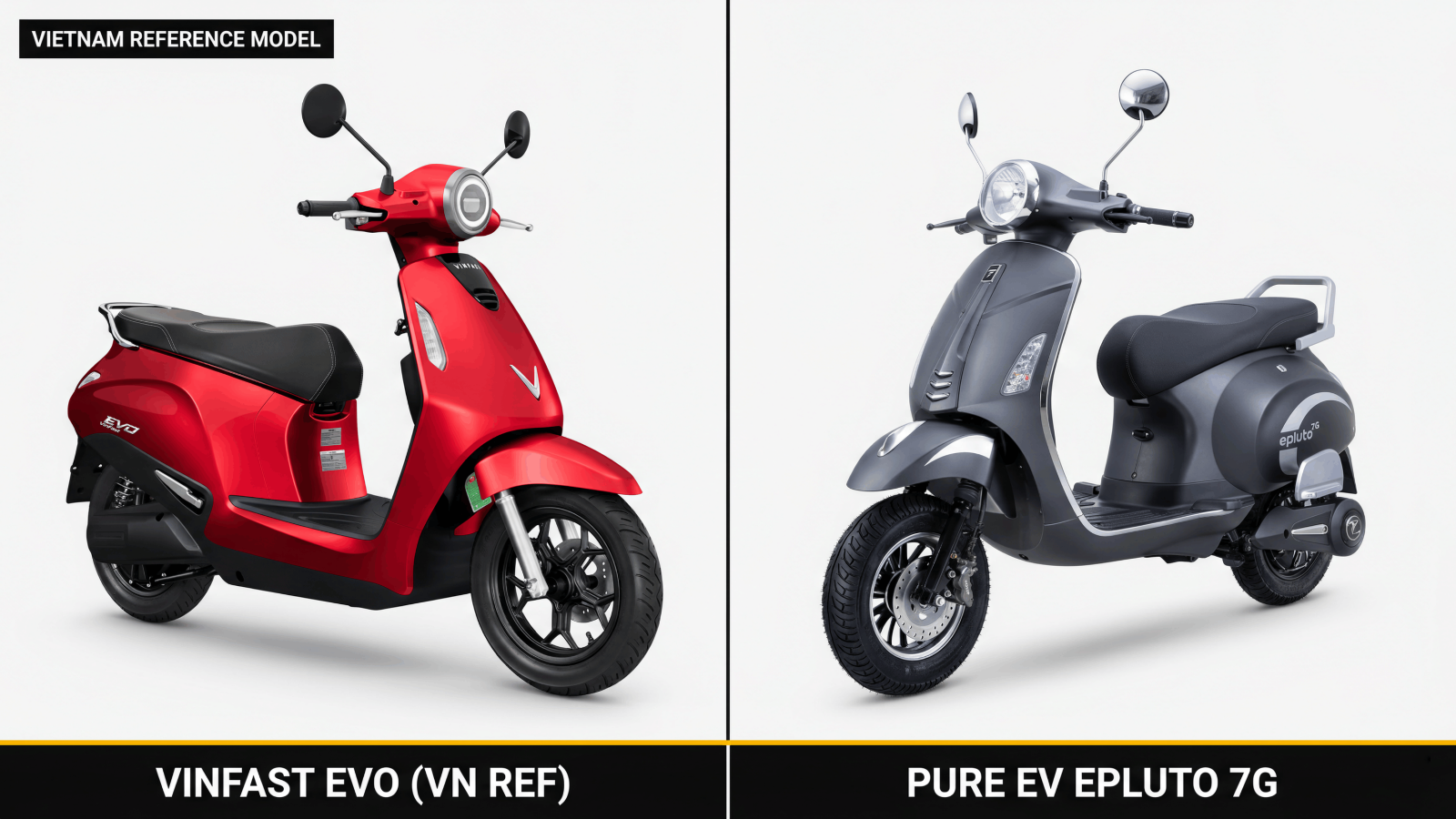
VinFast Evo vs. PURE EV EPluto 7G: Look at the side profile: a round handlebar-mounted headlamp, a smooth extended front mudguard, small 12-inch wheels, a flat floorboard, and a bulbous, rounded rear body cowl wrapping a hub motor. Without the sheet-metal heft and paint depth of a Bajaj Chetak, that compact Vespa-lite shell instantly triggers memories of early assembled budget commuters rather than a modern ₹1 lakh mainstream scooter.
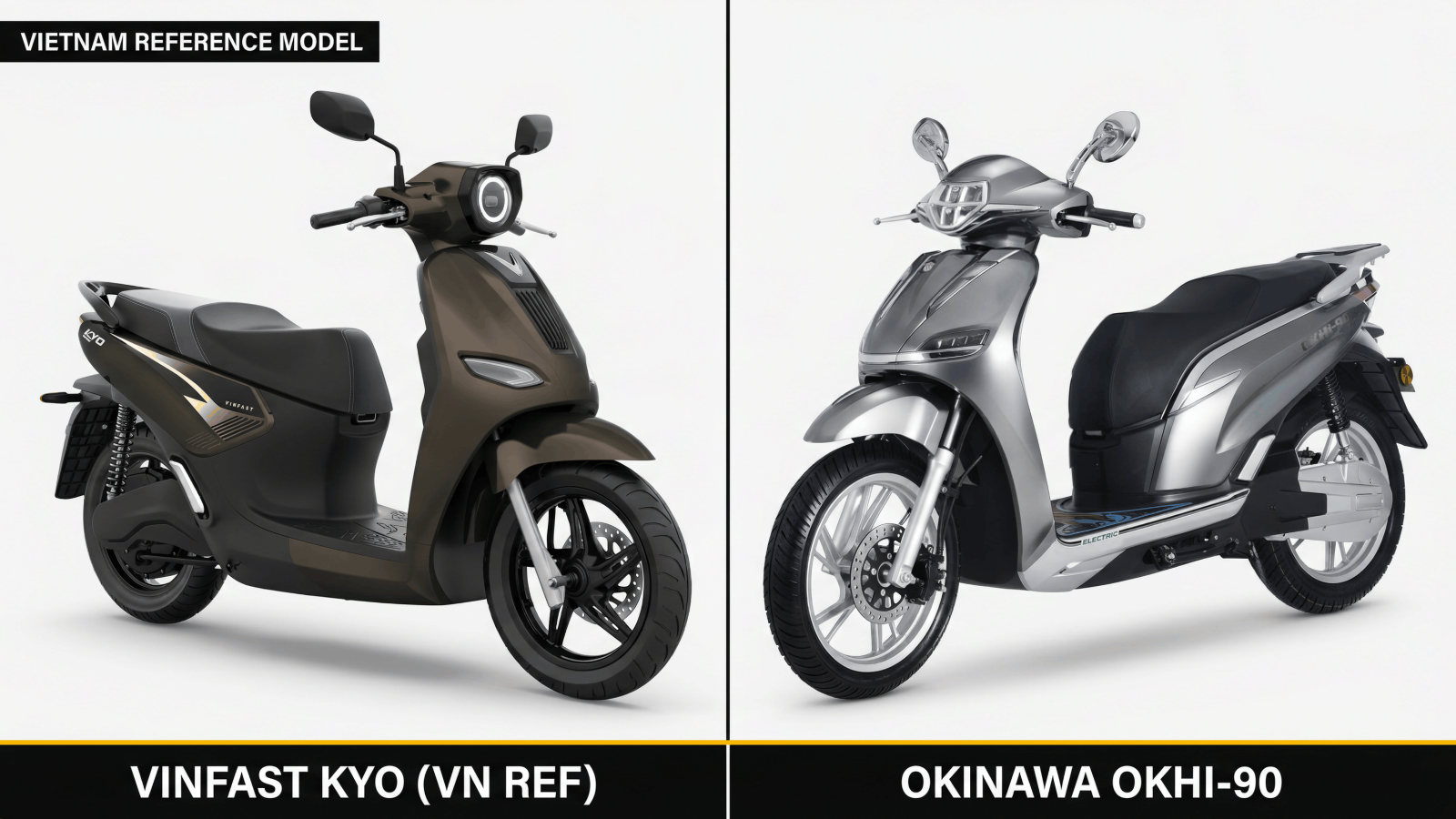
VinFast Kyo vs. Okinawa OKHI-90: Place the Kyo beside the OKHI-90 and the shared proportions stand out immediately: a slim vertical front apron, tall spoked wheels with visible air gaps under the mudguard, an upright step-through frame, and exposed twin rear shocks. To be clear, Indian buyers did not reject 14-inch wheels the River Indie runs 14-inch wheels at both ends alongside a 43-litre under-seat boot, while the TVS Orbiter pairs a 14-inch front wheel with 34 litres of storage. What Indian families rejected was that narrow, spindly big-wheel silhouette when modern domestic options look planted and substantial.
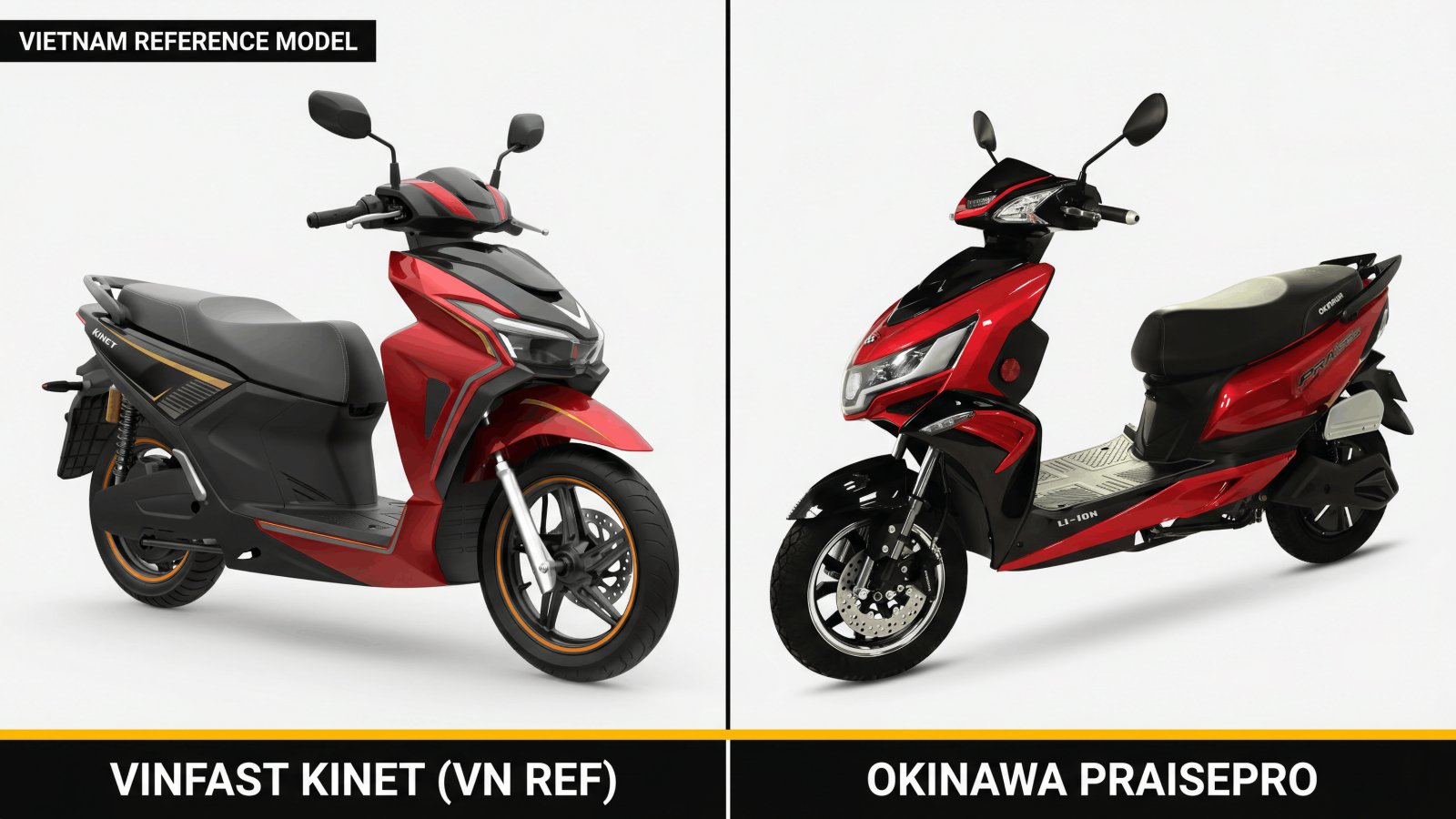
VinFast Kinet vs. Okinawa PraisePro: Even the flagship Kinet carries visual baggage. Its wide apron-mounted headlamp tucked beneath an angular front cowl, sharply creased side panels, telescopic front forks, exposed twin rear shocks, and rear hub motor look straight out of the Okinawa PraisePro playbook. Nobody can fairly fault the Kinet’s 22-litre boot when the Ather 450X carries the exact same 22 litres the deficit is visual desirability at ₹1.50 lakh, where buyers expect clean, ground-up Indian industrial design rather than sharp-beaked commuter bodywork.
VinFast itself seems aware of the risk. Speaking to car&bike on November 23, VinFast India Two-Wheelers CEO Anurag Saxena stated that the India-spec scooters will be “developed from scratch, so they will have an entirely new frame to start off with,” alongside modified chassis geometry, higher ground clearance, better footboard space, and larger storage capacity. That is a bold promise now VinFast has to prove it on Indian tarmac at Bharat Mobility 2027. Asking Indian families to choose dated hub-motor commuter bodywork with 16-second 0–50 km/h acceleration over an all-metal Chetak C2501 starting at ₹99,802, a 34-litre Orbiter, a removable-pack Vida VX2, or a 6.4 kW Ather 450X is a losing showroom pitch before a test ride even begins.
The Real Wedge: Swapping Economics, Honda’s Blunder, and Delhi Ground Reality
If VinFast’s reference scooters cannot win a beauty contest or spec sheet war against Indian domestic leaders, why should OEM boardrooms take this launch seriously? Because millions of two-wheeler commuters in India’s densely congested cities have zero access to ground-floor charging, and barely one or two practical removable-battery scooters exist on the market. (Hero Vida’s BaaS offering should be excluded from any operational swapping debate—it is a split vehicle-and-battery financing product designed to reduce upfront acquisition cost, not a live battery-swapping network.) For an apartment or builder-floor resident parked on a crowded street, battery swapping remains the only practical bridge into electric mobility.
That exact use case is where Honda’s Activa e: wrote the cautionary case study. Launched in February 2025 at ₹1.17 lakh+ ex-showroom with dual swap-only packs totaling 3.0 kWh (102 km claimed), Honda prohibited home charging altogether and confined swap stations to Bengaluru, Delhi, and Mumbai. Weak customer adoption forced HMSI to halt Activa e: and QC1 production from August 2025 to clear inventory, and by October 2026 reports indicated Honda had shelved its ₹600-crore dedicated EV factory plan at Narsapura, Karnataka.
VinFast’s dual-mode architecture directly corrects Honda’s misstep. Even when modern fixed-battery scooters comfortably deliver 100–150 km per charge, skeptical petrol riders keep coming back to one anxiety: “What happens if my battery runs out mid-day?” VinFast’s sharpest pitch to those ICE holdouts is straightforward: swap your battery in the same time it takes to fill petrol, for less money while keeping the option to charge at home. Still, hoisting a single 12 kg LFP pack or 24 kg across two packs up three flights of stairs every evening turns indoor charging into a backup safety net. Rider trust will live or die on V-Green swap uptime.
VinFast brings real overseas operational receipts to that bet, alongside clear structural differences:
- Vietnam (Captive Scale): VinFast delivered 406,453 e-scooters in 2025 (+473% YoY, ranking #1 domestically), pricing its 2026 swappable plans at 175,000 VND/month (1 pack) or 300,000 VND/month (2 packs) for unlimited kilometers plus 9,000 VND per pack per swap. That velocity benefits heavily from Vingroup’s captive ecosystem V-Green’s ~150,000 charging ports (pushing toward 30,000+ swap cabinets in 2026), Green SM ride-hailing fleets, and Vinhomes townships.
- Indonesia (The Closest Non-Captive Stress Test): Early bookings for VinFast’s swappable Evo, Feliz II, and Viper opened on May 20, 2026, with deliveries beginning in June. The Evo lists at IDR 18.98 million on subscription versus IDR 26.26 million with two batteries included, backed by IDR 84,000/month per battery, IDR 6,000 per swap, and ~2,000+ deployed swap stations built through V-Green hubs and third-party retail partners. Replicating that open-market partner density in India will test V-Green far more severely than Vietnam ever did.
Say what you want about the scooters, VinFast isn’t tip-toeing into India with a half-hearted pilot it is writing serious cheques upfront. At its Thoothukudi, Tamil Nadu complex part of $500 million invested so far within a multi-year $2 billion India commitment, backed by an agreement with Tamil Nadu for 500 additional acres Asia CEO Tapan Ghosh has confirmed the two-wheeler line can scale up to 1 million units a year (starting conservatively on demand), with two models targeted for H1 2027. On November 23, car&bike reported that VinFast Two-Wheelers has already appointed more than 55 dealers across 35 cities building on its earlier 50-plus dealer LOIs across 15 states and UTs with Anurag Saxena targeting 300 dealerships in 100 cities by end-2027 and an explicit focus on charging-constrained markets. VinFast has also leaned heavily on aggressive four-wheeler ownership perks in India including free public V-Green charging extended through March 31, 2029, extended warranties, and resale value guarantees and executives framed their Nha Trang strategy around tackling the same buyer anxieties (“5 Worries, 5 Solutions”), though exact incentive terms for two-wheelers remain unannounced.
Exclusive ground checks by EVINDIA in Delhi-NCR show that VinFast’s retail execution is already moving faster than corporate statements suggest. The company has formally signed a lease for the ground floor of a commercial building in Block B, Outer Ring Road, Saraswati Vihar, Pitampura right beside the Bagga Link Bajaj showroom to establish its first Company-Owned, Company-Operated (COCO) electric two-wheeler flagship directly on a prime North-West Delhi corridor packed with rival petrol and electric OEMs. Dealer caliber is equally telling: aided by seasoned dealer-development executives recruited from TVS Motor and other incumbent OEMs, VinFast has attracted strong applications from established Delhi dealer groups, and EVINDIA has learned that a prominent East Delhi TVS dealer has already been awarded a VinFast two-wheeler dealership.
The Delhi 2028 Catalyst and Three Tests for Bharat Mobility 2027
Securing a Pitampura COCO flagship and signing an established East Delhi incumbent dealer aligns directly with India’s sharpest regulatory shift. Under Delhi EV Policy 2.0 effective July 1, 2026 through March 31, 2030, backed by ₹15,000 crore in support, a Year-1 e2W subsidy of ₹10,000/kWh capped at ₹30,000, and a 100% road tax and registration fee waiver Delhi will ban new petrol and CNG two-wheeler registrations from April 1, 2028. Once Delhi legally stops registering petrol two-wheelers in 2028, millions of people in builder floors and DDA flats with no ground-floor plug won’t look at battery swapping as a nice feature they’ll need it just to commute. Inevitable NCR cross-border registration leakage into Gurugram and Noida will blunt some of that urgency, yet Delhi still hands VinFast its clearest launchpad a policy shift we will dissect in full in Part 2 next week.
When VinFast showcases its India-spec scooters around Bharat Mobility Global Expo 2027 (February 4–9, 2027), three operational proofs will determine whether it breaks through with skeptical petrol riders:
- Credible India-spec engineering: Genuine localization of chassis durability, usable storage, and faster standard charging suited to Indian households, replacing dated Vietnamese commuter compromises.
- Petrol-beating swap economics: Clear monthly and per-swap pricing that visibly undercuts daily petrol expenditure while keeping home charging completely open.
- Day-1 V-Green operational reliability: Dense, uptime-guaranteed swap cabinets functioning across launch cities before keys reach retail customers, building the everyday trust required to convert lifelong petrol scooter buyers.
Looking to buy an EV?
Compare, explore and find the perfect electric vehicle for you.
Explore EVs