TVS iQube 2.3 kWh Launched in India at ₹1.16 Lakh: Higher Range, Simpler Tech


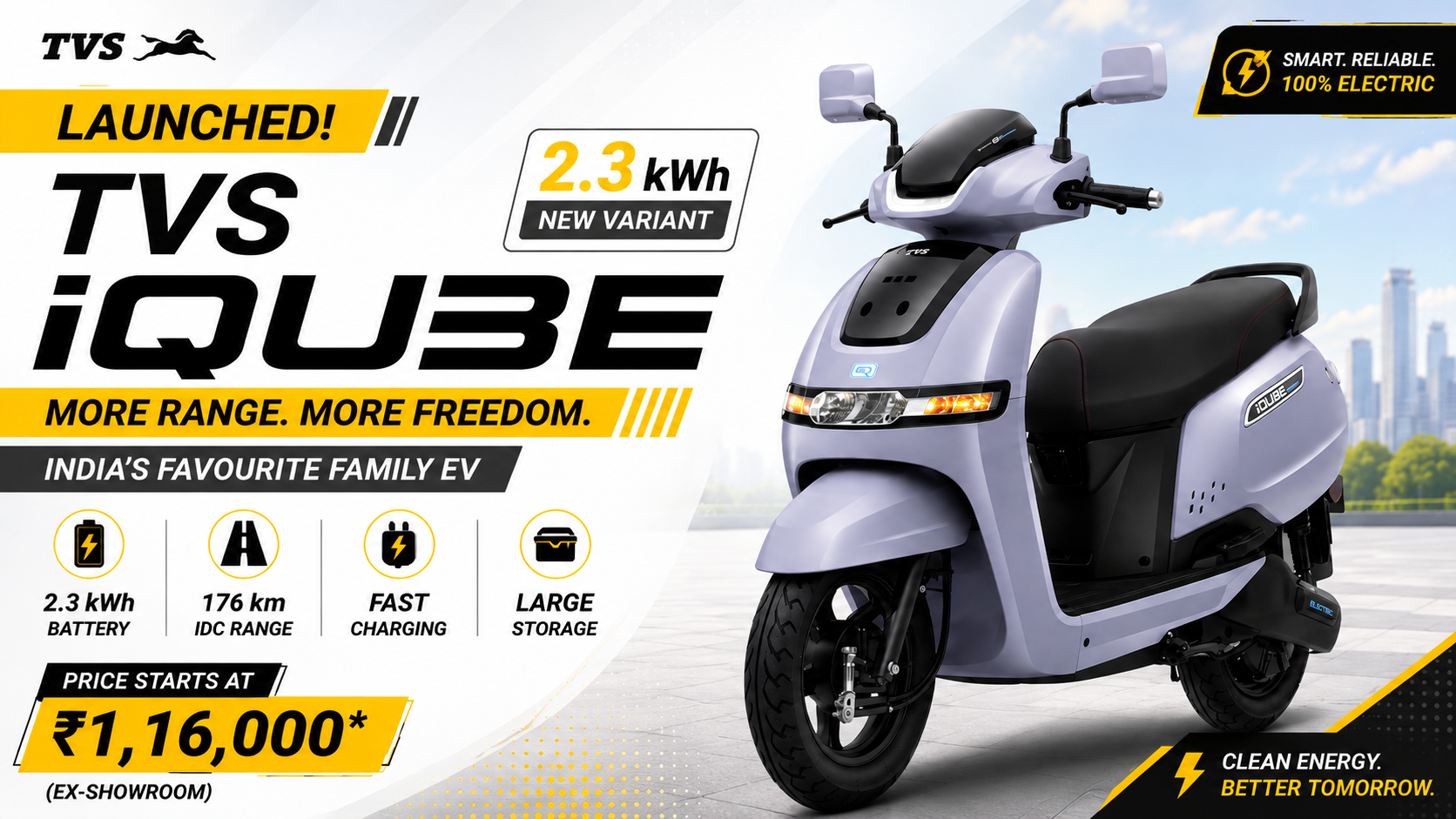
The Indian electric two-wheeler market just saw a very calculated move from one of its biggest players. TVS Motor Company has officially updated its electric scooter lineup by launching the new TVS iQube 2.3 kWh variant.
This new scooter replaces the outgoing 2.2 kWh base model. TVS designed this update with a clear goal: give Indian commuters exactly what they want—more range—while cutting back on features that do not strictly matter for daily city riding.
Priced at ₹1.16 lakh (ex-showroom, Delhi), the new 2.3 kWh iQube promises a real-world range of 115 km. As an automotive journalist analyzing the EV space for over a decade, I see this as a highly practical shift. TVS has recognized that budget-conscious buyers value distance over absolute speed or flashy screens.
Let us break down exactly what the new TVS iQube 2.3 kWh offers, what hardware you lose, and whether it makes sense to buy this scooter in 2026.
Pricing Strategy: A Marginal Hike for Major Gains
The new TVS iQube 2.3 kWh carries an ex-showroom Delhi price of ₹1,16,310. When you compare this to the discontinued 2.2 kWh variant, the price hike is a mere ₹988.
This pricing strategy is brilliant for a highly price-sensitive market. A price increase of less than one thousand rupees is essentially invisible when factored into a monthly EMI plan. Buyers will gladly pay this tiny premium to secure peace of mind regarding their daily battery charge.
You can buy the new iQube in three distinct color options:
- Titanium Grey
- Walnut Brown
- Pearl White
These colors remain identical to the outgoing model, maintaining a mature, family-friendly aesthetic. TVS is clearly targeting mature riders rather than college students looking for aggressive styling.
Battery Upgrade: Prioritizing Daily Commutes
The biggest talking point of this launch is the battery. TVS swapped the 2.2 kWh battery pack for a slightly larger 2.3 kWh unit.
While a 0.1 kWh increase sounds tiny on paper, TVS engineers have completely remapped the scooter's efficiency. According to official TVS claims, the new IDC (Indian Driving Cycle) range is now an impressive 176 km.
However, real-world numbers matter more. In everyday riding conditions—dealing with traffic, pillion riders, and varying road surfaces—the new iQube 2.3 kWh will deliver a true range of 115 km. This is a solid 20 to 21 km improvement over the older base model.
For the average Indian commuter traveling 20 to 30 km a day, a 115 km range means you only need to charge the scooter twice a week.
Charging Times and Infrastructure
TVS provides a standard 950W portable charger with this variant.
Using this charger plugged into a regular household 15-amp socket, the 2.3 kWh battery takes roughly 2 hours and 50 minutes to charge from 0 to 80 percent. A full 0 to 100 percent charge will take slightly longer, typically crossing the four-hour mark.
This charging speed is perfectly adequate for overnight charging at home or topping up at the office parking lot.
The Trade-Offs: What Did TVS Remove?
To offer a larger battery and more range without hiking the price, TVS had to cut costs elsewhere. They achieved this by downgrading three specific areas: top speed, the instrument cluster, and the braking hardware.
1. Reduced Top Speed
The electric motor remains the same. You still get the reliable 3.68 kW hub-mounted electric motor that generates 140 Nm of peak torque.
However, TVS has electronically limited the top speed. The outgoing 2.2 kWh model could hit 75 km/h. The new 2.3 kWh model maxes out at 68 km/h.
Why did TVS do this? Speed drains electric batteries incredibly fast. By capping the speed at 68 km/h, the motor draws less current, which directly contributes to the higher 115 km range. In heavy city traffic, you rarely cross 50 km/h anyway, so this drop in top speed will not bother most buyers.
2. Basic LCD Replaces Premium TFT
Modern electric scooters rely heavily on their digital displays to attract customers. The previous base iQube featured a crisp, full-color TFT screen.
TVS has replaced that TFT unit with a simpler 5-inch LCD screen. LCD screens cost significantly less to manufacture and consume slightly less power. The display might lack the vibrant colors of higher variants, but it remains highly functional and easy to read under direct sunlight.
3. Drum Brakes Take Over
Perhaps the most notable mechanical downgrade is the braking setup.
The previous iteration offered a front disc brake. The new iQube 2.3 kWh comes with drum brakes on both the front and rear wheels. While drum brakes lack the sharp bite of a disc brake, they are cheaper to maintain and perfectly capable of stopping a scooter traveling at a maximum speed of 68 km/h.
The suspension remains untouched. You still get a telescopic front fork and twin rear shock absorbers, ensuring the plush ride quality the iQube is famous for.
Connectivity and Smart Features
Despite downgrading the screen hardware to an LCD, TVS did not strip away the software features. The new iQube remains a fully connected smart scooter.
Riders can connect their smartphones via Bluetooth using the TVS Connect app. The 5-inch LCD will still show you:
- Turn-by-turn navigation alerts
- Incoming call notifications
- SMS alerts
- Battery health and range estimates
Additionally, the scooter retains highly requested features like reverse mode (park assist), OTA (Over-The-Air) updates, and geo-fencing for anti-theft security.
How It Compares to the Competition
The sub-₹1.2 lakh electric scooter segment is a fiercely competitive space in India. Let us see how the new TVS iQube 2.3 kWh stacks up against its direct rivals.
Bajaj Chetak 2901
Priced at ₹96,000 (ex-showroom), the Chetak 2901 is cheaper. It offers a solid metal body and a 123 km ARAI range. However, the Chetak's top speed is slightly lower at 63 km/h, and it lacks the plush suspension feel of the iQube.
Ather Rizta (Base Variant)
The Ather Rizta targets the exact same family-scooter demographic. Its base variant costs around ₹1.10 lakh. It offers a 123 km certified range and hits 80 km/h. The Rizta provides more under-seat storage, but the iQube generally enjoys a wider service network across tier-2 and tier-3 cities.
Ola S1 X (3 kWh)
Ola’s budget offering costs around ₹85,000 to ₹90,000. It offers a much higher top speed of 90 km/h and a certified range of 143 km. While Ola wins on raw performance and price, TVS wins heavily on brand trust, build quality, and after-sales service reliability.
Quick Specifications Table
Here is a quick look at the technical specifications of the new 2026 TVS iQube 2.3 kWh.
The Broader Impact on the EV Market
TVS recently announced that the iQube lineup crossed the one million customer milestone. This makes the iQube one of the most successful electric two-wheelers in Indian history.
This new 2.3 kWh variant shows that the market is maturing. Early EV adopters bought scooters for immediate acceleration, large touchscreens, and tech gimmicks. Today’s buyers treat EVs like traditional commuting tools. They want reliability, long range, and low maintenance costs.
By removing the front disc brake and TFT screen, TVS has effectively lowered the long-term maintenance costs for the owner. If you break an LCD screen, it costs much less to replace than a TFT module. Changing drum brake shoes is far cheaper than replacing brake pads and bleeding hydraulic disc fluid.
Final Verdict: Should You Buy It?
The 2026 TVS iQube 2.3 kWh is a masterclass in market understanding.
TVS took an already successful formula and adjusted it for the core Indian buyer. Yes, you lose the 75 km/h top speed, the disc brake, and the fancy screen. But in return, you get an extra 20 km of daily range for just ₹988 extra.
Who should buy this? If you want an electric scooter for dropping kids at school, running daily errands, or commuting 20 kilometers to the office through dense traffic, this is an excellent choice. It is comfortable, incredibly reliable, and backed by a massive service network.
Who should skip this? If your daily commute involves open highways where you need to cruise comfortably at 70 to 80 km/h, the 68 km/h top speed will feel restrictive. In that case, you should look at the more expensive iQube ST variant or the Ather 450X.
The TVS iQube 2.3 kWh proves that an electric scooter does not need to be a spaceship. Sometimes, it just needs to be a dependable daily workhorse that does not run out of charge on your way home.
Frequently Asked Questions
Q.1What is the price of the new TVS iQube 2.3 kWh?
Q.2What is the actual riding range on a single charge?
Q.3Did the top speed change with this new model?
Q.4Does it still have Bluetooth and smart features?
Looking to buy an EV?
Compare, explore and find the perfect electric vehicle for you.
Explore EVs