Ola Electric Opens Sales and Service Network to Dealer Partners Across India


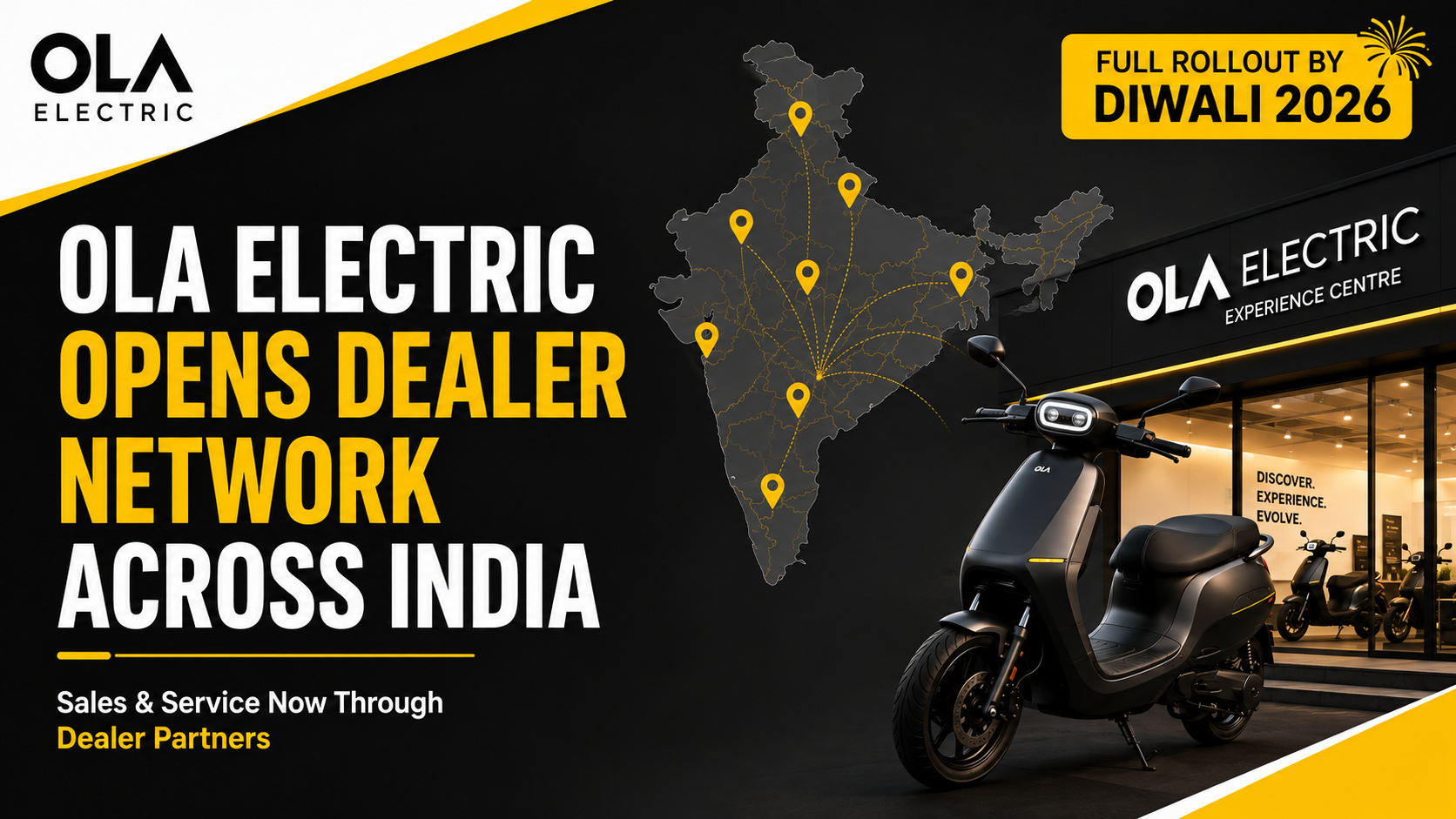
Ola Electric is finally bringing its sales and service operations closer to where its customers actually live. Starting now, independent dealer partners across India will handle local sales, vehicle delivery, and day-to-day service -- meaning buyers and existing owners no longer need to rely solely on Ola's limited company-owned stores. Bhavish Aggarwal, the company's founder and CEO, confirmed the move on X (formerly Twitter) on 6 August 2026, calling it "something a lot of people have been asking us to do since day one."
Quick Summary
- Ola Electric is opening its entire sales and service network to independent dealer partners across India, ending its exclusive company-owned store model.
- Target for full dealer rollout: Diwali 2026 -- the company expects meaningful on-ground scale in time for the festive season.
- Over 10 Lakh (1 million) cumulative EV riders make up India's largest electric two-wheeler installed base, which will now be serviced through local dealers.
- BVR Subbu, former President of Hyundai Motor India, is rejoining as Senior Advisor to steer the transition.
- Dealer portfolio includes scooters, motorcycles, and energy products like Ola's Shakti home battery system.
- June 2026 registrations hit 16,144 units, doubling from the previous quarter, according to Sahi Markets.
Why Ola Electric Is Ditching the D2C-Only Model
If you have been following the Ola Electric ownership experience on social media, you already know the biggest complaint: service. Riders in cities like Jaipur, Lucknow, Coimbatore, and dozens of Tier-2 and Tier-3 towns have spent months travelling long distances just to get a basic check-up or a software update. Some waited weeks for spare parts. It was the single biggest frustration for people who otherwise loved their scooters.
The root cause was simple. When Ola launched its electric scooters five years ago, it built everything in-house -- company-owned experience centres, direct online sales, its own service network. That made sense when nobody in India knew what buying an EV scooter even looked like. And it worked. Ola crossed 10 Lakh cumulative EV registrations, becoming the first Indian EV brand to reach that milestone.
But as the customer base grew, the cracks showed. As Bhavish Aggarwal put it in his announcement, "auto retail has a lot of local nuances." A centralised, company-run operation simply cannot keep up with a million riders spread across hundreds of cities. Local dealer partners who know their market, their customers, and their city's service rhythms can respond far faster -- and that is exactly what this move is about.
What Is Actually Changing
Here is how the new structure works:
- Company-owned stores pivot to experience centres. These will focus on brand building, product demos, and test rides -- the kinds of things that make someone want an Ola scooter. They will not handle sales transactions or service.
- Dealer partners take over local sales and service. Third-party dealers will manage everything from walk-in sales to delivery to routine maintenance. They will have access to Ola's complete product suite.
- Ola supplies parts directly. The company will maintain its parts supply chain, ensuring dealers have what they need without middlemen.
For someone looking to buy an Ola S1 Pro Plus or any other Ola product, this should mean more showrooms closer to home and, critically, faster service turnaround times.
What Is In It for Dealers
Ola is not just asking dealers to sell scooters. The company is positioning this as a multi-revenue opportunity:
- Sales across the full Ola portfolio: Electric scooters, electric motorcycles, and energy storage products like the Shakti home battery.
- Recurring service revenue: With over 10 Lakh Ola vehicles already on the road, dealers inherit a massive captive service market from day one.
- Strong brand pull: Ola is the most-recognised EV brand in India's two-wheeler space, which reduces the marketing burden on dealers.
The company confirmed it has spent the last month meeting potential dealer partners across the country. According to Bhavish Aggarwal, "the feedback is unambiguous -- Ola's product leadership, combined with their local execution, can significantly accelerate both our sales and EV adoption."
Ola has also said the dealer model is designed for "strong dealer economics and returns," although specific margin structures have not been publicly disclosed.
BVR Subbu Returns to Guide the Transition
A notable part of this announcement is the return of BVR Subbu as Senior Advisor. Subbu previously served as President of Hyundai Motor India, where he played a central role in building the carmaker's now-legendary dealer network across the country. He also served as an independent director on Ola Electric's board before this.
His appointment is not symbolic. Building a dealer network from scratch, managing channel conflicts between existing company stores and new dealer partners, and maintaining consistent service standards across hundreds of independent operators -- these are exactly the challenges Subbu spent decades navigating at Hyundai. Ola is essentially bringing in someone who has done this before, at national scale.
The Bigger Picture: How This Fits Ola's Recent Moves
This dealer push does not exist in isolation. Over the past quarter, Ola Electric has been making a series of moves that signal a company shifting from aggressive growth mode to operational maturity:
- Gross margins hit 38.5% in Q4 FY26, according to Sahi Markets, indicating improved financial efficiency.
- An MoU with Axis Energy for the deployment of up to 20 GWh of battery energy storage systems by 2032 marks Ola's formal entry into utility-scale energy storage.
- Monthly registrations are accelerating -- June 2026 saw 16,144 units, doubling the previous quarter's run rate.
The dealer model fits neatly into this pattern. It is an asset-light approach that reduces capital expenditure on new stores while dramatically expanding geographic reach -- especially in smaller cities where EV adoption is still in its early stages.
What This Means for Buyers
This is the section that matters most if you own an Ola scooter or are thinking about buying one.
If you already own an Ola EV:
- Service centres will be closer to home. Instead of one company-owned centre covering an entire city (or worse, an entire district), multiple dealer-run workshops could share the load. This should cut down the "sorry, earliest slot is next week" problem significantly.
- Spare parts availability should improve. Dealers keeping local inventory means you are less likely to wait days for a part to ship from a central warehouse.
- Walk-in service becomes realistic. Many Ola owners have complained about appointment-only service slots that book out weeks in advance. Dealer workshops typically operate on a walk-in or same-day model.
If you are considering buying an Ola EV:
- Test rides become far more accessible. You will not need to drive across town to an Ola experience centre. A dealer showroom in your area can offer the same test ride experience.
- Local accountability matters. A dealer who lives in your city and depends on your neighbourhood's word-of-mouth has a stronger incentive to keep you happy than a distant corporate service desk.
- Easier EMI and financing options. Dealers often have relationships with local banks and NBFCs, which could make financing smoother than Ola's online-only process.
The transition will take a few months. Ola has set Diwali 2026 as the target for meaningful on-ground scale, so buyers should start seeing new dealer touchpoints roll out through September and October.
Ready to find a showroom? Search for your nearest Ola Electric dealer here.
What to Watch
Not everything about this shift is straightforward. A few things worth watching as the rollout unfolds:
- Channel conflict: Managing pricing consistency between remaining company stores and new dealers will be tricky.
- Service quality: Can Ola maintain uniform service standards across hundreds of independently operated workshops? This was one of Hyundai's toughest challenges too.
- Timeline pressure: Diwali 2026 is barely three months away. Onboarding, training, and equipping enough dealers to make a visible difference by then is ambitious.
The Bottom Line
For Ola's 10 Lakh+ existing riders, this is the news they have been waiting for. The D2C model built the brand, but it also left too many customers stranded with limited service access. For prospective buyers who held off because "there is no Ola service centre near me" -- that excuse is about to disappear. If BVR Subbu and the Ola team can actually execute this by Diwali, and if dealer partners deliver the kind of reliable, walk-in service that Indian two-wheeler buyers expect, this could be the tipping point that turns Ola from a brand people admire into one they confidently recommend to friends and family.
Frequently Asked Questions
Q.1How can I become an Ola Electric dealer partner?
Q.2Will existing Ola Electric stores shut down?
Q.3What products will Ola Electric dealers sell?
Q.4Will service quality change under the dealer model?
Looking to buy an EV?
Compare, explore and find the perfect electric vehicle for you.
Explore EVs