Bajaj Chetak Crosses 50,000 Sales Milestone in Kerala; EV Network Expands to 103 Touchpoints


The electric two-wheeler landscape in India is evolving rapidly. Early adopters focused heavily on battery range and digital features. Today, mainstream buyers want something far more traditional: reliable after-sales service and local accessibility.
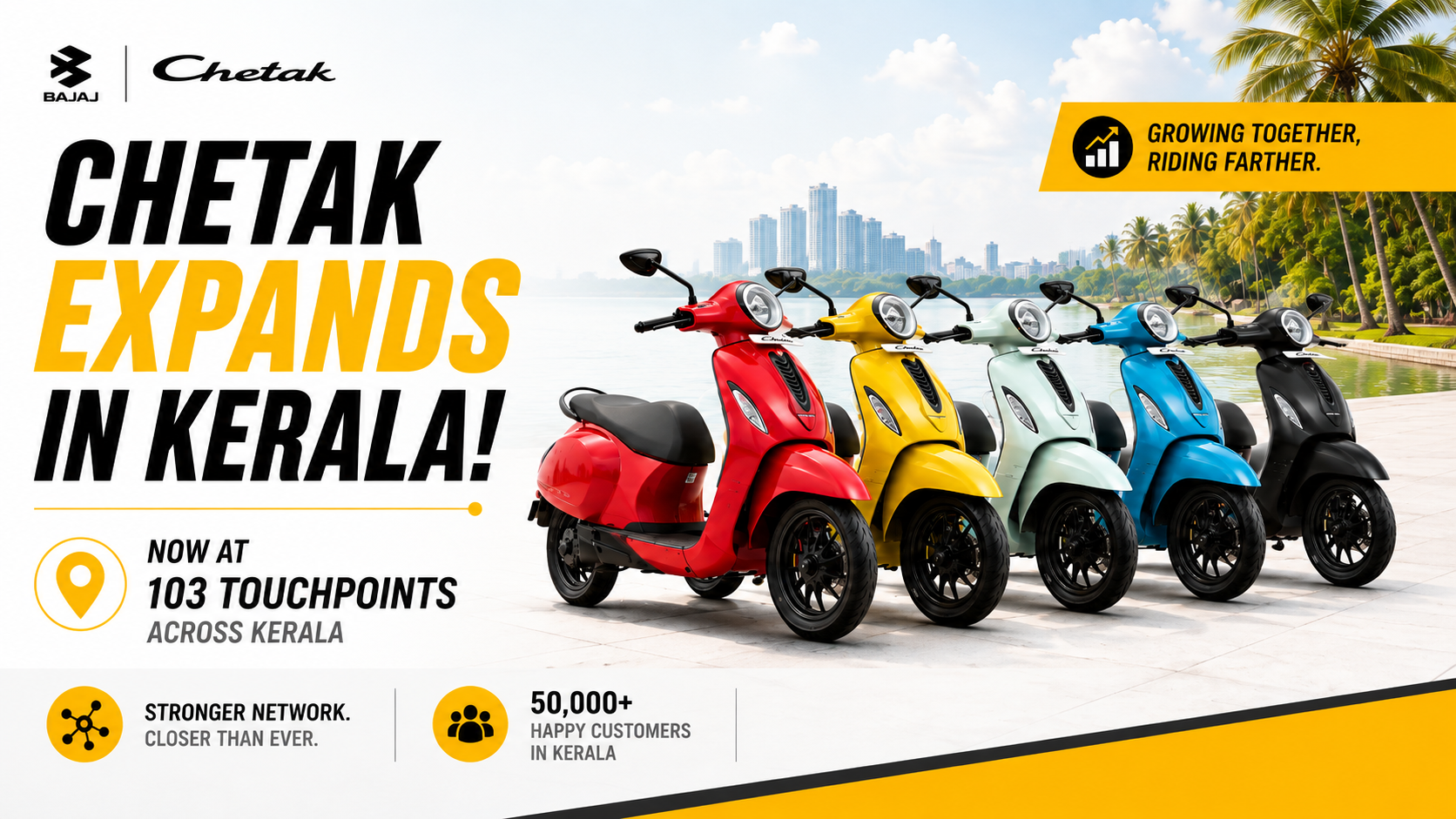
Recognizing this shift, Bajaj Auto has aggressively expanded its electric vehicle footprint in South India. The company recently announced that its Chetak electric scooter network in Kerala has grown to 103 customer touchpoints.
This massive retail expansion comes right as the brand celebrates a major regional milestone. Bajaj Chetak has officially crossed 50,000 owners across the state of Kerala. This achievement highlights a clear shift in consumer trust toward legacy automakers in the growing EV sector.
In this deep dive, we will look at how Bajaj Auto scaled its operations, why Kerala is a crucial battleground for electric scooters, and what this means for the broader Indian auto industry.
From Two Outlets to 103: The Kerala Expansion Strategy
Building a reliable electric vehicle brand requires a physical presence. While digital bookings are convenient, most Indian consumers still prefer to see, touch, and test-ride a vehicle before making a purchase.
When Bajaj initially relaunched the Chetak as an electric scooter, its presence in Kerala was modest. The brand started with just two exclusive outlets. Fast forward to today, and the network has multiplied exponentially.
The new 103-touchpoint network uses a hybrid retail model. It consists of:
- 18 Chetak Experience Centres: These are premium, exclusive showrooms dedicated entirely to the Chetak brand. They offer an immersive look at the electric scooter and its technology.
- 85 Bajaj Auto Dealerships: By upgrading existing traditional dealerships to handle electric vehicles, Bajaj has rapidly expanded its footprint without building from scratch.
This expanded network covers major hubs and regional markets alike. Customers in Kochi, Thiruvananthapuram, Wayanad, and Palakkad now have immediate access to sales, test rides, and service support.
Eric Vas, President of the Urbanite Business at Bajaj Auto, confirmed the aggressive growth strategy. "Chetak has grown significantly in Kerala, from an initial presence of two outlets to a network of over 103 outlets today," Vas stated during the recent announcement.
Festive Season Boost
To celebrate the 50,000-customer milestone and attract holiday buyers, Bajaj has introduced a festive offer. Customers buying a new Chetak can avail a flat ₹1,999 discount.
While the discount amount is modest, it acts as a sweet deal to drive foot traffic into the newly expanded showrooms. The offer remains valid until stocks last across all Kerala touchpoints.
Why Kerala is a Goldmine for Electric Two-Wheelers
You might wonder why a legacy brand like Bajaj is focusing so heavily on a single southern state. The answer lies in Kerala's unique geography and demographic layout.
Unlike states with a few massive megacities separated by vast rural stretches, Kerala features a highly urbanized, continuous settlement pattern. The state is essentially a network of closely connected towns and medium-sized cities.
This geography creates the perfect environment for electric scooters.
- Short Commutes: Daily travel between connected towns fits perfectly within the real-world range of modern electric scooters.
- High Literacy and Awareness: Kerala boasts high environmental awareness, making buyers more receptive to zero-emission vehicles.
- Strong Charging Potential: High rates of independent housing make home-charging setups much easier compared to the high-rise apartments of Mumbai or Delhi.
However, capturing this market requires deep physical penetration. You cannot win Kerala by simply opening a flagship store in Kochi. You need service centers in places like Palakkad and Wayanad. By establishing 103 touchpoints, Bajaj is ensuring that buyers in smaller towns feel confident that service and spare parts are just a short ride away.
The Math Behind the Expansion: Service Density Matters
Selling 50,000 electric scooters is an impressive feat. But keeping 50,000 electric scooters on the road requires serious infrastructure.
Let us look at the numbers. With 103 touchpoints serving a base of 50,000 customers, Bajaj currently offers one touchpoint for roughly every 485 Chetak owners in Kerala.
This is a vital metric for customer satisfaction. When an electric scooter requires software updates, battery diagnostics, or physical repairs, a dense service network prevents long waiting times.
Legacy Brands vs. EV Startups
This network density reveals the massive competitive advantage legacy automakers hold over new EV startups.
Over the last few years, pure-play EV startups captured early market share through aggressive marketing and high-tech features. However, many struggled with after-sales support. Customers often faced long wait times for spare parts and had to travel long distances to find authorized service centers.
Bajaj Auto is leveraging its decades of traditional two-wheeler experience. By transforming 85 existing motorcycle dealerships into EV-ready touchpoints, they solved the service accessibility problem overnight. This infrastructure gives mainstream buyers the confidence to switch from petrol to electric.
National Context: Chetak's Explosive Growth in 2026
The success in Kerala is just one piece of a much larger national puzzle. Bajaj Auto has aggressively scaled the Chetak brand across India throughout 2025 and 2026.
According to the company's FY2026 annual report data, Chetak has evolved from an experimental EV project into a primary volume driver for Bajaj's domestic business.
Key Sales Statistics
The numbers tell a story of rapid acceleration. Let's look at the national sales performance based on recent industry dispatch data:
The July 2026 data is particularly striking. Dispatching over 47,000 units in a single month marks a massive 307% year-on-year increase. It also represents a 17% month-on-month growth compared to June 2026.
For the first time, Chetak emerged as Bajaj's highest-volume model in a given month, actually outpacing major legacy motorcycle nameplates like the Pulsar in domestic dispatches. Bajaj Auto closed FY2026 holding a commanding 20.7% share of the Indian electric scooter market.
To support this national volume, Bajaj expanded its all-India network to more than 530 exclusive stores and approximately 4,500 total customer touchpoints across 850 cities by July 2026.
A Broader Portfolio to Capture Every Buyer
You cannot sell massive volumes with a single, expensive product. To reach the 50,000-mark in Kerala and the 7-lakh mark nationally, Bajaj had to diversify the Chetak lineup.
Initially launched as a single premium variant, the Chetak portfolio has now been split into distinct families to target different price brackets and range requirements.
- The C35 Family: This represents the top-tier Chetak models. Equipped with a larger 3.5kWh battery pack, these scooters offer the highest range and premium features. They target buyers who want no compromises on daily commuting distances.
- The C30 Family: Sitting in the middle, these models utilize a 3.0kWh battery. They balance cost and range, appealing to the average urban commuter.
- The C25 Family: This is the most recent strategic addition. By introducing a more accessible battery configuration, Bajaj significantly lowered the entry price of the Chetak.
This tiered strategy is brilliant. It allows Bajaj to capture budget-conscious buyers moving away from 110cc petrol scooters, while still offering premium options for buyers upgrading from older EVs. Most importantly, all variants retain the Chetak's signature metal body—a major selling point in a market where plastic body panels are the norm.
What This Means for the Indian Auto Industry
Bajaj’s strategy in Kerala serves as a blueprint for the future of India's electric mobility sector. It highlights several key trends that will dominate the industry over the next few years.
1. The Shift to Tier-2 and Tier-3 Markets The first wave of EV adoption happened in major metros like Delhi, Bengaluru, and Mumbai. The second wave—which will bring massive volume—is happening in Tier-2 and Tier-3 cities. Kerala’s decentralized urban structure perfectly represents these emerging markets. Brands that build networks outside the massive capital cities will win the volume game.
2. After-Sales is the New Battleground We are moving past the phase where a colorful touchscreen could sell a scooter. Consumers are maturing. They are asking questions about battery replacement costs, service turnaround times, and physical network density. The 103 touchpoints in Kerala prove that Bajaj is preparing for this shift.
3. Legacy Brands are Taking Control For a brief period, startups dominated the electric conversation. Now, giants like Bajaj, TVS, and Hero are flexing their manufacturing and distribution muscles. The ability to turn 85 existing showrooms into EV service centers gives legacy players an unmatched advantage in scaling quickly.
Final Thoughts
The milestone of 50,000 customers in Kerala is not just a regional victory for Bajaj Auto; it is a clear indicator of where the electric vehicle market is heading.
By aggressively expanding to 103 touchpoints across the state, Bajaj is solving the biggest hurdle to EV adoption: range anxiety and service doubt. They are showing buyers that an electric scooter can be just as easy to buy, maintain, and repair as a traditional petrol motorcycle.
As the Chetak portfolio broadens and the nationwide network edges closer to 5,000 touchpoints, Bajaj is positioning itself not just as a participant in the EV transition, but as a dominant leader. For automotive analysts and consumers alike, the message is clear: the future of commuting is electric, and it requires a strong physical foundation to succeed.
Frequently Asked Questions
Q.1What is the breakdown of these 103 touchpoints?
Q.2Which major areas in Kerala are covered by the Chetak network?
Q.3Is there any festive offer currently available for the Bajaj Chetak in Kerala?
Q.4What is Bajaj Chetak’s nationwide network footprint?
Looking to buy an EV?
Compare, explore and find the perfect electric vehicle for you.
Explore EVs