Ampere Xyber Electric Bike Design Patented in India


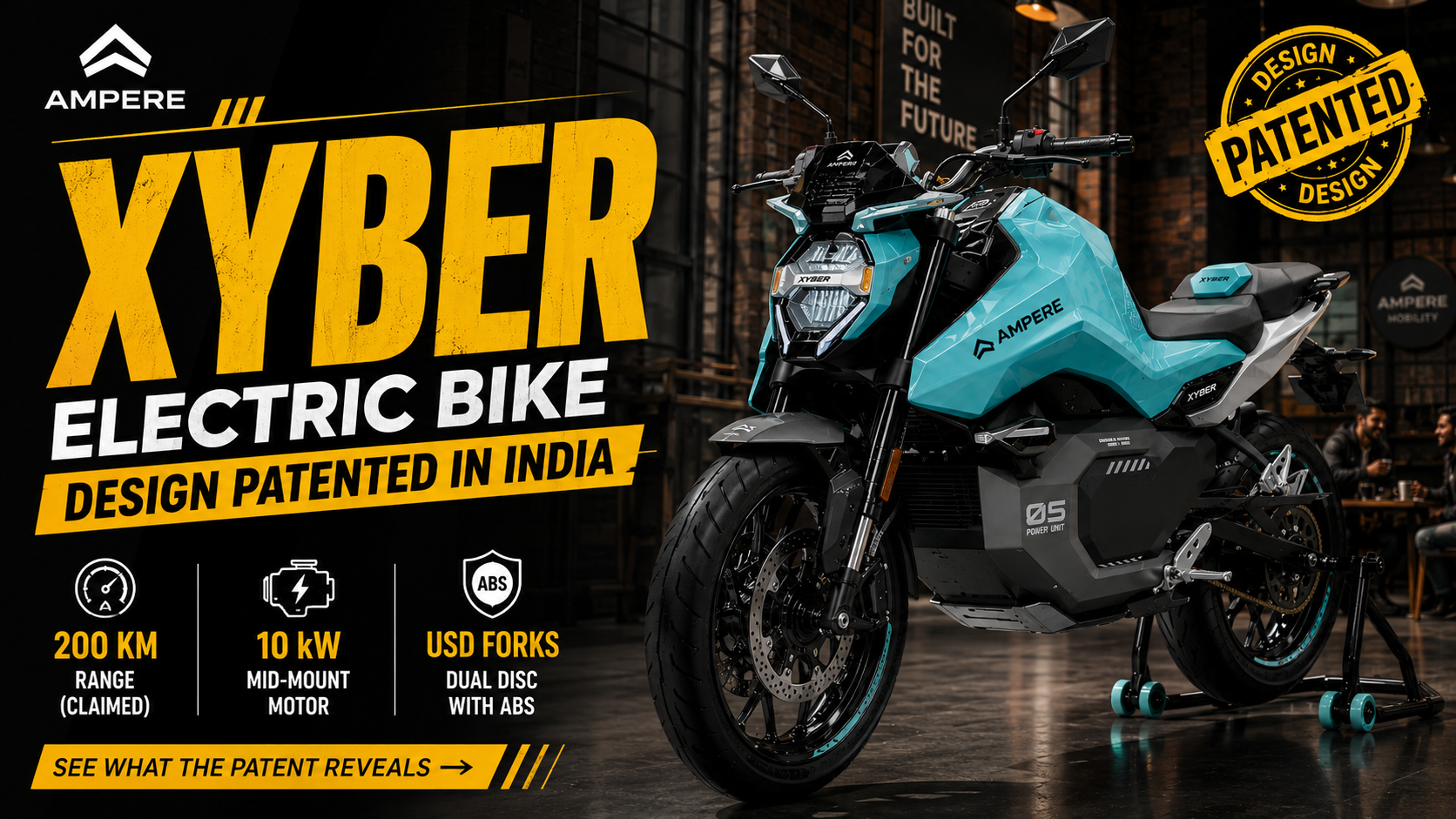
Ampere, the electric two-wheeler brand under Greaves Electric Mobility, has officially filed a design patent for the Xyber electric motorcycle in India. The patent filing, dated 01 September 2026, confirms the production design will closely mirror the concept showcased at the Bharat Mobility Global Expo in January 2025 — over 18 months after its initial reveal. This marks a significant escalation in Ampere's ambitions, taking it beyond the mass-market scooter segment where it recently crossed 4 lakh cumulative EV sales (a 51% year-on-year growth in FY26), into the premium electric motorcycle arena.
Quick Summary
- Design patent filed in India for the Ampere Xyber — the brand's first electric motorcycle.
- Retains the aggressive streetfighter aesthetic of the Bharat Mobility 2025 concept, including 'Arctic Tern' wing-inspired DRLs and muscular body panels.
- Targets a claimed range of up to 200 km on a Lithium Ferro Phosphate (LFP) battery; exact kWh capacity not yet confirmed.
- Powered by a mid-mounted 10 kW electric motor with a claimed top speed of 100 km/h.
- Premium underpinnings: USD (inverted) front fork, rear monoshock, 17-inch alloy wheels, dual disc brakes with ABS.
- Features a TFT instrument cluster with Bluetooth connectivity and integrated Google Maps navigation.
- Production timeline and launch pricing remain not yet officially confirmed by Ampere.
What the Design Patent Reveals
The patent images depict a production-intent streetfighter-naked form that retains the drama of the 2025 concept with only minor detail refinements expected between now and launch. Key visual callouts from the patent filing include:
Lighting & Front End: A sharp, angular LED headlamp unit flanked by the signature 'Arctic Tern' wing-inspired DRLs — a design motif directly referencing the Arctic Tern bird's swept wing silhouette. A small flyscreen above the wide handlebar reinforces the streetfighter identity without transitioning into full-faired territory.
Body & Seating: Single-piece muscular body panels with a sculpted fuel tank area and split seat configuration. The overall mass distribution suggests a mid-mounted motor layout, consistent with the company's stated powertrain architecture.
Wheels & Brakes: 17-inch alloy wheels shod with chunky, road-biased tyres. Both ends get disc brakes and, based on the concept's specification sheet, dual-channel ABS is expected on the production version.
Suspension: Upside-down (USD) front forks and a rear monoshock — hardware typically reserved for motorcycles priced above ₹1.50 Lakh (ex-showroom) in the petrol segment, signalling that Ampere intends to position the Xyber as a credible premium product, not a base-spec entry.
Powertrain & Technology
Ampere has previously disclosed the Xyber's core powertrain targets, though none of these figures carry the status of final confirmed production data:
- Motor: Mid-mounted electric motor, 10 kW peak power (~13.4 PS equivalent)
- Claimed Top Speed: 100 km/h
- Battery Chemistry: Lithium Ferro Phosphate (LFP) — the same chemistry Ampere deploys across its scooter portfolio, valued for thermal stability and longer cycle life vs. standard NMC cells
- Claimed Range: Up to 200 km per charge (certification standard not specified; likely IDC or MIDC)
- Charging: Supports both AC home charging and DC fast charging
The LFP battery choice is consistent with Ampere's published strategy of prioritising long-term battery health and safety over peak energy density — a practical consideration for Indian riding conditions and varied charging infrastructure quality.
The TFT instrument console from the concept — with smartphone pairing and turn-by-turn Google Maps navigation — is expected to carry over to the production bike, though exact software features are not yet officially confirmed.
Specifications
Note: Specifications below are based on manufacturer targets disclosed at the Bharat Mobility Global Expo 2025 and are subject to change ahead of production launch.
| Specification | Details |
|---|---|
| Expected Price | Not yet officially confirmed (Est.) |
| Motor Type | Mid-mounted electric motor |
| Peak Power | 10 kW (~13.4 PS) |
| Claimed Top Speed | 100 km/h |
| Battery Chemistry | Lithium Ferro Phosphate (LFP) |
| Battery Capacity | Not yet officially confirmed (Est.) |
| Claimed Range | Up to 200 km |
| Charging | AC + DC Fast Charging |
| Front Suspension | USD (Inverted) Fork |
| Rear Suspension | Monoshock |
| Wheels | 17-inch Alloy Wheels |
| Brakes | Dual Disc with ABS |
| Display | TFT Instrument Cluster |
| Connectivity | Bluetooth, Google Maps Navigation (Est.) |
Market Comparison
The Xyber enters a small but fast-growing sub-segment of the Indian electric motorcycle market that is rapidly gaining structure with the arrival of funded challengers such as Revolt, Oben Electric, and Avore.
| Feature | Ampere Xyber | Revolt RVX | Oben Rorr Evo | Avore EX2 |
|---|---|---|---|---|
| Price (ex-showroom) | Not yet confirmed | ~₹1.29 Lakh | ~₹1.25 Lakh | ~₹1.50 Lakh |
| Motor Power | 10 kW (Est.) | ~8.5 kW | ~10 kW | ~10 kW |
| Claimed Range | 200 km (Est.) | ~150 km | ~150 km | ~150 km |
| Battery | LFP (Est.) | NMC | LFP | LFP |
| Top Speed | 100 km/h (Est.) | ~85 km/h | ~100 km/h | ~100 km/h |
| Suspension | USD Fork + Monoshock | Telescopic + Monoshock | USD Fork + Monoshock | USD Fork + Monoshock |
| TFT Display | Yes (Est.) | Yes | Yes | Yes |
| Fast Charging | Yes (Est.) | Yes | Yes | Yes |
If the 200 km claimed range figure holds through to production testing, it would give the Xyber a 25–30% range advantage over its nearest competitors at launch — a meaningful differentiator in the segment where range anxiety remains the primary purchase barrier. The USD fork hardware further lifts its premium positioning above the Revolt RVX.
The Bharat Mobility Concept to Production Path
The 18-month gap between the concept debut at Bharat Mobility Global Expo 2025 and the design patent filing in September 2026 is typical for Indian EV startups and established players navigating the regulatory, supply chain, and production tooling cycle. A design patent filing is usually followed by type approval testing under India's AIS 156 Phase 2 standards, homologation, and then retail launch announcement.
Ampere's track record with its scooter lineup — including the Nexus, Magnus, and Zeal series — demonstrates production competency at scale. The company's use of LFP batteries across its portfolio also means the Xyber's battery chemistry is already validated in Indian field conditions, reducing one key technical risk in the development timeline.
For context, Ampere's electric two-wheeler lineup is manufactured out of Tamil Nadu. The brand crossed 4 lakh cumulative EV sales in June 2026, growing its market share from 3.6% in FY25 to 4.4% in FY26, demonstrating commercial momentum ahead of the Xyber's anticipated launch.
Frequently Asked Questions
Q.1What is the Ampere Xyber's expected launch date?
Q.2What is the expected price of the Ampere Xyber in India?
Q.3What battery does the Ampere Xyber use?
Q.4How does the Ampere Xyber compare to the Revolt RVX?
Q.5The Bottom Line
Looking to buy an EV?
Compare, explore and find the perfect electric vehicle for you.
Explore EVs