Volkswagen Mission Efficiency Concept Unveiled: The 500-Mile Range Electric Marvel


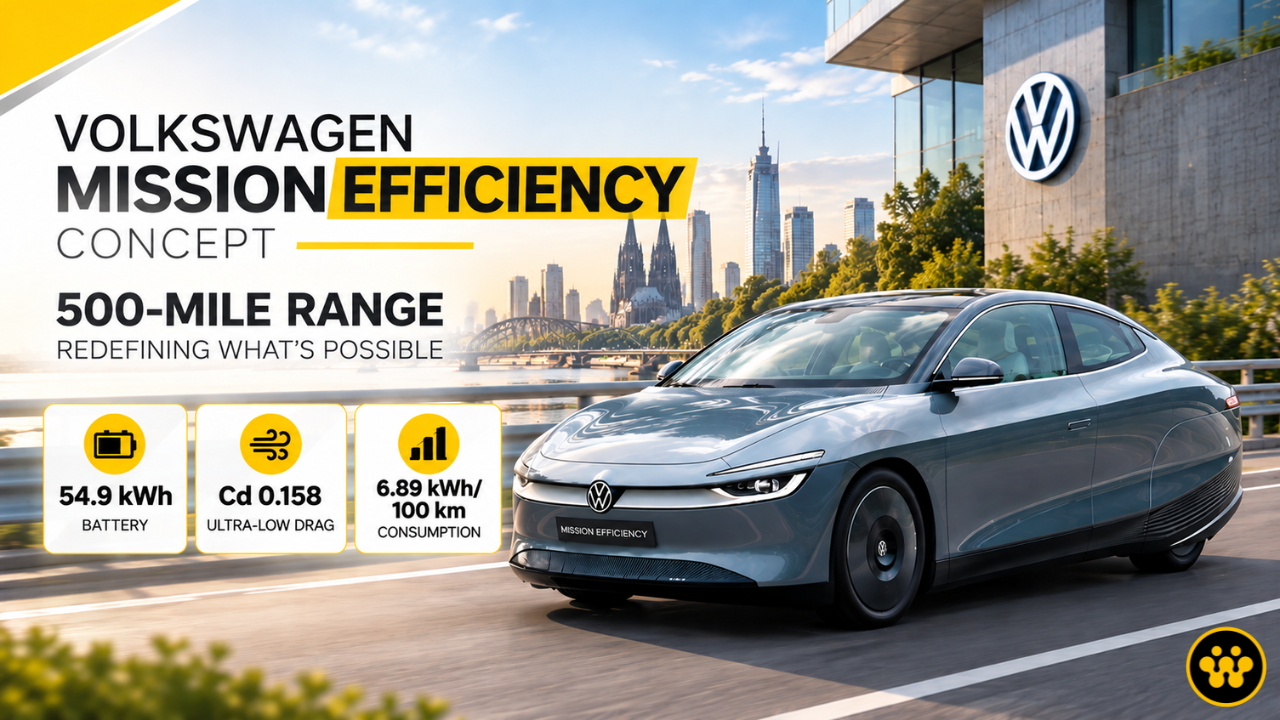
The global automotive landscape has shifted its gaze toward Germany, where Volkswagen has officially pulled the wraps off its groundbreaking Volkswagen Mission Efficiency concept. Often dubbed the spiritual successor to the legendary XL1 for the modern battery-electric era, this futuristic prototype redefines what is possible in terms of energy conservation, proving that extreme efficiency does not require exotic, cost-prohibitive materials.
Instead, Volkswagen has leveraged mainstream production technology to shatter efficiency benchmarks, setting multiple world records right out of the gate.
Record-Breaking Aerodynamics and Performance
At the core of the Mission Efficiency concept is a relentless focus on reducing drag. The vehicle achieves an astonishing drag coefficient (Cd) of just 0.158, making it one of the most aerodynamically slick road-going prototypes ever conceptualized.
To put this engineering feat into perspective, Volkswagen put the prototype through a rigorous, officially documented real-world endurance drive. Traveling 1,278.36 kilometers (794 miles) from the research center in Wolfsburg, Germany, through Poland and the Czech Republic, all the way to Vienna, Austria, the vehicle completed the journey with only a single charging stop.
- Net Battery Capacity: 54.9 kWh
- Average Energy Consumption: 6.89 kWh/100 km (or approx. 7.51 kWh/100 km including charging losses)
- Remaining Range Upon Arrival: 164.0 km (102 miles) left in reserve
- Total Theoretical Range: Translates to a capability nearing 500 miles (approx. 800+ kilometers) on a full charge under optimal conditions.
Democratizing EV Tech: Powered by MEB+ and ID. Polo Components
Unlike niche hyper-miler vehicles of the past that relied on expensive, low-volume components, Volkswagen’s board emphasized that the Mission Efficiency is a "technology for the masses not just for the few."
The concept utilizes standard, large-scale production architecture adapted directly from the upcoming MEB+ platform with front-wheel drive. Specifically, it adopts the lightweight 99 kW (135 PS) electric motor and high-voltage battery system found in the new ID. Polo lineup. By combining standard hardware with specialized aerodynamic styling such as active cooling air flaps, clad rear wheels, and a fully enclosed underbody Volkswagen has proven that massive efficiency gains are already hidden within its current production pipeline.
Practicality Meets Sustainable Innovation
While extreme aerodynamic silhouettes often compromise interior space, Volkswagen managed to prioritize everyday usability. Measuring 4,775 mm long and 1,392 mm tall, the coupe configuration features a practical 2+2 seating layout alongside an impressive 481 liters of luggage capacity in the boot.
Additional sustainability features integrated into the build include:
- Solar Roof Integration: A 370 W photovoltaic system embedded into the glass roof and boot lid that feeds the on-board electronics, adding up to 30 kilometers of extra range per day depending on weather conditions.
- Weight-Saving Measures: Lightweight interior paneling, specialized seating structures, and even a portable Bluetooth speaker system designed to trim unnecessary electronic architecture.
What the Mission Efficiency Means for Future EVs
As automakers grapple with range anxiety and charging infrastructure constraints, Volkswagen’s latest concept offers a clear roadmap. By demonstrating that high-speed highway efficiency can be improved by over 30% compared to standard configurations at speeds above 80 km/h, the technologies tested on the Mission Efficiency are expected to trickle down rapidly into upcoming production models.
While official commercial release dates for a direct production clone remain under evaluation, the world premiere firmly establishes Volkswagen's engineering prowess at the forefront of the electric vehicle revolution.
Frequently Asked Questions
Q.1What is the Volkswagen Mission Efficiency concept?
Q.2What is the driving range of the Volkswagen Mission Efficiency?
Q.3Is the Volkswagen Mission Efficiency going into production?
Q.4What platform does the Mission Efficiency use?
Q.5How does the Mission Efficiency achieve such high range?
Q.6What is the battery capacity of the Volkswagen Mission Efficiency?
Looking to buy an EV?
Compare, explore and find the perfect electric vehicle for you.
Explore EVs