VinFast VF5 Facelift Patented in India: Key Design and Tech Updates


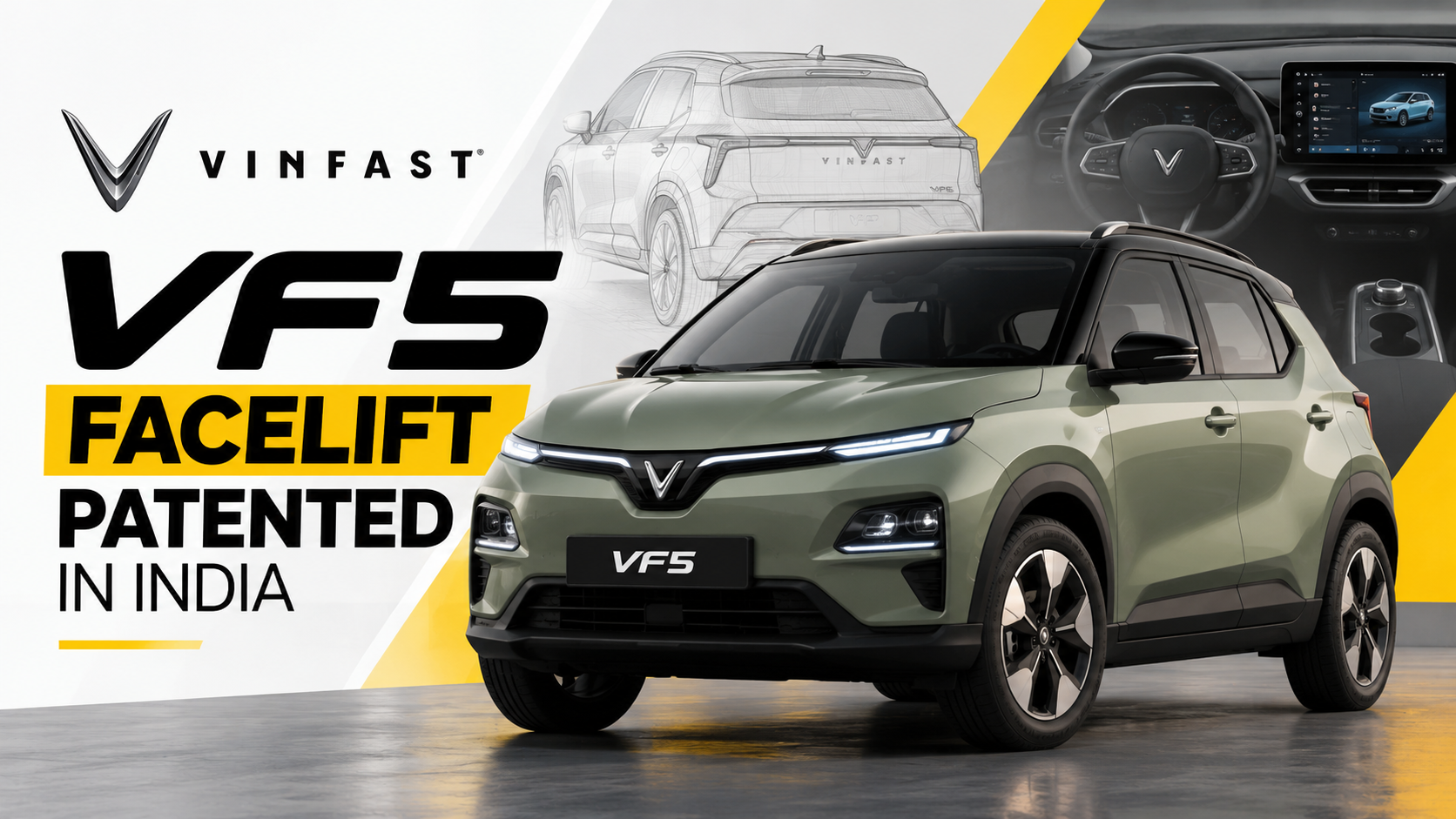
VinFast has registered the design patent for the facelifted VF5 electric compact crossover in India on 28 October 2026. The official filing highlights a revised front fascia with lower-mounted slim headlamps, reworked bumpers, and an integrated connected taillight bar. Anticipated to arrive as one of the brand's key upcoming models by 2027, the VF5 is projected to enter the domestic market at an estimated price range of ₹10.00 Lakh – ₹12.00 Lakh (ex-showroom) to challenge established mass-market electric cars.
Quick Summary
- Design Patent Registered: VinFast has secured Indian design registrations for the updated VF5, previewing major exterior styling refinements over the outgoing international edition.
- Reworked Exterior: The facelift introduces repositioned, slimmer headlamp clusters, a narrowed bumper intake, revised 16-inch alloy wheels, and an integrated rear LED lightbar.
- Modernized Cabin: Uncamouflaged test prototypes confirm a larger freestanding infotainment touchscreen, a flat-top/flat-bottom two-spoke steering wheel, leatherette upholstery, and instrument cluster integration into the central display.
- Global Battery Options: International variants feature 29.6 kWh (90 hp, 268 km NEDC range) and 37.23 kWh (136 hp, 326 km NEDC range) battery configurations with front-wheel-drive motors.
- Target Price Point: Estimated at ₹10.00 Lakh – ₹12.00 Lakh (ex-showroom), positioned directly against the Tata Punch EV, Tata Nexon EV, and Mahindra XUV 3XO EV.
- Domestic Assembly Context: Launch plans align with the development of VinFast's integrated EV manufacturing facility in Thoothukudi, Tamil Nadu.
Exterior Design Changes: Global Spec vs Facelift
Official patent drawings show that the VF5 facelift focuses its styling revisions on the front and rear sections while maintaining the original side profile.
At the front, the facelifted model replaces the bulkier lighting setup of the current global version with slimmer headlamp assemblies positioned lower down the fascia. The contrasting black cladding beneath the primary lamps has been trimmed, transitioning cleanly into the updated air intake section of the front bumper. The bonnet has also been reprofiled with sharper character lines extending toward the central emblem.
Along the flanks, the sub-4-metre silhouette and roofline remain identical to the outgoing model, preserving the crossover's compact urban footprint. The patent filing depicts a refreshed aerodynamic wheel design, matching test units spotted with 16-inch dual-tone alloys.
The rear end undergoes significant lighting modifications. On the existing global-spec VF5, the reversing lights and turn indicators are housed low within the rear bumper apron. In contrast, the facelift integrates all rear signalling into a prominent connected LED taillight strip spanning the tailgate. The brand's wordmark remains positioned centrally across the boot lid, accompanied by the VF5 model badge on the right.
Cabin Upgrades: Minimalist Architecture and Updated Tech
Interior images of uncamouflaged evaluation units indicate that the VF5 facelift adopts a consolidated digital cabin layout similar to newer international electric vehicles.
The dashboard drops the small standalone digital driver display located behind the steering wheel on the previous version. In its place, driving data, speedometer telemetry, and battery statistics are merged into an enlarged central infotainment screen.
Key cabin updates include:
- Enlarged Floating Touchscreen: Handles vehicle diagnostics, air conditioning controls, and navigation on a single responsive interface.
- Redesigned Two-Spoke Steering Wheel: Features a squircle layout with flattened upper and lower rims to enhance forward visibility.
- Updated Centre Console: Houses a rotary drive selector dial alongside twin cup holders and a dedicated wireless smartphone tray.
- Upgraded Interior Materials: The outgoing variant's fabric upholstery is replaced by dual-tone leatherette upholstery on higher trims.
Powertrain Options and Driving Range
VinFast currently sells the VF5 in multiple Southeast Asian markets with two battery capacities. While domestic technical configurations remain unfinalized, these existing powertrains establish the baseline for the Indian model.
The base international version utilizes a 29.6 kWh lithium iron phosphate (LFP) pack paired with a front-axle electric motor generating 90 hp and 135 Nm of torque. This unit delivers a certified range of 268 km under the NEDC test cycle.
A larger 37.23 kWh pack powers the higher-tier variant, raising output to 136 hp while keeping torque at 135 Nm. This configuration achieves an NEDC-rated range of 326 km.
Under Indian driving conditions, real-world highway and city commuting is expected to yield approximately 190 km – 210 km from the smaller pack and 230 km – 250 km from the larger option.
Specifications
Note: Specifications below are based on manufacturer targets and industry estimates.
| Specification | 29.6 kWh Variant (Est.) | 37.23 kWh Variant (Est.) |
|---|---|---|
| Battery Capacity | 29.6 kWh LFP | 37.23 kWh LFP |
| Peak Power | 90 hp (67 kW) | 136 hp (100 kW) |
| Peak Torque | 135 Nm | 135 Nm |
| Drivetrain | Front-Wheel Drive (FWD) | Front-Wheel Drive (FWD) |
| Claimed Range (NEDC) | 268 km | 326 km |
| Estimated Real-World Range | 190 km – 210 km | 230 km – 250 km |
| Fast Charging (10%–70%) | ~30 minutes (Est.) | ~30 minutes (Est.) |
| Top Speed | 130 km/h (Est.) | 130 km/h (Est.) |
| Expected Price (Ex-showroom) | ₹10.00 Lakh (Est.) | ₹12.00 Lakh (Est.) |
Market Comparison
To succeed in India's price-sensitive crossover EV category, the VF5 must compete against entrenched domestic offerings from Tata Motors and Mahindra. Buyers can compare how the projected specifications stack up against the market leaders:
| Metric | VinFast VF5 Facelift (Est.) | Tata Punch EV (Long Range) | Tata Nexon EV (45 kWh) |
|---|---|---|---|
| Expected Price (Ex-showroom) | ₹10.00 Lakh – ₹12.00 Lakh | ₹9.99 Lakh – ₹14.49 Lakh | ₹13.99 Lakh – ₹17.19 Lakh |
| Battery Capacity | 29.6 kWh / 37.23 kWh | 35.0 kWh | 45.0 kWh |
| Peak Power | 90 hp / 136 hp | 122 hp | 145 hp |
| Peak Torque | 135 Nm | 190 Nm | 215 Nm |
| Claimed Range | 268 km / 326 km (NEDC) | 421 km (MIDC) | 489 km (MIDC) |
| Real-World Range (Est.) | 190 km – 240 km | 270 km – 300 km | 340 km – 370 km |
| Fast Charging Time | ~30 mins (10%–70% DC, Est.) | ~56 mins (10%–80% DC) | ~40 mins (10%–80% DC) |
Pricing Breakdown and Positioning Strategy
VinFast's ongoing investment in its ₹4,000 Crore ($500 million committed phase-one) manufacturing facility in Thoothukudi, Tamil Nadu, will be instrumental in avoiding steep customs duties applied to fully imported vehicles. Local assembly or manufacturing will enable the brand to target an introductory ex-showroom price close to ₹10.00 Lakh.
| Variant | Estimated Ex-Showroom Price | Estimated On-Road Price |
|---|---|---|
| VinFast VF5 Standard (29.6 kWh) | ₹10.00 Lakh (Est.) | ₹10.60 Lakh (Est.) |
| VinFast VF5 Long Range (37.23 kWh) | ₹12.00 Lakh (Est.) | ₹12.75 Lakh (Est.) |
Note: On-road pricing estimates reflect state EV road tax exemptions and registration waivers applicable in major EV-adopting states.
The Bottom Line
The VinFast VF5 facelift introduces critical exterior refinements and a cleaner, technology-led cabin layout that addresses key aesthetic shortcomings of the outgoing model. Should VinFast leverage its upcoming Tamil Nadu manufacturing hub to deliver the 37.23 kWh edition within the ₹11.00 Lakh – ₹12.00 Lakh (ex-showroom) corridor, the vehicle will present strong competition to segment benchmarks like the Tata Punch EV. Market traction, however, will depend on VinFast establishing an accessible authorized service footprint and reliable charging collaborations across Tier 1 and Tier 2 cities.
Frequently Asked Questions
Q.1When will the VinFast VF5 facelift launch in India?
Q.2What is the expected price of the VinFast VF5 in India?
Q.3What is the real-world driving range of the VinFast VF5?
Q.4Where will the VinFast VF5 be produced in India?
Looking to buy an EV?
Compare, explore and find the perfect electric vehicle for you.
Explore EVs