Tata Nano EV Comeback Hinted by Tata Motors Design Chief: Here is What We Know


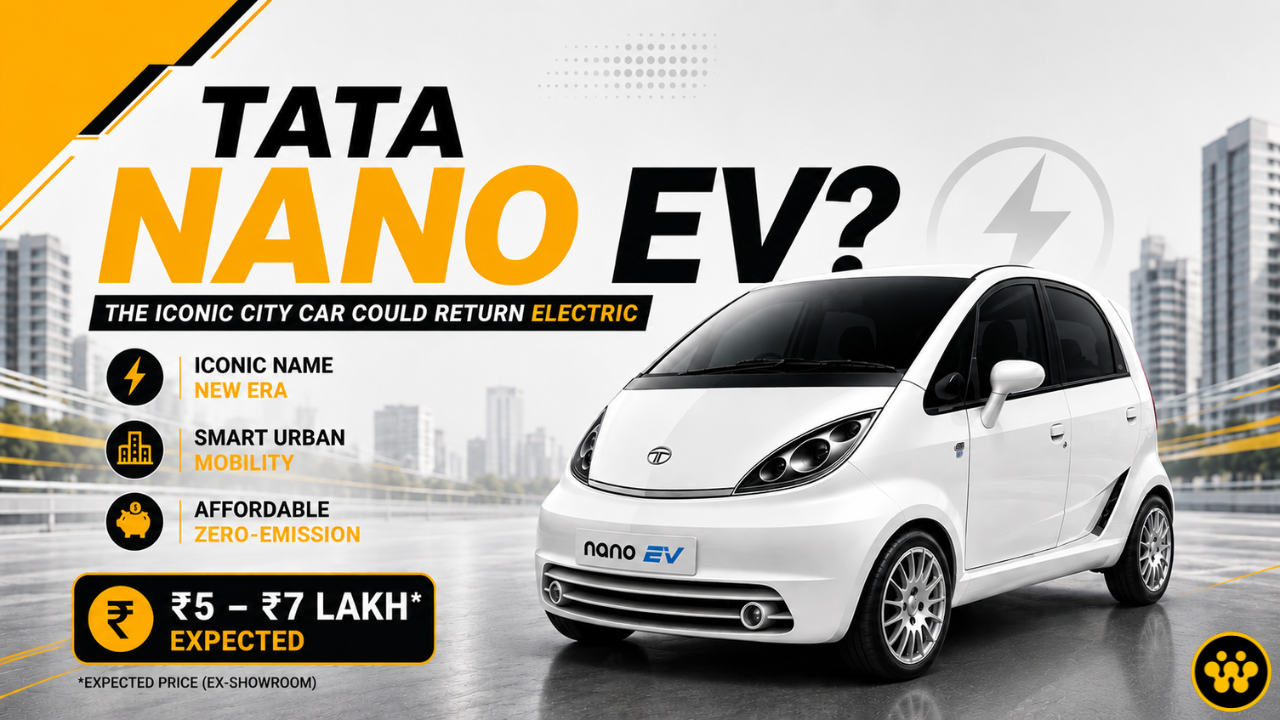
Speculation surrounding the revival of India’s most iconic small car has resurfaced. Fresh comments from a top Tata Motors design executive have sparked speculation that the Tata Nano could return in a modern electric vehicle (EV) avatar.
What Did Tata Motors Say About the Nano EV Revival?
During a recent interaction with ABP Auto Live, Ajay Jain, India Design Head at Tata Motors, was asked if the iconic small car could ever make a comeback. Responding with an optimistic "Try Karenge" ("We will try"), Jain hinted that electrifying the platform could be a key strategy for reinventing the brand for a new generation of buyers.
Jain noted that the original Nano was an innovative project that put India on the global automotive map, adding that seeing the nameplate return—"maybe in an electric avatar"—would be a major milestone for urban mobility.
Important Note: Tata Motors has not officially confirmed an active development program, specifications, or a launch timeline for a Tata Nano EV. Jain’s statements reflect creative exploration and market possibilities rather than an officially approved production model.
Why a Tata Nano EV Makes Strategic Sense Today
While the original petrol-powered Nano was discontinued after struggling with its "world's cheapest car" tag, the market dynamics in 2026 present a drastically different landscape for a small EV.
1. Filling the Gap Below the Tiago EV
Tata Motors dominates the Indian passenger electric vehicle market with models ranging from the Tiago EV and Punch EV to the Nexon EV, Curvv EV, Harrier EV, and Sierra EV. However, there remains an unexplored segment for a ultra-compact, sub-Tiago city EV tailored for congested metro streets.
2. A Shift in Positioning: From "Cheapest" to "Smart Urban Mobility"
The original Nano suffered because Indian car buyers view vehicles as aspirational purchases. Repositioning a future Nano EV as an affordable, feature-packed, zero-emission urban mobility vehicle—rather than a "cheap car"—aligns directly with modern consumer demand.
3. Urban Congestion & Micro-Mobility
With rising traffic, tight parking spaces, and shorter daily commutes, an entry-level micro-EV provides an ideal upgrade path for:
-
Two-wheeler commuters looking for weather protection and enhanced safety.
-
Families seeking a compact, easy-to-park second car for daily errands.
-
First-time EV buyers needing an affordable city runabout.
Past Precedent: The Jayem Neo Electric Nano
Electrifying the Nano platform isn't entirely new for Tata Motors. The company previously collaborated with Coimbatore-based Jayem Automotives to develop the Jayem Neo—an electric fleet variant based on the original Nano shell.
Equipped with a 17 kWh battery pack offering a claimed range of roughly 130 km, the Neo proved that the Nano’s tall-boy architecture and rear-wheel drive setup could adapt to an electric powertrain, establishing a baseline proof-of-concept.
What Would a Next-Gen Tata Nano EV Need?
If Tata Motors decides to move from concept to production, a modern Nano EV would be built from the ground up rather than retrofitting the old chassis.
|
Area |
Original Petrol Nano |
Expected Next-Gen Nano EV |
|
Powertrain |
624cc 2-Cylinder Petrol |
High-efficiency Electric Motor |
|
Battery / Range |
N/A |
~180 km – 220 km Real-World Range |
|
Target Positioning |
World's Cheapest Car |
Smart, Accessible Urban EV |
|
Safety Standards |
Basic Structural Frame |
Multi-Airbag, ABS with EBD, Rigid Crash Structure |
|
Tech & Features |
Minimalist Cabin |
Touchscreen Infotainment, Connected Car Tech, Digital Cluster |
Expected Pricing and Market Positioning
For a Nano EV to succeed, pricing will be the critical factor. Given current battery chemistry costs, matching the original Nano's price point is impossible. Industry estimates suggest an entry-level urban EV positioned below the Tiago EV would likely target the ₹5 Lakh to ₹7 Lakh (ex-showroom) range, making zero-emission four-wheeler mobility significantly more accessible.
Looking to buy an EV?
Compare, explore and find the perfect electric vehicle for you.
Explore EVs