Simple Wave Family Electric Scooter Confirmed for 2 September Launch


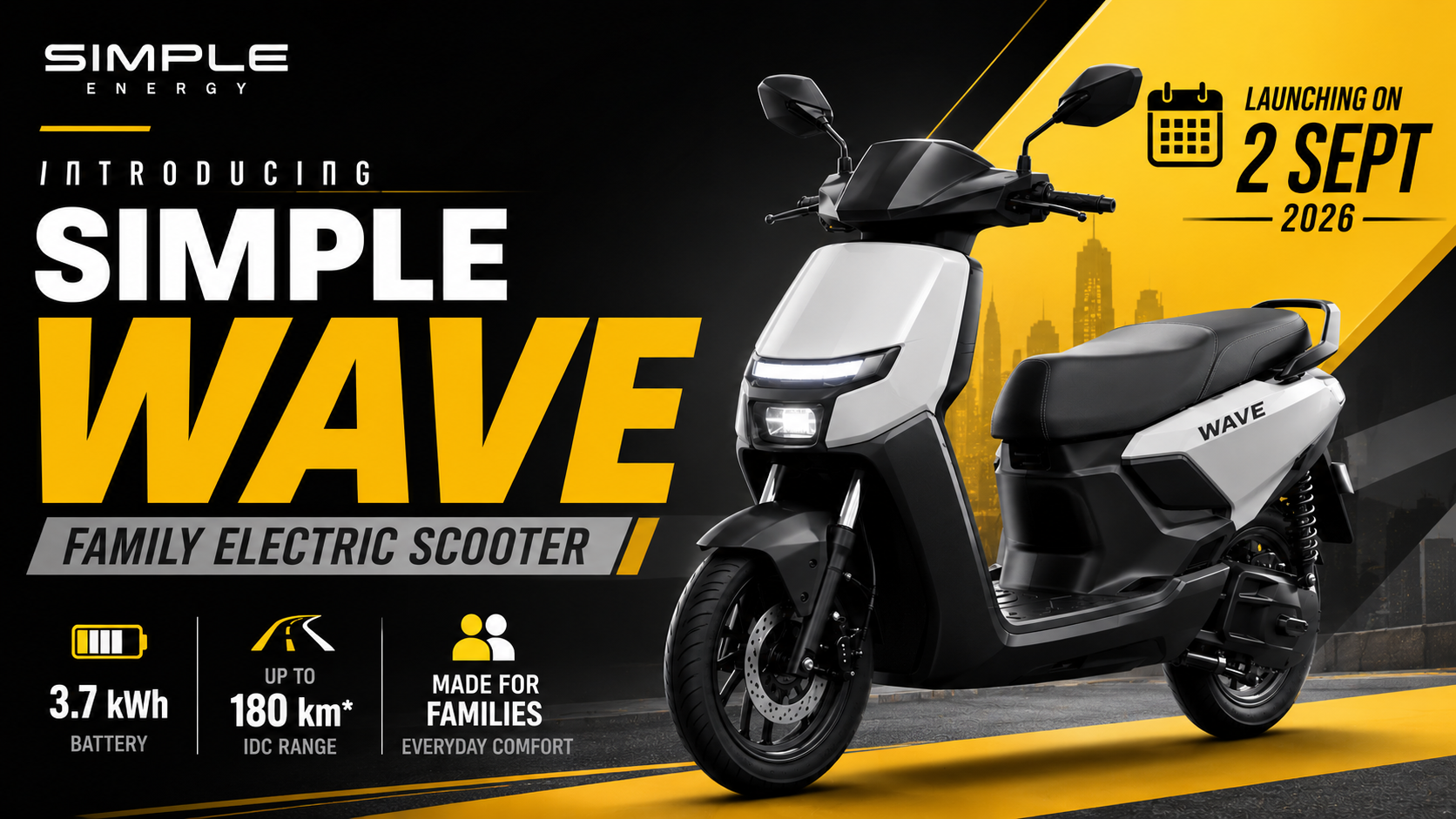
Simple Energy will launch its first family-oriented electric scooter, officially named the Simple Wave, on 2 September 2026. Previously known by its internal codename 'Arrive', the Wave steps away from the high-performance focus of the Simple One series. Instead, it prioritizes practical daily commuting and comfort, marking the Bengaluru-based startup's entry into the competitive family scooter segment.
Quick Summary
- Official Name & Launch: Officially named Simple Wave; launching on 2 September 2026.
- Market Positioning: Practical family commuter aimed at buyers in tier-2 and tier-3 Indian cities.
- Estimated Specs: Expected 3.7 kWh battery pack delivering an estimated 180 km – 200 km IDC range on a single charge.
- Hardware Configuration: Features telescopic front forks, twin rear shock absorbers, a front disc brake, and rear drum brake.
- Retail Strategy: Simple Energy currently operates 75 dealerships and plans to expand to 150–200 touchpoints by the end of FY2026.
- Target Price Range: Estimated at ₹1.35 Lakh – ₹1.50 Lakh (ex-showroom), making it the brand's most accessible model.
Design, Hardware, and Ergonomics
The Simple Wave is a clear departure from the aggressive, angular styling seen on the Simple One and One S. To maximize utility and comfort, it adopts a more conventional, boxier silhouette.
Up front, the scooter sports full-width LED Daytime Running Lights (DRLs) with the main LED headlamp mounted just below on the apron. Designed for shared journeys, the Wave features a long, flat single-piece seat to easily accommodate two adults. Ergonomics lean heavily toward practicality, offering an upright handlebar, a spacious flat floorboard for groceries, small storage cubbies in the front apron, and a standard center stand.
Mechanically, the Wave swaps the Simple One's sporty rear monoshock for a comfort-focused setup: telescopic front forks and twin rear shock absorbers. Braking is managed by a front disc and a rear drum brake, riding on alloy wheels. A full-digital TFT display console handles vehicle telemetry and navigation.
Battery, Range, and Performance Expectations
While official technical specifications will be confirmed on 2 September 2026, Simple Energy is expected to use a powertrain tuned for efficiency and smooth power delivery rather than outright acceleration.
To keep prices accessible while delivering strong range, the Wave will likely feature a 3.7 kWh battery pack. This setup should yield a real-world riding range between 150 km and 180 km, with an IDC claimed range touching 200 km. If these numbers hold true at launch, the Wave will offer one of the largest battery capacities in its target segment.
Note: Specifications below are based on manufacturer targets and industry estimates.
Specifications
| Specification | Simple Wave (Est.) |
|---|---|
| Starting Price | ₹1.35 Lakh – ₹1.50 Lakh (ex-showroom) (Est.) |
| Battery Capacity | 3.7 kWh Lithium-ion (Est.) |
| IDC Claimed Range | 180 km – 200 km (Est.) |
| Peak Power Output | 6.0 kW (8.04 bhp) (Est.) |
| Top Speed | 85 km/h (Est.) |
| Front Suspension | Telescopic Forks |
| Rear Suspension | Twin Shock Absorbers |
| Brakes (Front / Rear) | Disc / Drum |
| Instrument Console | 7.0-inch Digital TFT Display |
Positioning within Simple Energy Lineup
Until now, Simple Energy has strictly focused on high-capacity, premium scooters:
- Simple One S: 3.7 kWh battery, 190 km IDC range, priced at ₹1.72 Lakh (ex-showroom).
- Simple One: 5.0 kWh battery, 265 km IDC range, priced at ₹1.95 Lakh (ex-showroom).
- Simple Ultra: 6.5 kWh battery, 400 km IDC range, priced at ₹2.35 Lakh (ex-showroom).
With an expected price under ₹1.50 Lakh (ex-showroom), the Wave aims to attract value-conscious buyers looking to switch from petrol family scooters. To support this push into the mass market, Simple Energy is aggressively expanding its retail network—growing from its current footprint of 75 dealerships to a targeted 150–200 centers across India by the end of this financial year.
Market Comparison
When it arrives, the Simple Wave will directly compete against major family-oriented electric scooters in India, including the Ather Rizta, TVS iQube, and Bajaj Chetak C25.
| Feature / Spec | Simple Wave (Est.) | Ather Rizta S | TVS iQube 3.4 kWh |
|---|---|---|---|
| Estimated Ex-Showroom Price | ₹1.35 Lakh – ₹1.50 Lakh | ₹1.12 Lakh | ₹1.37 Lakh |
| Battery Capacity | 3.7 kWh (Est.) | 2.9 kWh | 3.4 kWh |
| IDC / Claimed Range | 180 km (Est.) | 123 km | 100 km |
| Top Speed | 85 km/h (Est.) | 80 km/h | 78 km/h |
| Rear Suspension | Twin Shock Absorbers | Monoshock | Twin Shock Absorbers |
| Primary Focus | Range & Family Utility | Underseat Storage & Tech | Comfort & Build Quality |
For buyers wanting to compare electric scooters in the family category, the Simple Wave offers a distinct range advantage over direct rivals, thanks to its larger battery pack.
The Bottom Line
The Simple Wave is a necessary and strategic pivot for Simple Energy, shifting focus from niche performance to mass-market family utility. By combining a practical chassis, a comfortable bench seat, and an impressive estimated range of 180 km for under ₹1.50 Lakh (ex-showroom), the Wave has the fundamental hardware to challenge established market leaders.
Frequently Asked Questions
Q.1What is the launch date of the Simple Wave electric scooter?
Q.2What is the expected price of the Simple Wave?
Q.3What is the estimated battery range of the Simple Wave?
Q.4How does the Simple Wave differ from the Simple One?
Looking to buy an EV?
Compare, explore and find the perfect electric vehicle for you.
Explore EVs