Reliance Bypasses the Global "Lithium War": Bets Big on Sodium-Ion Batteries for India's EV Future


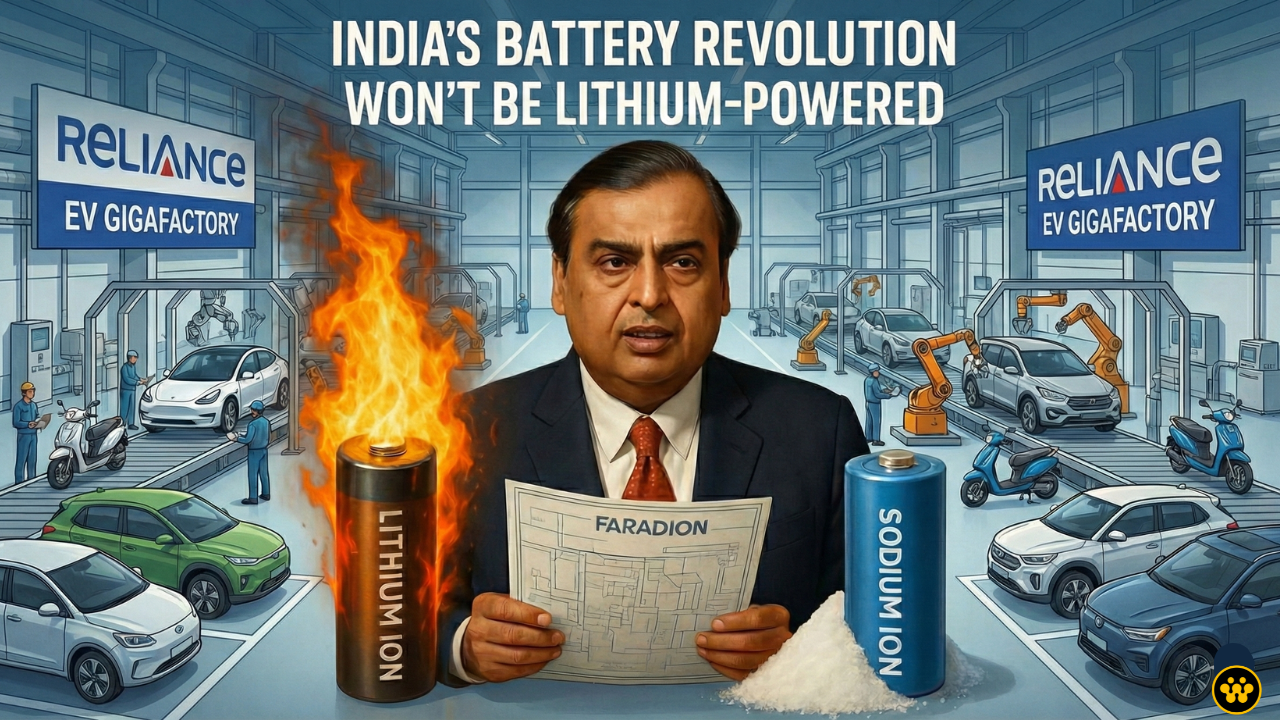
As the global race for electric vehicle (EV) dominance heats up, nations and corporations are locked in a fierce battle over one critical resource: Lithium. Dubbed "white gold," lithium is the backbone of modern batteries, but its scarcity and skyrocketing prices have created a supply chain bottleneck.
Enter Reliance Industries Limited (RIL), While competitors scramble to secure lithium mines in Africa and South America, Mukesh Ambani’s conglomerate has quietly executed a masterstroke to bypass this hurdle entirely. By fully acquiring the UK-based battery tech firm Faradion, Reliance is placing a massive bet on Sodium-ion technology—a move that could rewrite the rules of the energy storage game.
The Strategic Shift: Why Reliance is Choosing Sodium Over Lithium
The news, recently highlighted by industry observers, confirms that Reliance New Energy has completed its 100% acquisition of Faradion. But this is more than just a purchase; it is a strategic pivot away from the geopolitical and economic risks associated with lithium.
1. Abundance vs. Scarcity
Lithium reserves are concentrated in a few countries (China, Chile, Australia), leading to volatile pricing and supply shortages. Sodium, on the other hand, is one of the most abundant elements on Earth. It can be harvested from soda ash or even sea salt, making the raw material supply virtually limitless and free from geopolitical monopolization.
2. Drastic Cost Reduction
One of the biggest barriers to EV adoption in India is cost. Sodium-ion batteries are significantly cheaper to manufacture than their Lithium-ion counterparts. By utilizing sodium, Reliance plans to lower the cost of battery packs, which could pave the way for affordable EVs for the Indian mass market.
3. Safety and Performance
Sodium-ion batteries offer superior safety characteristics. Unlike lithium batteries, which carry a risk of thermal runaway (fire) and require complex management systems, sodium batteries can be transported at zero volts (fully discharged), making them incredibly safe to ship and store. They also perform better in extreme temperatures—a crucial factor for India's diverse climate.
The Faradion Advantage : Bringing Tech to Jamnagar
Faradion is recognized as a global leader in non-aqueous sodium-ion cell technology. Reliance’s plan is to integrate this technology into its ambitious Dhirubhai Ambani Green Energy Giga Complex in Jamnagar, Gujarat.
According to recent updates, Reliance aims to commence production at its gigafactory by the second half of 2025. The facility will not only manufacture batteries for EVs but also focus on grid-scale energy storage, ensuring that India’s solar and wind energy can be stored efficiently.
What This Means for India's Energy Independence
This move aligns perfectly with the Indian government's "Make in India" and "Atmanirbhar Bharat" (Self-Reliant India) initiatives. Currently, India is heavily dependent on battery imports.
By championing a technology that relies on domestically available raw materials, Reliance is ensuring that India does not trade its dependence on oil for a dependence on imported lithium.
Key Takeaways for Investors and Industry Watchers
-
Strategic Pivot : Reliance is avoiding the crowded and expensive lithium market.
-
Commercialization : Production is expected to scale in late 2025.
-
Market Impact : Could significantly lower the price of electric 2-wheelers and economy cars in India.
-
Sustainability : Sodium mining is far less environmentally damaging than lithium extraction.
Conclusion
While the rest of the world is "fighting over lithium," Reliance has found a smarter, cheaper, and more sustainable alternative. If successful, the Sodium-ion bet won't just make Reliance a leader in the battery space. it could make India a global hub for the next generation of clean energy storage.
Looking to buy an EV?
Compare, explore and find the perfect electric vehicle for you.
Explore EVs