Driving Independence: How OSM’s New Accessible EV Aims to Transform Indian Mobility


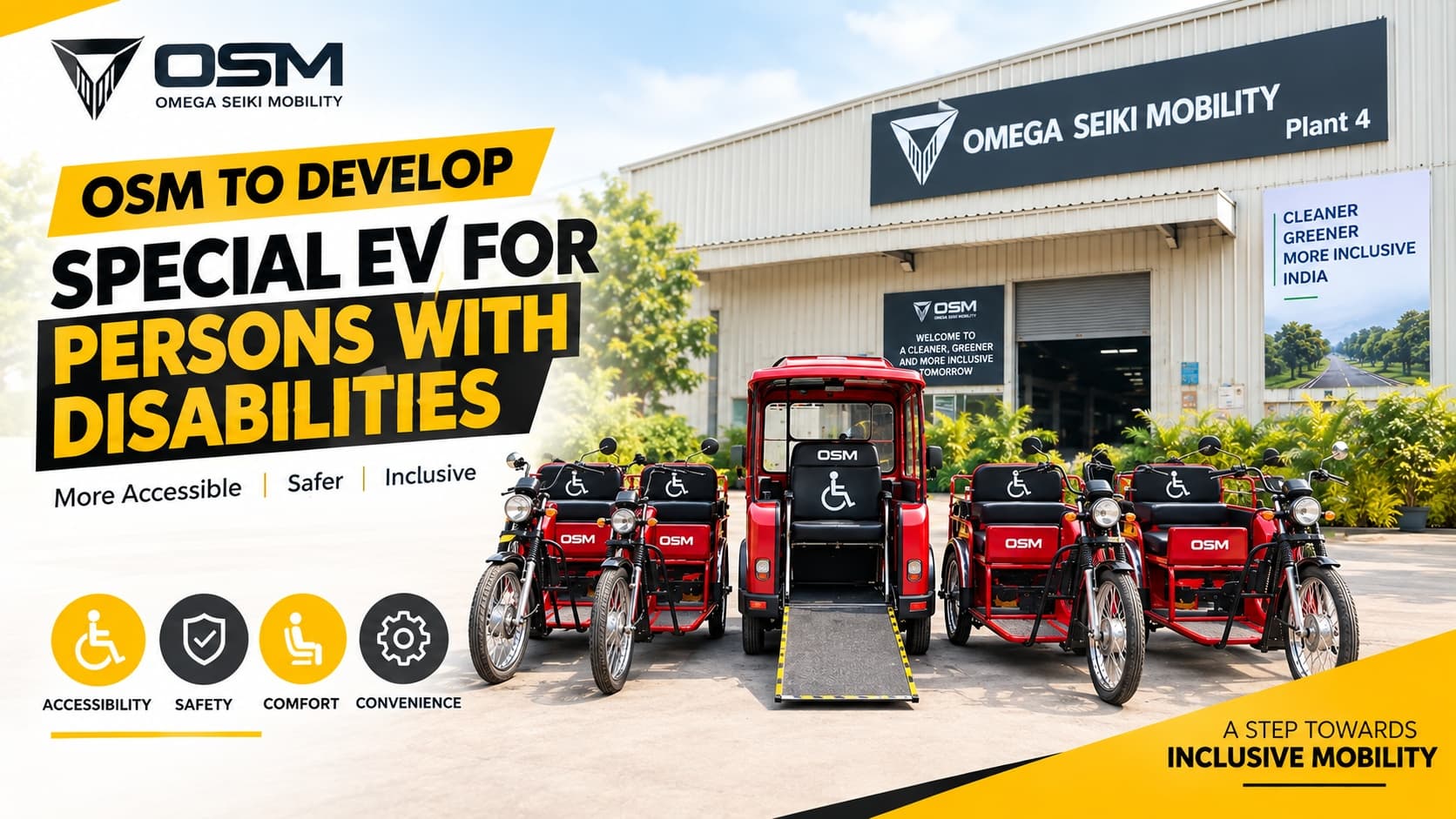
The Indian electric vehicle (EV) revolution has largely focused on efficiency, range, and cutting carbon emissions. However, a crucial segment of the population has often been overlooked in this rapid transition: persons with disabilities. Changing the narrative, Omega Seiki Mobility (OSM) has announced the initiation of the design and development of a specially engineered electric vehicle for persons with disabilities.
This groundbreaking initiative was officially announced in September 2026. It serves as a strong reminder that the future of transportation must be accessible to everyone. The initiative, announced on the occasion of Prime Minister Narendra Modi’s birthday, reflects OSM’s commitment to building an inclusive, accessible and sustainable mobility ecosystem.
For years, the automotive industry has retrofitted standard vehicles with aftermarket hand controls or ramps. Yet, purpose-built passenger vehicles designed from the ground up for diverse mobility needs remain scarce. By taking on this challenge, OSM is stepping into a largely untapped but socially critical segment of the automotive market.
A Tribute to the Vision of Inclusive Development
Aligning corporate goals with national developmental visions is a powerful way to drive change. The initiative has been dedicated to Prime Minister Narendra Modi on his birthday as a tribute to the vision of inclusive development and sustainable mobility.
This dedication mirrors broader national efforts, such as the Sugamya Bharat Abhiyan (Accessible India Campaign), which was launched to reshape India into an inclusive society. While the government has made strides in retrofitting public transport, private mobility solutions have lagged. OSM’s latest project bridges this gap, taking the ethos of national inclusivity directly to the consumer automotive sector.
The Core Engineering Philosophy: Human-Centric Design
Creating a vehicle for persons with disabilities requires more than just removing seats or adding a ramp. It demands a fundamental rethinking of automotive architecture. The proposed electric vehicle will follow a human-centric approach with the specific mobility requirements of persons with disabilities forming the foundation of the development process.
Instead of adapting an existing platform as an afterthought, OSM is placing the user at the very beginning of the engineering blueprint. The vehicle will focus on accessibility, safety, comfort, convenience and ease of use, with the broader aim of supporting greater independence and dignity in everyday mobility.
Breaking Down the Design Pillars
To truly understand what a human-centric approach entails, we must look at the specific parameters OSM is prioritizing. While exact technical specifications remain under wraps, the foundational pillars of this project are clear:
- Accessibility: Making entry and egress seamless, potentially through lowered floors, wide-opening doors, or integrated automated ramps.
- Safety: Ensuring that structural integrity and crash safety accommodate non-traditional seating or wheelchair securing mechanisms.
- Comfort: Refining the suspension and interior ergonomics to provide a smooth, fatigue-free ride.
- Ease of Use: Integrating intuitive controls that require minimal physical exertion, addressing the diverse range of physical limitations users might face.
Dr. Uday Narang’s Vision for a Sustainable and Accessible Future
Leadership plays a pivotal role in steering an automotive company toward purpose-driven manufacturing. Under the guidance of its Founder and Chairman, Dr. Uday Narang, Omega Seiki Mobility has rapidly evolved. Originally making waves with electric commercial cargo vehicles like the Rage+ and Rage+ Frost, the company is now expanding its horizons into specialized passenger transport.
Dr. Narang has consistently championed the idea that mobility is a fundamental human right. Discussing the new project, Dr. Uday Narang, Founder & Chairman, Omega Seiki Mobility, said, “At Omega Seiki Mobility, we believe that mobility is not simply about moving from one place to another, it is about independence, dignity and the freedom to participate fully in society."
Beyond Just Moving From Point A to Point B
The transition from internal combustion engines to electric powertrains offers a unique opportunity to redesign vehicles without the spatial constraints of traditional engines and gearboxes. Dr. Narang acknowledges this unique timing in the Indian automotive landscape.
He noted, “As India moves rapidly towards electric mobility, we want to ensure that this transformation is inclusive and reaches people with diverse mobility needs."
The goal is not merely to build a car, but to foster empowerment. “With this initiative, our objective is to use technology, engineering and innovation to create a practical mobility solution designed around the real requirements of persons with disabilities,” Dr. Narang explained.
He added, “Innovation has its greatest value when it improves everyday life. This initiative marks the beginning of a journey to create a solution that can give persons with disabilities greater confidence and independence in their daily mobility.”
Bridging the Gap: India’s EV Boom Meets Accessible Transport
The Indian EV market is growing at an unprecedented rate, yet the options for disabled drivers and passengers are strikingly limited. Many individuals who use wheelchairs or have limited mobility are forced to rely on expensive, custom aftermarket modifications. These retrofits often void vehicle warranties and compromise factory safety standards.
By offering a factory-engineered solution, OSM is attempting to solve a major pain point in the Indian mobility ecosystem. Electric vehicles are inherently well-suited for accessible modifications. The absence of a central transmission tunnel allows for a completely flat floorpane. Furthermore, battery packs positioned under the floor provide a low center of gravity, which improves stability—a critical factor when designing vehicles with modified suspensions for ramp access.
The Market Need for Accessible Transportation
According to data from India's Accessible India Campaign, transport accessibility remains an ongoing challenge. While thousands of public buses have been designated as partially or fully accessible, the reality of last-mile connectivity and personal, independent travel remains a hurdle. Public transport cannot offer the sheer autonomy of a personal vehicle.
OSM’s initiative taps directly into this underserved market. Providing a purpose-built EV will not only grant personal freedom to thousands but also set a new industry benchmark. It challenges other major automakers to look beyond mass-market passenger cars and consider the diverse needs of the modern consumer base.
What to Expect: The Development Roadmap for OSM’s Accessible EV
Automotive engineering is a complex process, and developing a niche vehicle requires rigorous real-world testing and localized manufacturing to keep costs viable. OSM plans to draw on its experience in electric vehicle engineering and manufacturing to explore a Made-in-India mobility solution that can contribute to more accessible transportation.
Leveraging local supply chains will be crucial. A "Made-in-India" badge ensures that the vehicle remains cost-effective and relatively affordable, which is a significant factor given the high costs generally associated with specialized medical and mobility equipment.
Stakeholder Integration and Collaborative Engineering
A common pitfall in designing accessibility products is failing to consult the end-user. Engineers in boardrooms cannot fully grasp the daily friction points experienced by a person with a disability. OSM appears acutely aware of this challenge.
As part of the development process, the company will work towards understanding the requirements of users and engaging with relevant experts and stakeholders during the development process. This collaborative strategy ensures that the final product is not just a theoretical concept, but a highly practical tool.
This approach is intended to ensure that the vehicle’s design is informed by practical user needs and delivers meaningful improvements in everyday mobility. Whether it involves consulting ergonomic specialists, occupational therapists, or disability advocacy groups, this stakeholder integration will heavily influence the vehicle's final layout.
Technical Speculations Versus Confirmed Facts
While the overarching philosophy of the vehicle has been clearly communicated, specific mechanical and technical details have not yet been disclosed by the company. Based on industry standards and OSM's current portfolio, we can distinguish confirmed facts from logical speculations:
| Feature/Aspect | Confirmed Information | Speculative / Pending Announcement |
|---|---|---|
| Development Status |
Design and development initiated
| Launch timeline, testing phases |
| Target Audience |
Persons with disabilities
| Specific disability accommodations (e.g., wheelchair drive-in vs. passenger only) |
| Manufacturing Base |
Made-in-India solution
| Specific assembly plant location |
| Vehicle Format |
Electric Vehicle (EV)
| Body style (Two, three, or four-wheeler) |
| Design Approach |
Human-centric, focusing on user needs
| Battery range, powertrain specs, pricing |
The Automotive Industry’s Responsibility Towards Divyangjan
The announcement by Omega Seiki Mobility opens up a broader conversation about corporate social responsibility within the automotive sector. For decades, the burden of mobility has been placed on the disabled individual, requiring them to adapt to a world built for the able-bodied.
The shift toward purpose-built inclusive vehicles represents a paradigm shift. It acknowledges that the built environment—and the vehicles that traverse it—should adapt to the user. As EV technology democratizes mobility through lower running costs and simpler mechanical architectures, manufacturers have an ethical obligation to ensure these benefits are universally accessible.
OSM’s foray into this space could serve as a catalyst. If successful, it will prove that there is a viable, sustainable market for inclusive mobility solutions in India. This could eventually prompt larger legacy automakers to allocate research and development budgets toward similar inclusive platforms.
Why This Matters: The Path Forward for EV Manufacturers
Electric vehicles represent the future, but a future that excludes millions of citizens is inherently flawed. OSM's decision to prioritize an accessible EV highlights a maturation in the Indian EV startup ecosystem. Companies are now looking beyond the low-hanging fruit of basic urban scooters and delivery trucks, moving toward complex, socially impactful engineering.
The challenge ahead for Omega Seiki Mobility will be balancing cutting-edge accessibility features with affordability. The Indian automotive market is notoriously price-sensitive. To truly achieve the goal of granting "greater confidence and independence," the final product must be accessible not just physically, but economically.
Relying on a localized supply chain and robust in-house R&D will be the key to achieving this delicate balance. If OSM can deliver a safe, comfortable, and affordable product, it will cement its legacy as a true pioneer in the Indian mobility space.
Final Thoughts: A Paradigm Shift in Indian Mobility
Omega Seiki Mobility has thrown down the gauntlet. By committing to design a vehicle that places the needs of persons with disabilities at the forefront, the company is attempting to rewrite the rules of automotive design in India.
The journey from the drawing board to the showroom floor is long and fraught with engineering challenges. However, the intent is clear and commendable. This upcoming EV promises to be much more than a new addition to India’s growing electric fleet; it represents a tangible step toward a more equitable and inclusive society.
As the project advances, the automotive community and consumers alike will be watching closely. We await further announcements regarding the vehicle's body style, battery specifications, and commercial launch dates. Until then, OSM's commitment stands as a beacon of progressive, human-centric engineering in the electric age.
Frequently Asked Questions
Q.1What are the key focus areas for this new electric vehicle?
Q.2When was this initiative announced and who was it dedicated to?
Q.3What design philosophy is guiding the development of the EV?
Q.4How does OSM plan to make sure the vehicle meets real-world needs?
Looking to buy an EV?
Compare, explore and find the perfect electric vehicle for you.
Explore EVs