NIT Rourkela Develops Smart Power Management System for EV Charging Stations


India's electric vehicle (EV) ecosystem is expanding, but the development of reliable charging infrastructure remains an important challenge. Addressing this issue, researchers at the National Institute of Technology (NIT) Rourkela have secured a patent for a smart power management system designed to improve the efficiency, reliability and sustainability of electric vehicle charging stations.
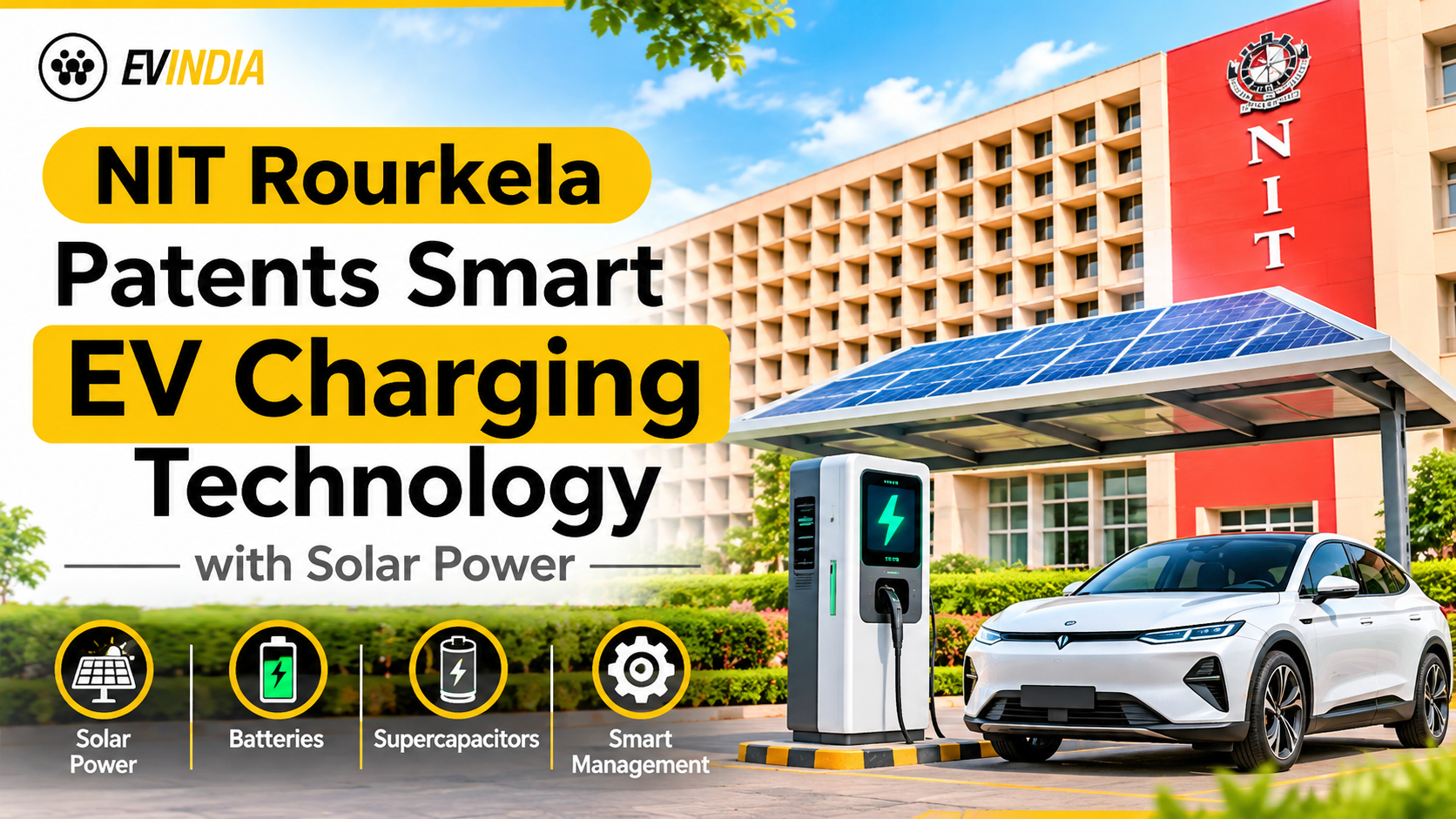
The newly developed technology uses a solar-powered EV charging microgrid that combines solar panels, the conventional electricity grid and a hybrid energy storage system consisting of batteries and supercapacitors. The system is designed to manage changing electricity demand, fluctuations in solar power generation and electricity flow between electric vehicles and the power grid.
The innovation could help address some of the technical challenges associated with expanding India's EV charging network, particularly when several electric vehicles need to charge simultaneously.
NIT Rourkela's Smart EV Charging Technology: What Is New?
The research team at NIT Rourkela has developed a solar-powered microgrid that intelligently manages electricity from multiple sources. Instead of depending entirely on conventional grid electricity or battery-based storage, the system combines renewable energy generation with two different energy storage technologies.
The key components include:
- Solar panels for generating renewable electricity.
- Conventional grid connectivity for additional power supply.
- Batteries for storing energy and meeting sustained electricity demand.
- Supercapacitors for responding to sudden changes in power demand.
- An intelligent control system for managing electricity distribution.
According to the research team, the technology uses an improved mixed droop control technique to distribute power between batteries and supercapacitors according to changing operating conditions.
This approach is intended to maintain stable power sharing and improve the overall performance of the EV charging microgrid.
How Does the Solar-Powered EV Charging System Work?
The proposed EV charging system operates by coordinating electricity generation, storage and distribution.
Solar panels generate electricity during daylight hours, while the conventional electricity grid can provide additional power whenever required. The energy storage system helps manage the difference between electricity generation and charging demand.
For example, when solar panels generate more electricity than the charging station currently needs, excess energy can be stored for later use. During periods of lower solar generation, stored electricity can help support charging operations.
However, the system's most important feature is its combination of batteries and supercapacitors.
Unlike conventional battery-only storage systems, this hybrid arrangement uses two different technologies to handle different electricity requirements. Batteries manage longer-duration and relatively steady power demand, while supercapacitors respond to sudden fluctuations by absorbing and releasing energy much faster.
This division of responsibilities is designed to reduce electrical stress on batteries and improve the reliability of the overall charging system.
Batteries and Supercapacitors: Why Does the Combination Matter?
Energy storage is an important part of renewable-powered EV charging infrastructure. Solar electricity generation changes depending on weather conditions, cloud cover, seasons and the time of day.
Batteries can store surplus electricity and supply it when solar generation decreases. However, frequent charging and discharging can gradually affect battery performance and shorten its operational lifespan.
This is where supercapacitors become useful.
Supercapacitors can absorb and release electrical energy much faster than conventional battery storage systems. They are particularly suitable for handling short-duration fluctuations and sudden changes in electricity demand.
In the NIT Rourkela-developed system, batteries are responsible for meeting sustained electricity requirements, while supercapacitors handle rapid power variations.
Professor Pravat Kumar Ray from NIT Rourkela explained that combining these two components helps reduce stressful current fluctuations on batteries, potentially extending their service life.
The hybrid energy storage architecture is therefore designed to improve power management while reducing the operational stress associated with sudden electricity demand changes.
Improved Mixed Droop Control Technique Explained
Another important part of the patented technology is its improved mixed droop control technique.
In simple terms, droop control is a method used in electrical power systems to regulate how different energy sources share electricity according to changing operating conditions.
In an EV charging microgrid, electricity may come from solar panels, the conventional power grid and energy storage components. Their power contributions need to be coordinated to maintain stable operation.
The improved mixed droop technique developed by the NIT Rourkela researchers automatically manages power distribution between batteries and supercapacitors.
This allows the system to respond to changing electricity generation and demand without relying on a fixed power-sharing arrangement.
The technology also incorporates intelligent power management features to regulate electrical voltage, adjust the amount of electricity supplied for EV charging according to the vehicle battery's state of charge, and manage electricity flowing from vehicles back into the grid.
These capabilities could become particularly relevant as EV charging infrastructure evolves towards more advanced energy management systems.
Vehicle-to-Grid Technology: How Will It Support EV Charging?
The NIT Rourkela innovation is also designed to support two-way electricity flow between electric vehicles and the power grid.
Currently, most conventional EV charging operations follow a Grid-to-Vehicle (G2V) arrangement. Under this system, electricity flows from the power grid to the vehicle battery.
Vehicle-to-Grid (V2G) technology works in the opposite direction. It allows compatible electric vehicles to send stored electricity back to the grid when required.
This approach could help electric vehicles function as distributed energy storage resources, potentially supporting electricity networks during periods of high demand.
However, managing electricity flow in both directions requires advanced control systems to maintain electrical stability and ensure safe power transfer.
The NIT Rourkela-developed smart power management system incorporates controls intended to manage both G2V and V2G operations.
Although the technology has demonstrated prototype-level capabilities, its performance in practical commercial charging environments will need to be established through further development and field testing.
Why Is This Technology Important for India's EV Charging Infrastructure?
India's electric mobility transition requires more than the introduction of new electric cars, scooters and motorcycles. A reliable charging network is equally important for encouraging wider EV adoption.
As the number of electric vehicles increases, charging stations will need to handle higher electricity demand, particularly in residential areas, commercial establishments and public charging locations.
One of the challenges is the possibility of sudden electricity demand spikes when multiple vehicles charge simultaneously. Such situations can place additional pressure on local electricity distribution networks.
Solar-powered charging stations offer an alternative by allowing operators to generate and store renewable electricity. However, solar generation is not constant throughout the day, making energy storage and intelligent power distribution essential.
The NIT Rourkela technology aims to address these challenges through its combination of solar power, hybrid energy storage and smart electricity management.
If successfully developed for commercial applications, the system could potentially be used in several locations, including:
- Public EV charging stations.
- Residential apartment complexes.
- Commercial buildings and business parks.
- Educational institutions and university campuses.
- Renewable-energy-powered charging facilities.
However, these are potential application areas rather than confirmed deployment locations.
NIT Rourkela EV Charging Technology: Prototype Testing and Future Plans
The research team has already developed a prototype of the proposed smart EV charging microgrid. Its performance was tested under simulated variations in solar power generation and electricity demand.
The initial testing represents an important development stage, as it demonstrates the system's ability to manage changing operating conditions in a controlled environment.
However, the researchers are not treating the current prototype as a commercially ready product.
According to Associate Professor Arnab Ghosh from the Department of Electrical Engineering at NIT Rourkela, the team plans to scale up the prototype for a higher-power EV charging system.
Future development activities are expected to include:
- Integration of advanced battery management systems.
- Development of energy optimisation algorithms.
- Exploration of grid-forming control.
- Integration of multiple electric vehicles.
- Real-time field trials.
- Further development towards an industry-ready solution.
These steps will be important in determining how effectively the technology performs under actual charging conditions.
The next phase will also help assess its ability to support higher charging capacities and more complex electricity distribution requirements.
What Does This Mean for the Future of Electric Vehicle Charging in India?
The NIT Rourkela patent highlights the growing importance of energy management technology in India's electric mobility ecosystem.
While improvements in battery technology, vehicle range and charging speed continue to attract attention, the reliability of electricity supply is another important factor in the development of EV infrastructure.
Combining solar power with hybrid energy storage could help charging stations make better use of renewable electricity while managing fluctuations in demand.
The addition of Vehicle-to-Grid capabilities also introduces the possibility of using compatible electric vehicles as part of a wider energy management network.
Nevertheless, the technology will need further testing, scaling and industry development before its commercial potential can be established.
For India's EV industry, innovations such as this could contribute to the development of smarter, more flexible and renewable-energy-supported charging infrastructure.
Conclusion
NIT Rourkela's patented smart power management system represents a promising development in EV charging infrastructure. By combining solar panels, conventional grid connectivity, batteries, supercapacitors and an improved mixed droop control technique, the researchers aim to make electric vehicle charging stations more stable and efficient.
With prototype testing completed and plans for higher-power development and real-time field trials, the next stage will be to establish its suitability for practical applications. If successfully commercialised, the technology could contribute to India's transition towards a more reliable and sustainable electric mobility ecosystem.
Frequently Asked Questions
Q.1What is the new EV charging technology developed by NIT Rourkela?
Q.2How does NIT Rourkela's solar-powered EV charging system work?
Q.3 What is the role of supercapacitors in EV charging stations?
Q.4Who developed the smart EV charging technology at NIT Rourkela?
Looking to buy an EV?
Compare, explore and find the perfect electric vehicle for you.
Explore EVs