JSW MG Motor India Unveils Revolutionary 'ADAPT' Multi-Powertrain Platform


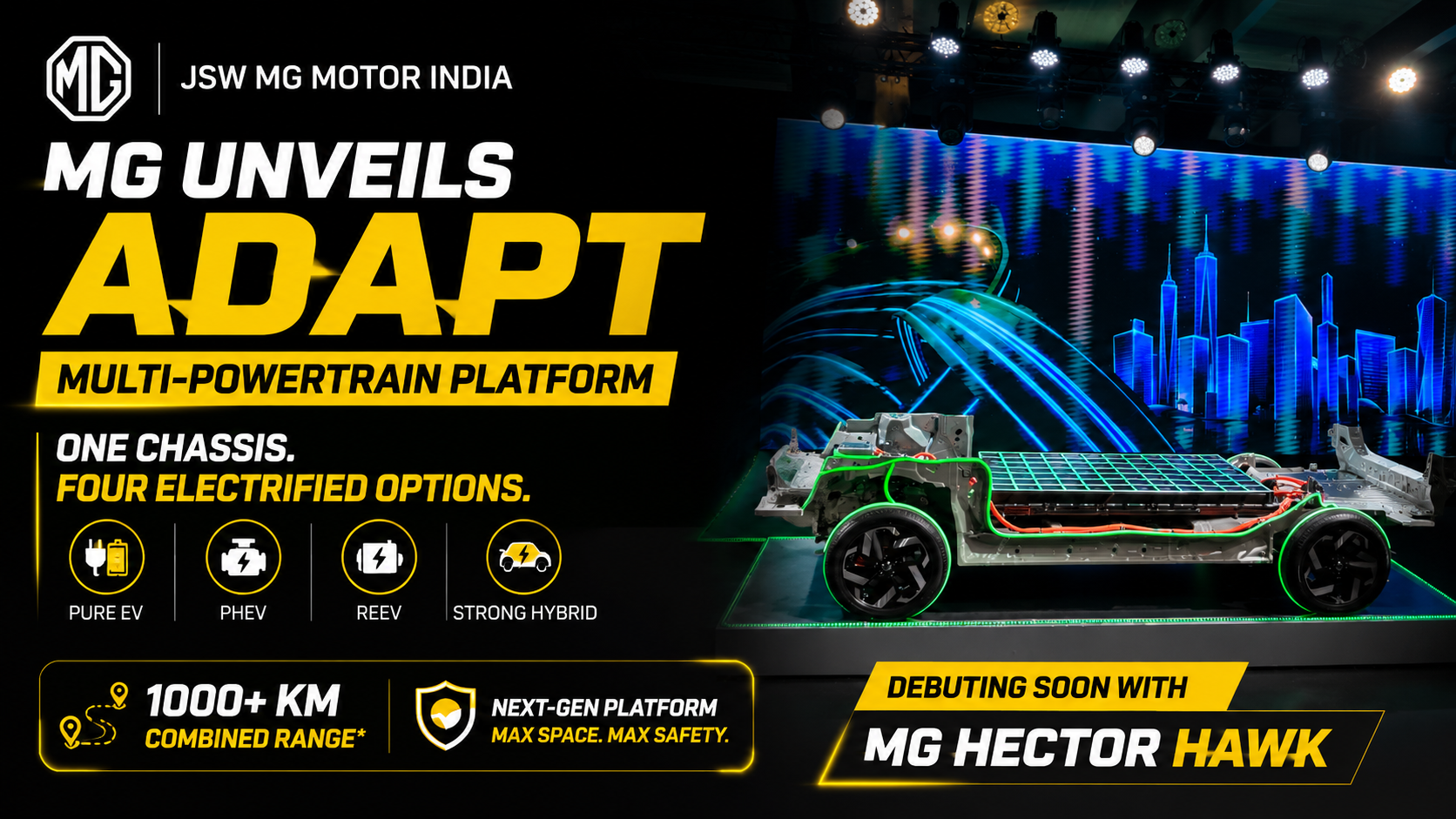
JSW MG Motor India has unveiled MG ADAPT (Advance Drive Architecture Platform Technology), a modular architecture designed to support electric vehicles (EVs), plug-in hybrid electric vehicles (PHEVs), strong hybrid electric vehicles (HEVs), and range-extender electric vehicles (REEVs) on a single platform. The company confirmed that the first two models built on ADAPT — one EV and one PHEV — will debut in the Indian market by the end of the current financial year (FY2026-27, i.e., by March 2027). No pure-ICE (petrol or diesel) models will be based on this architecture.
Quick Summary
- JSW MG Motor India has introduced the ADAPT platform, which it calls India's first multi-New Energy Vehicle (NEV) architecture.
- The platform supports four powertrain types: EVs, PHEVs (Plug-in Hybrids), HEVs (Strong Hybrids), and REEVs (Range Extender Electric Vehicles).
- The first two ADAPT-based models — an EV and a PHEV variant of a new SUV — are scheduled to launch by March 2027 (end of FY2026-27).
- The hybrid powertrain integrates a dedicated petrol engine with thermal efficiency of up to 43 percent.
- A compact 10-in-1 intelligent electric drive unit and an electromagnetic dedicated hybrid transmission (DHT) handle power delivery across all modes.
Integrated Hybrid Ecosystem and Key Powertrain Components
At the core of the ADAPT platform is an integrated hybrid technology ecosystem. The manufacturer has detailed the following key components:
- Dedicated Hybrid Petrol Engine: A naturally aspirated petrol unit designed exclusively for hybrid applications, claiming a thermal efficiency of up to 43 percent. For context, conventional petrol engines typically operate in the 20–35 percent thermal efficiency range.
- Dedicated Battery System: A purpose-built battery pack optimized for rapid electric discharge, providing instant torque response with enhanced thermal stability and safety.
- 10-in-1 Intelligent Electric Drive Unit: Described as a first-in-India unit, this compact assembly integrates a permanent magnet synchronous motor and a 2-stage reduction gearbox into a single package, reducing powertrain complexity and weight.
- Electromagnetic Dedicated Hybrid Transmission (DHT): MG claims this is the world's first electromagnetic DHT. Unlike the e-CVTs commonly found in hybrid cars, this transmission uses mechanical gears for improved torque delivery. The electromagnetic e-clutch is designed to offer significantly faster response times than conventional hydraulic units, enabling mode-switching speeds of approximately 0.1 seconds.
MG has not disclosed specific details such as engine displacement, cylinder count, or peak power output for the hybrid engine.
Four Intelligent Driving Modes
The ADAPT platform's Intelligent Energy Management System continuously monitors driving conditions and automatically selects the most efficient operating strategy from four dedicated drive modes:
- Pure Electric Drive: The combustion engine is deactivated. The battery pack and electric motor handle all propulsion, suited for quiet urban driving.
- Series Hybrid Drive: The petrol engine runs at an optimized RPM to generate electricity, while the electric motor drives the wheels. This is the primary operating mode for Range Extender Electric Vehicle (REEV) configurations.
- Parallel Hybrid Drive: Both the petrol engine and electric motor work together to deliver maximum combined power and torque.
- Engine Direct Drive: The petrol engine connects directly to the wheels via mechanical gears, optimized for fuel-efficient highway cruising.
These modes correspond to the different powertrain configurations ADAPT will support: strong hybrids use Parallel and Engine Direct modes, range-extenders correspond to Series mode, pure EVs operate in Pure Electric mode, and PHEVs can utilize all four modes.
Upcoming Vehicles and Market Launch Timelines
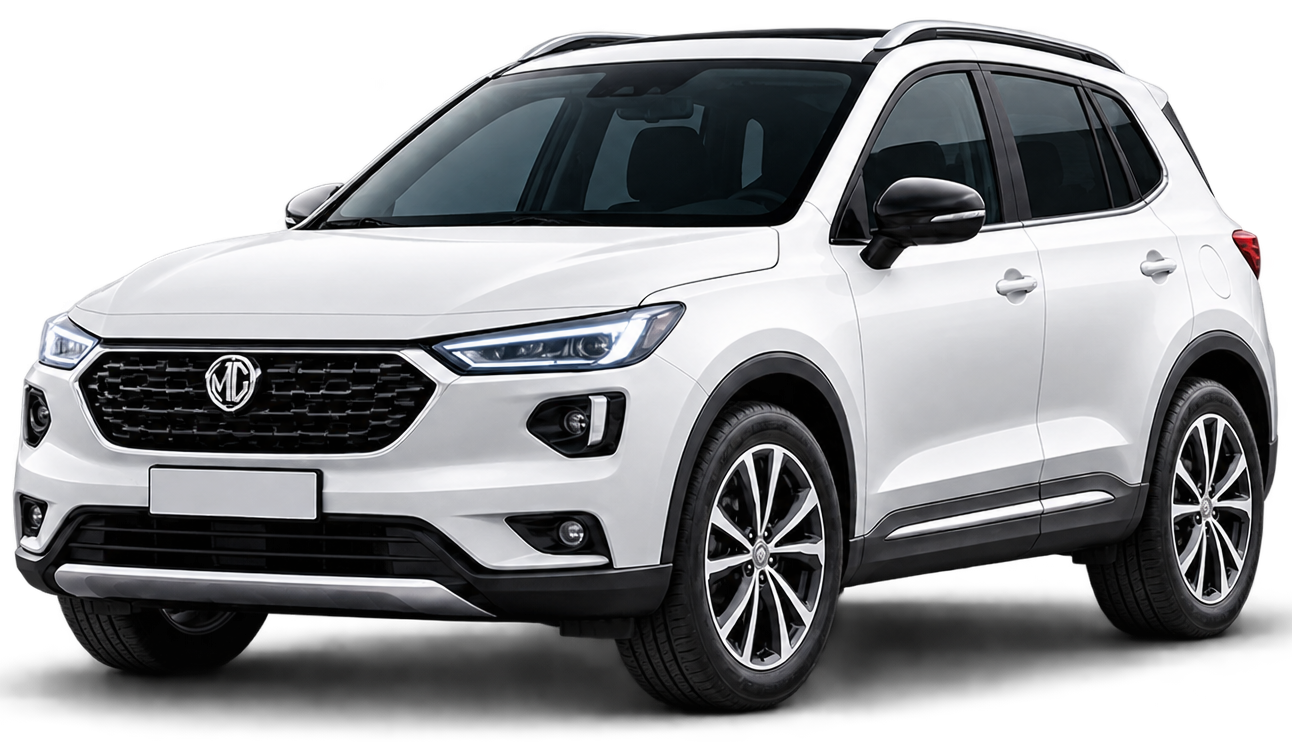
The first vehicle to use the ADAPT platform in India is widely expected to be the Indian-spec version of the Wuling Starlight 560, a 7-seater SUV available globally in both EV and PHEV guises. Multiple test mules of the SUV have been spotted on Indian roads, and its design was patented in India in March 2026.
The vehicle will carry MG branding in India, but may not retail under the "Starlight 560" name. Reports suggest it could be sold under the Hector nameplate with a new suffix (such as "Hector Hawk"), though this has not been officially confirmed by JSW MG Motor India.
The company has confirmed that both an EV and a PHEV variant will arrive within FY2026-27 (by March 2027). The EV version is expected to launch first, but a specific month has not been officially announced. It remains unconfirmed whether the models will be branded as "MG" or "MG Select."
This rollout expands MG's footprint in the electric vehicles segment while simultaneously entering the plug-in hybrid space in India.
Specifications
Note: Specifications below are based on the global Wuling Starlight 560 and industry estimates. Indian-spec details may vary and have not been officially confirmed.
| Specification | Starlight 560-Based EV (Est.) | Starlight 560-Based PHEV (Est.) |
|---|---|---|
| Expected Price | ₹20.00 Lakh – ₹27.00 Lakh (ex-showroom) | ₹15.00 Lakh – ₹25.00 Lakh (ex-showroom) |
| Battery Capacity | 56.7 kWh – 69.2 kWh (LFP) | 20.5 kWh (LFP) |
| Claimed Range | ~530 km (CLTC) | ~100–125 km EV-only (CLTC); 1,000+ km combined |
| Motor/Combined Output | ~201 bhp / 310 Nm | ~194 bhp / 230 Nm (combined) |
| Engine | N/A | 1.5L naturally aspirated petrol |
| Seating | 5/7-seater | 5/7-seater |
| Dimensions (L × W × H) | 4,745 × 1,850 × 1,755 mm (Est.) | 4,745 × 1,850 × 1,755 mm (Est.) |
| Wheelbase | 2,810 mm (Est.) | 2,810 mm (Est.) |
Pricing Breakdown
Final retail pricing for the upcoming ADAPT-based models has not been officially confirmed by JSW MG Motor India. However, industry estimates indicate the following:
- Estimated Ex-Showroom Range: The EV version is expected to start at approximately ₹20.00 Lakh (ex-showroom) for the entry-level trim and extend to around ₹27.00 Lakh (ex-showroom) for the long-range variant. The PHEV version is estimated between ₹15.00 Lakh – ₹25.00 Lakh (ex-showroom).
- On-Road Price Estimates: Factoring in state-specific road tax exemptions for electric cars, on-road prices for the EV variant are projected between ₹21.00 Lakh – ₹29.00 Lakh (on-road), depending on the registration state.
- Tax Treatment: Pure EVs attract a concessional 5 percent GST with no additional cess. PHEVs and strong hybrids, however, are taxed at 18 percent GST (for smaller vehicles) or up to 40 percent GST (for larger vehicles) under the post-September 2025 GST structure — significantly higher than the EV rate. This tax differential will directly impact the on-road pricing gap between the EV and PHEV variants.
The Bottom Line
The MG ADAPT platform is a strategic pivot for JSW MG Motor India, consolidating EV, PHEV, HEV, and REEV capabilities on a single modular architecture. If MG can price the EV variant competitively against the Tata Harrier EV and BYD Atto 3, the added flexibility of a PHEV option on the same platform could give the brand a distinct edge in markets where charging infrastructure remains limited.
Frequently Asked Questions
Q.1What is the MG ADAPT platform?
Q.2When will the first vehicles based on MG ADAPT launch in India?
Q.3What is Range Extender Electric Vehicle (REEV) technology?
Q.4Which vehicle will be the first to use the ADAPT platform?
Looking to buy an EV?
Compare, explore and find the perfect electric vehicle for you.
Explore EVs