India's Electric Car Penetration Hits 8.8% in September 2026, Surpassing the United States


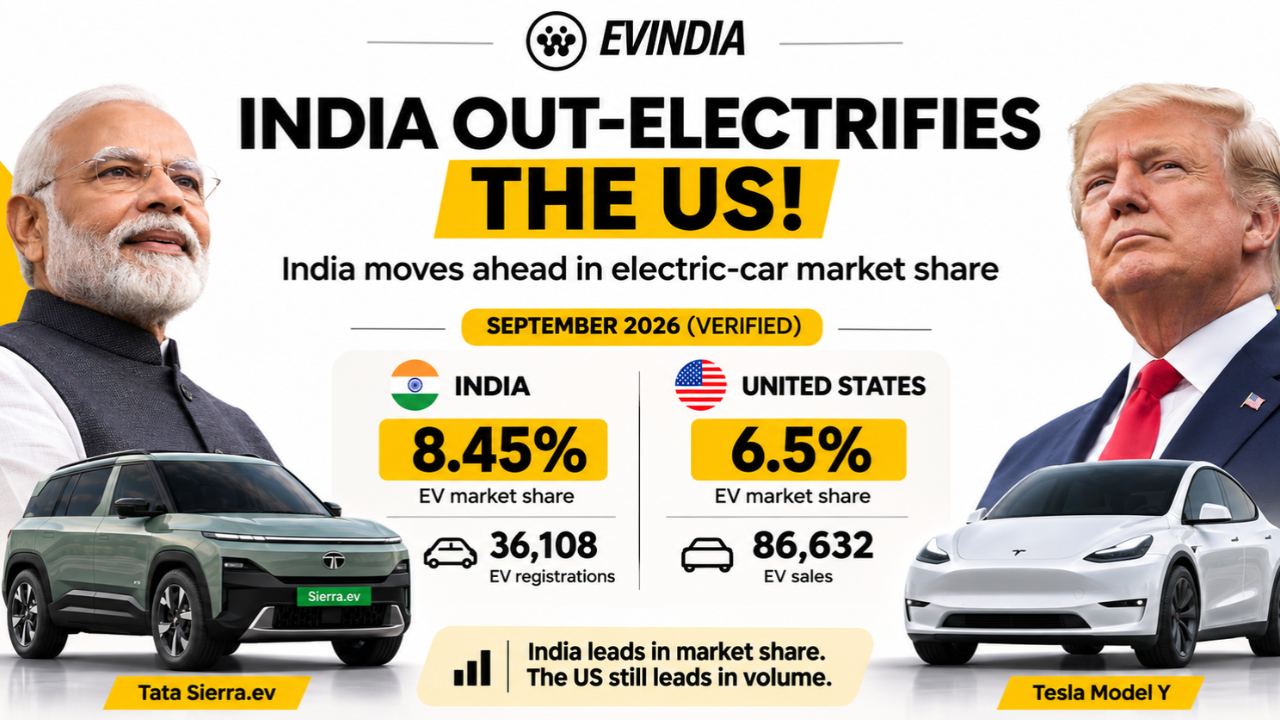
India’s electric mobility sector achieved a landmark milestone as battery electric vehicles (BEVs) accounted for 8.8% of new passenger car registrations in September 2026. This rapid rise allowed India to surpass the United States, where the BEV share for the same period stood at 6.8%. Highlighted by former NITI Aayog CEO and G20 Sherpa Amitabh Kant, the shift underlines India's accelerating transition toward clean transportation.
India vs US EV Adoption: A Historical Shift
Data compiled by electromobility analyst Eugen Siebert reveals a sharp trajectory in India's electric car penetration rate over the past decade. In 2019, BEVs accounted for just 0.03% of new car registrations in India. That figure rose incrementally to 0.42% in 2021, 2.2% in 2023, and 4.3% in 2025, before jumping to 8.8% in September 2026.
Conversely, the US market maintained an early lead, expanding from 1.4% in 2019 to a peak annual share of 7.8% in 2024. However, adoption in the US slowed down, dipping to 7.5% in 2025 and 6.8% in September 2026.
|
Year / Period |
India BEV Share (%) |
US BEV Share (%) |
|
2019 |
0.03% |
1.4% |
|
2021 |
0.42% |
3.1% |
|
2023 |
2.2% |
5.5% |
|
2024 |
2.5% |
7.8% |
|
2025 |
4.3% |
7.5% |
|
September 2026 |
8.8% |
6.8% |
Note: Data for 2019–2025 represents annual market share, whereas September 2026 reflects a monthly snapshot. Indian figures draw from VAHAN, FADA, and government databases; US figures reflect data from Argonne National Laboratory and Wards Intelligence.
Understanding Market Dynamics: Penetration Rate vs. Total Sales Volume
While the monthly penetration percentage places India ahead, market experts emphasize the distinction between adoption rates and total sales volumes. The US automotive market remains significantly larger overall, meaning it still registers a higher absolute volume of electric passenger vehicles each month.
Nonetheless, India's higher percentage of new buyers choosing electric powertrains signals a structural shift in consumer preference. Lower operating costs, expanding product portfolios from domestic manufacturers, and supportive state-level policies have encouraged Indian car buyers to switch from internal combustion engine (ICE) models to electric alternatives.
Charging Infrastructure: The Next Growth Bottleneck
Despite the growth in vehicle registrations, industry leaders warn that sales momentum could plateau without adequate physical infrastructure. Taking to social media platform X, Amitabh Kant emphasized that selling electric cars is only the first phase of the mobility transition.
"The next leap won't come from EV sales alone. India must build a robust charging network: more fast chargers along highways, reliable charging in residential complexes, and accessible public charging stations in Tier 2 and Tier 3 cities." Amitabh Kant
To sustain consumer confidence and address range anxiety, three primary areas require immediate infrastructure expansion:
- Highway Fast-Charging Corridors: High-kW DC fast chargers along major national highways are essential to enable long-distance intercity travel.
- Residential Infrastructure: Dedicated EV charging setups within housing societies and apartment complexes ensure hassle-free overnight charging.
- Tier 2 and Tier 3 Expansion: Public charging hubs in regional cities and suburban clusters are critical as EV adoption spreads beyond metropolitan areas.
Government Policy and the PM E-DRIVE Framework
The Indian government continues to support the EV ecosystem through policy frameworks aimed at infrastructure development. Under the flagship PM E-DRIVE scheme, the government has allocated ₹2,000 crore specifically for public EV charging stations and battery-swapping infrastructure across the country.
Out of this allocation, financial outlays totaling ₹503.86 crore have already been approved to set up 4,874 EV chargers nationwide. These public investments aim to reduce infrastructure gaps, lower total cost of ownership, and encourage broader private-sector investment in charging operations.
Frequently Asked Questions
Q.1What was India's BEV market share in September 2026?
Q.2How does India's EV adoption compare to the United States in 2026?
Q.3Does India sell more electric cars in absolute volume than the US?
Q.4What sources were used to compare India and US electric car data?
Q.5What key challenge did former NITI Aayog CEO Amitabh Kant highlight?
Looking to buy an EV?
Compare, explore and find the perfect electric vehicle for you.
Explore EVs