BYD Unveils 1,500 kW Flash Charging: Adds 400 km Range in 5 Minutes with Robotic Solar Microgrids


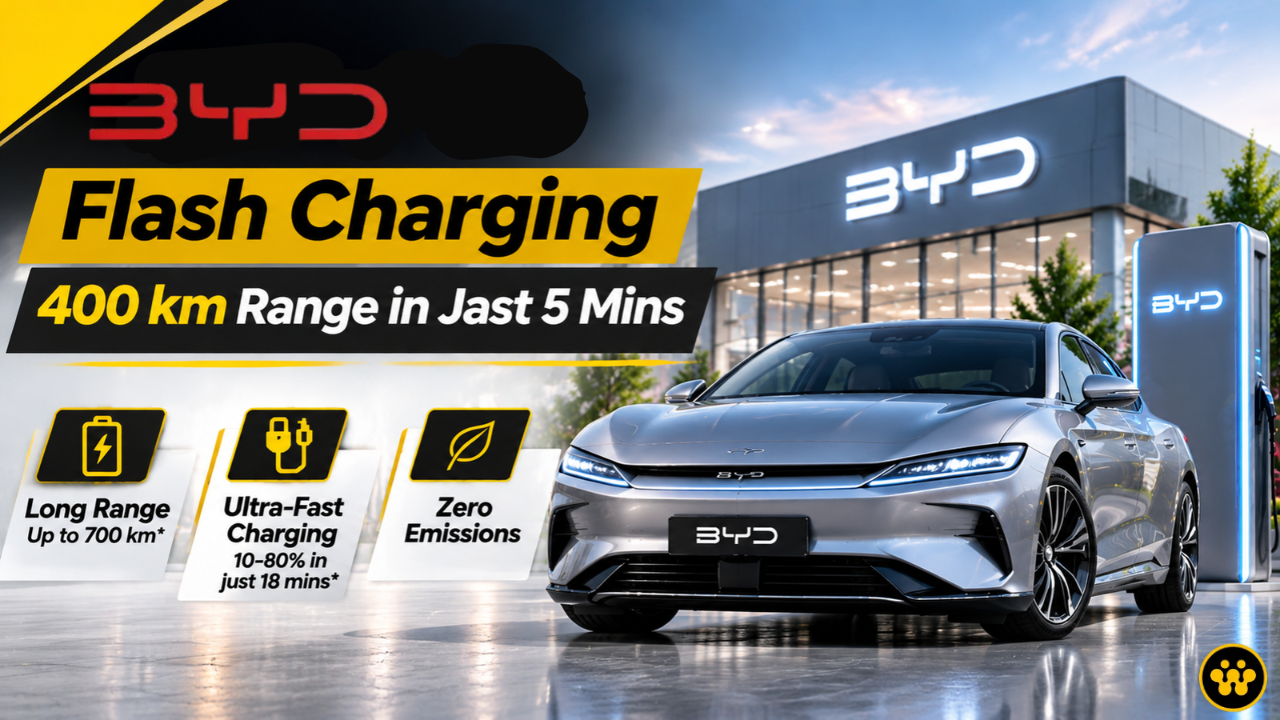
Electric vehicle (EV) giant BYD has officially taken aim at one of the biggest hurdles in electric mobility charging time. With the global rollout of its megawatt-class Flash Charging technology, BYD is delivering charging speeds that finally rival a standard gas-station refuel.
The breakthrough system pushes charging power up to 1,500 kW , allowing compatible EVs to gain 400 kilometers of range in just 5 minutes.
Breakthrough Performance: How BYD Flash Charging Works
Achieving refueling-level charge times requires a complete re-engineering of both vehicle hardware and charging station architecture:
- 1,000V Full-Domain Architecture: BYD's Super e-Platform upgrades the battery, motors, power electronics, and auxiliary systems to operate on a full-domain 1,000V system paired with up to 1,000A charging currents.
- Second-Gen Blade Battery (Blade 2.0): Utilizing proprietary "FlashPass" ion transport chemistry, the pack cuts internal electrical resistance by 50%. This permits a 10C charge rate, enabling a 10% to 70% state-of-charge (SoC) jump in 5 minutes and reaching 97% in just 9 minutes.
- Extreme Safety Standards: Despite extreme power transfer, the Blade Battery 2.0 successfully passes simultaneous flash-charging and nail-penetration tests without experiencing thermal runaway.
- Cold-Weather Resilience: At extreme temperatures down to -30°C (-22°F), the battery can still complete a 20% to 97% charge in just 12 minutes.
Solar Power & Autonomous Robotics in the Abu Dhabi Desert
To demonstrate the full capability of its ecosystem, BYD unveiled a showcase station in the Abu Dhabi desert that operates as a self-contained, smart energy microgrid.
- On-Site Solar & Battery Storage: Integrated solar panels feed high-capacity battery storage banks (370 kWh per station setup). The station buffers power locally to deliver megawatt charges to vehicles without overloading regional power grids.
- Hands-Free Robotic Charging: Working in tandem with Automated Valet Parking, drivers can exit their car while the vehicle parks itself. A vision-guided robotic arm uses force-feedback control to automatically locate the charge port and insert the liquid-cooled charging gun—sparing drivers from handling heavy cables in extreme heat.
Global Network Expansion Plans
BYD is aggressively scaling its ultra-fast charging footprint to support its next-generation EV lineups, including the Denza Z9GT and Seal 07.
|
Milestone / Metric |
Targets & Technical Specifications |
|
Peak Power Output |
Up to 1,500 kW per connector (1,000 kW dual-gun simultaneous) |
|
Charge Velocity |
Adds ~2 km of driving range per second |
|
Global Expansion Target |
6,000 FLASH Charging stations worldwide by 2027 |
|
Highway Coverage |
Dedicated stations placed every 100 km across major transport corridors |
By integrating clean solar generation, local grid-buffering battery storage, and ultra-high-voltage vehicle architectures, BYD's Flash Charger blueprint effectively eliminates range anxiety while accelerating global EV adoption.
Frequently Asked Questions
Q.1What is BYD’s 1,500 kW Flash Charging technology?
Q.2How fast does BYD Flash Charging charge an EV battery?
Q.3What makes Blade Battery 2.0 compatible with ultra-fast charging?
Q.4How do BYD Flash Charging stations prevent electrical grid overload?
Q.5Can non-BYD electric vehicles use BYD Flash Chargers?
Q.6Will existing Indian BYD models like Atto 3 or Seal support 1,500 kW Flash Charging?
Looking to buy an EV?
Compare, explore and find the perfect electric vehicle for you.
Explore EVs