Buying an EV in 2027? Check Your State’s Hidden Road Tax and Subsidy Rules


Quick Summary
- Instant Discounts: The new central PM E-DRIVE scheme gives you an instant ₹5,000 discount on electric two-wheelers right at the dealership.
- Zero Road Tax: Major states like Delhi, Maharashtra, and Odisha still offer 100% road tax waivers, saving buyers lakhs of rupees on electric cars.
- Massive Daily Savings: Electric scooters cost roughly ₹1.48 per kilometre to run, compared to ₹2.46 for petrol scooters.
- The Bottom Line: With a rapidly growing charging network, zero engine maintenance, and a silky-smooth driving experience, 2027 is the best time to upgrade to an electric vehicle.
Are you thinking about bringing an electric vehicle (EV) into your garage this year? You are not alone. With over 2.5 million EVs registered in India during the 2025–26 financial year, electric mobility has officially gone mainstream.
However, buying an EV today is slightly different than it was a few years ago. The government has updated its rules, and the amount of money you save depends entirely on where you live and register your vehicle.
To help you make the smartest financial decision, we have broken down the state-wise EV subsidies in India, compared the real-world costs of EVs vs petrol cars, and highlighted why going electric will put a smile on your face and money back in your pocket.
The Big Shift: Say Hello to PM E-DRIVE
For years, Indian EV buyers relied on a government scheme called FAME II to get huge cash discounts. Today, that scheme has been replaced by a smarter, highly efficient program called PM E-DRIVE.
Backed by a massive ₹11,900 crore budget, this central government initiative runs until March 2028. Here is exactly how it benefits you:
- Electric Two-Wheelers: You get a direct subsidy of ₹2,500 per kWh of battery capacity, capped at a maximum of ₹5,000 per scooter. The scooter must be priced under ₹1.5 lakh to qualify.
- Instant Savings: You do not have to fill out complex forms and wait months for a government refund. The ₹5,000 discount is applied immediately at the dealership using an Aadhaar-linked e-Voucher.
- Electric Cars: Note that private electric passenger cars do not receive this central cash subsidy. Your car savings will come from your state's road tax policies.
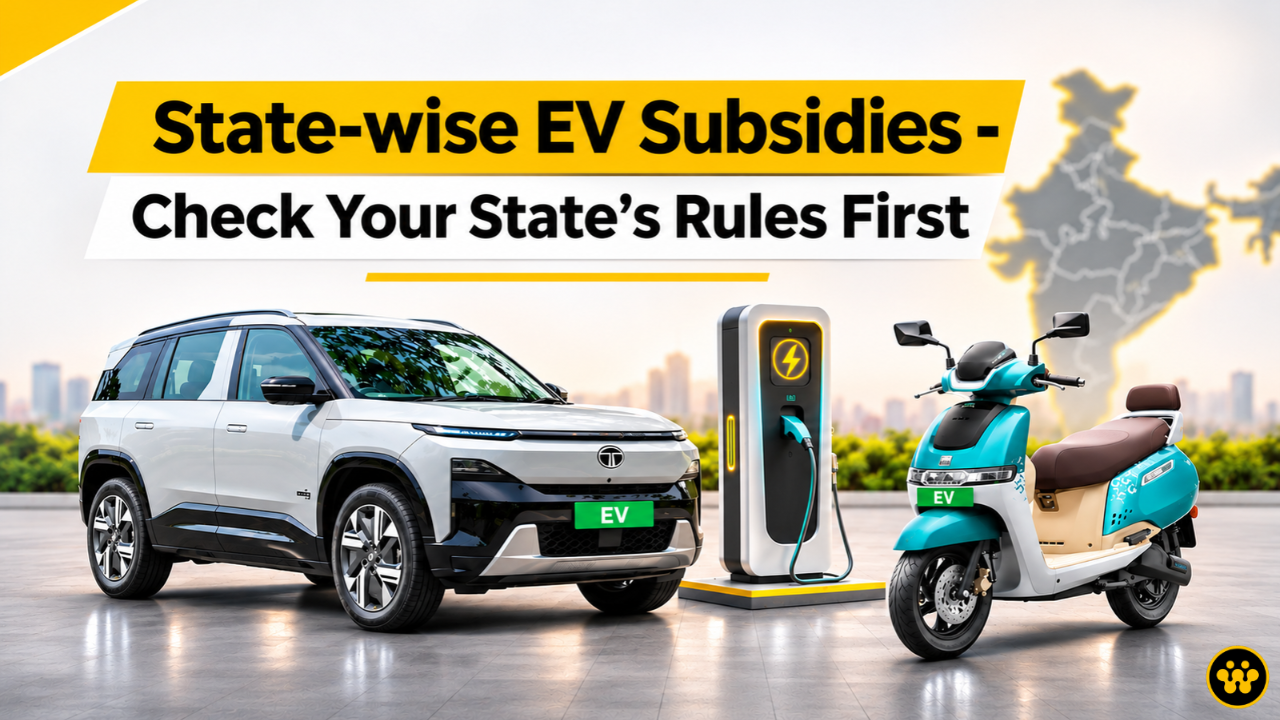
State-wise EV Subsidies and Road Tax in India
While the central government gives you a flat discount, your state government controls the heavy lifting: Road Tax Exemptions and State Purchase Subsidies.
Because electric vehicles are taxed at a flat 5% GST nationwide (compared to a massive 28% GST for petrol vehicles), you are already saving money on the base price. But state road taxes can make or break a deal.
Here is the verified status of top Indian states:
|
Indian State |
Road Tax Status for EVs |
Direct State Subsidy & Important Rules |
|
Delhi |
100% Waived (up to ₹30 Lakh) |
Up to ₹30,000 for two-wheelers + ₹1 Lakh if you scrap an old car. |
|
Maharashtra |
100% Waived |
Up to ₹1.5 Lakh for the first 10,000 electric cars; up to ₹10,000 for two-wheelers. |
|
Gujarat |
6% Standard Tax |
The old 1% tax rule lapsed. Buyers are waiting for the new Green Mobility Policy to launch. |
|
Uttar Pradesh |
100% Waived (Conditional) |
Road tax is only waived if the EV is manufactured, sold, and registered inside UP. |
|
Karnataka |
100% Waived for 2-Wheelers |
Electric cars now pay a 5% to 10% road tax depending on the vehicle's price. |
|
Odisha |
100% Waived |
Up to ₹1.5 Lakh for cars and ₹20,000 for scooters. Valid until December 2026. |
|
Tamil Nadu |
100% Waived |
Full road tax exemption extended until 31 December 2027. |
|
Rajasthan |
100% Waived |
Up to ₹10,000 for two-wheelers plus a refund on the State GST. |
|
Kerala |
Concessional Slabs |
3% tax for EVs under ₹10 Lakh; up to 15% tax for luxury EVs over ₹40 Lakh. |

The Local Manufacturing Twist
A major trend in 2026 is state protectionism. For example, Uttar Pradesh will only give you a 100% road tax waiver if the electric vehicle was assembled locally inside the state. Otherwise, you have to pay the standard 8% to 10% tax. Always double-check with your local RTO or dealership before signing the cheque!
EV vs Petrol: The Real Cost of Ownership
Many buyers look at the showroom price and think, "Electric vehicles are too expensive!" This is the biggest mistake you can make. When you calculate the Total Cost of Ownership (TCO) over five years, EVs dominate petrol vehicles.
Let’s look at the daily reality for a two-wheeler rider who travels 30 kilometres a day.
According to research by the Council on Energy, Environment and Water (CEEW), the national average cost to run an electric scooter is just ₹1.48 per kilometre. A petrol scooter costs ₹2.46 per kilometre to run.
If you drive 50,000 kilometres over five years, here is the simple math:
- Petrol Scooter Fuel & Maintenance: 50,000 km × ₹2.46 = ₹1,23,000.
- Electric Scooter Charging & Maintenance: 50,000 km × ₹1.48 = ₹74,000.
That is a pure saving of ₹49,000 just on running costs! When you add the ₹5,000 PM E-DRIVE discount and your state's road tax waiver, the electric scooter becomes incredibly budget-friendly.
Why Petrol Cars Are Quietly Draining Your Wallet
Sticking with an Internal Combustion Engine (ICE) vehicle might feel familiar, but it comes with heavy hidden burdens:
- Fuel Price Shocks: India imports nearly 89% of its crude oil. When global oil prices jump, you pay the price directly at the petrol pump. EV owners who charge at home are completely protected from this stress.
- Endless Servicing: Petrol engines are incredibly complicated. Over a lifetime, they require 10 to 15 scheduled services for engine oil changes, spark plugs, transmission fluids, and exhaust repairs.
- Pollution Rules: ICE vehicles release tailpipe emissions like nitrogen oxides. Because of this, older petrol and diesel vehicles are facing strict bans and entry restrictions in major metro cities.
The Joy of Driving an EV: Why You Will Love It
Switching to an EV isn't just about saving money—it is a massive upgrade to your daily lifestyle.
- Wake Up to a Full Tank: Imagine never standing in a crowded petrol pump line again. You just plug your vehicle into your home wall socket at night, and every morning, it is 100% ready to go.
- Peace and Quiet: EVs have no engine, meaning there is zero vibration and no engine noise. It makes city traffic far less exhausting.
- Instant Power: Because electric motors deliver torque instantly to the wheels, EVs accelerate smoothly and quickly the second you twist the throttle or press the pedal.
- Magic Brakes: Thanks to "regenerative braking," every time you slow down, the EV uses that energy to recharge the battery. This also means your brake pads last much longer than they do on a petrol car.
What Does the Future Hold?
If you are worried about the future of electric vehicles, the data is highly reassuring.
The charging network is exploding. The government recently confirmed there are over 52,718 public EV charging stations active across India, meaning highway road trips are easier than ever. Furthermore, India is rapidly building its own battery manufacturing plants, which will bring replacement costs down and boost battery recycling.
Will petrol cars disappear tomorrow? No. The transition will be gradual. But as the International Energy Agency (IEA) projects, electric cars could make up 15% of all new car sales in India by 2030. As EVs become the norm, the resale value of old petrol vehicles is expected to drop significantly.
Conclusion: Should You Buy an EV in 2027?
The verdict is undeniably positive. If you commute daily, drive within the city, and have a simple plug point at your home or apartment parking, buying an EV in 2027 is one of the smartest financial choices you can make.
You get a superior, silent, and smooth driving machine that requires almost zero maintenance, while completely escaping the rising costs of petrol.
However, because state rules are constantly shifting, you need to verify the exact on-road price in your specific pin code.
Ready to discover how much you can save with an electric vehicle?
👉 Fill out the quick lead form below to get started, or chat with our WhatsApp EV Guru to explore your options and find the right EV for you.
Looking to buy an EV?
Compare, explore and find the perfect electric vehicle for you.
Explore EVs