Ola Electric Becomes First Indian Firm to Secure BIS Certification for Indigenous 46100 LFP Cell


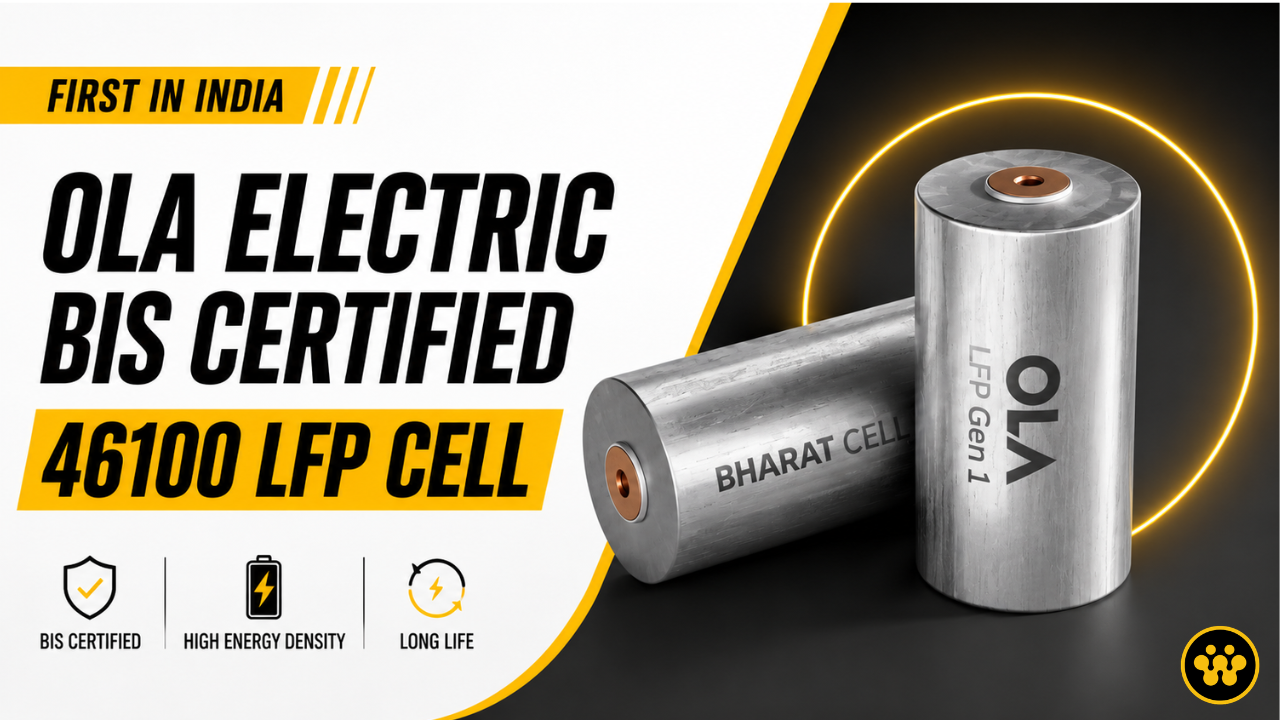
Ola Electric has achieved a major milestone in India’s electric vehicle (EV) evolution, becoming the first domestic company to receive Bureau of Indian Standards (BIS) certification for its indigenously developed 46100 LFP (Lithium Iron Phosphate) cell.
This certification, granted under IS 16046 (Part 2):2018 / IEC 62133-2:2017, validates Ola Electric’s capability to design, qualify, and industrialize advanced battery technologies entirely within India. The development is a significant step toward reducing the country’s reliance on imported battery cells and strengthening local energy independence.
Testing and Safety Standards
To achieve this certification, Ola Electric’s 46100 LFP cell underwent rigorous testing at a National Accreditation Board for Testing and Calibration Laboratories (NABL) accredited facility. The cells were subjected to a wide array of safety and performance assessments, including:
-
Safety Tests: Thermal abuse, external short circuit, and forced discharge.
-
Durability & Environment: Vibration, mechanical shock, impact, and free fall tests.
-
Operational Integrity: Altitude and abnormal charging assessments.
In addition to BIS approval, the cell has qualified under IS 16893 (Parts 2 and 3) and UN 38.3 standards, ensuring high safety and reliability for both mobility and energy storage applications.
Key Technical Specifications
The new 46100 LFP platform is designed to provide high efficiency and long-term durability. Key highlights include:
-
Energy Density: Over 170 Wh/kg.
-
Longevity: A development pathway exceeding 4,000 charge discharge cycles.
-
Versatility: The cell is built for diverse operating temperatures, catering to both EV and stationary energy storage systems.
Strengthening India’s EV Ecosystem
Ola Electric, through its subsidiary Ola Cell Technologies (OCT), is scaling its battery manufacturing strategy at its massive Gigafactory. By utilizing a common "46-series" architecture, the company can deploy both NMC and LFP chemistries, offering a flexible, high performance foundation for future electric vehicles.
"The BIS certification of our indigenously developed 46100 LFP cell is a significant milestone in our mission to build India’s most advanced EV and energy ecosystem," said an Ola Electric spokesperson. "It reflects the strength of our R&D at our Battery Innovation Centre (BIC) and our commitment to world class battery technology."
With thousands of vehicles already running on the company's 4680 Bharat Cells, this new certification further cements Ola Electric’s position as a leader in India’s transition to sustainable energy and mobility.
Frequently Asked Questions
Q.1What is the Ola 46100 LFP cell?
Q.2 Why is BIS certification important for EV batteries?
Q.3What is the benefit of LFP chemistry over other types?
Q.4How does the 46100 cell improve EV performance?
Q.5 Is Ola the first company to get this certification in India?
Q.6 Will this make Ola electric scooters cheaper?
Q.7Can these batteries be used for home energy storage?
Q.8Where are these battery cells being manufactured?
Looking to buy an EV?
Compare, explore and find the perfect electric vehicle for you.
Explore EVs