The EV Warranty Truth: Why Your Battery Might Not Be Covered and How to Protect It?


For many Indian EV owners, the battery is the single most valuable component of their vehicle, often representing 30% to 40% of the total on-road price. With EV manufacturers frequently offering generous warranties—often 8 years or 1,60,000 km—it is easy to treat this coverage as an impenetrable safety net.
However, there is a dangerous misconception spreading among owners: the belief that a warranty covers everything that happens to the battery during the ownership period. The reality is much stricter. If you aren't careful, simple habits like using the wrong charger or ignoring power quality during the monsoon can void your warranty, leaving you with a replacement bill that could range from ₹5.5 lakh to ₹9 lakh.
This guide explores the fine print of Indian EV warranties and the practical steps you must take to protect your investment.
Decoding Your EV Battery Warranty in India
Before we discuss how to protect your car, you must understand what you are actually protected against. Warranty documentation is filled with jargon, but three terms are critical for every owner to understand:
1. The High-Voltage (HV) Battery Warranty
This is the long-term coverage on your battery pack and traction motor. In India, the industry standard is 8 years or 1,60,000 km from the date of first registration. It is important to note that while the year limit is consistent, the kilometre cap varies by brand and model; check your specific manual to ensure you don’t exceed your limit.
2. The SoH (State of Health) Floor
This is the "rescue lever" in your warranty. Manufacturers typically guarantee that your battery will not fall below a certain State of Health (SoH)—usually 70%—within the warranty term. If your pack drops below this capacity floor under normal usage conditions, the manufacturer is obligated to repair, recondition, or replace it.
3. Normal Degradation vs. Covered Failure
It is crucial to distinguish between expected wear and a defect. Slow, gradual range loss over years is normal and is not a warranty event. A covered failure is defined as a sudden defect, cell failure, or a drop below the SoH capacity floor.
What Automakers Explicitly Exclude?

As shown in above image , major manufacturers including Tata Motors, Mahindra, MG, Hyundai, and Kia explicitly exclude coverage for damages caused by "external events."
If you think a service center won't be able to distinguish between a faulty battery and a user-induced issue, you are mistaken. Modern EVs feature an advanced Battery Management System (BMS) that functions as a "black box".
This system logs
-
Every over-voltage or under-voltage event with exact timestamps.
-
Charging behavior, including use of unapproved chargers.
Service centers utilize these logs to determine if a grid surge or external disturbance caused the cell failure. If the logs prove that the damage resulted from external factors—such as power surges, lightning strikes, or improper charging infrastructure—your warranty claim will almost certainly be rejected.
Common traps that lead to rejected claims include :
-
Using non-approved fast chargers : Cheap portable or third-party units that push unsupported charge profiles are the leading cause of denied claims in India.
-
Unauthorized modifications : Wiring aftermarket accessories (like amplifiers) into the High-Voltage (HV) bus is a major violation that can void your cover.
-
Neglect : Skipping scheduled services at authorized workshops creates gaps in your service history, weakening your claim.
Monsoon Risks and Voltage Fluctuations
With the monsoon season approaching, EV owners face an increased risk of voltage fluctuations and power surges. Water ingress and unstable power grids can wreak havoc on sensitive electronics, including your On-Board Charger (OBC) and battery management circuits.
Because the manufacturer classifies these as "external electrical disturbances," the financial burden of these repairs falls entirely on the owner.
The Financial Reality of Battery Replacement
If you find yourself out of warranty, the financial impact is significant. As of 2026, the cost of EV battery replacement in India is heavily dependent on the battery's kWh capacity.
-
City EVs (25–30 kWh) : Approximately ₹3 lakh to ₹7 lakh.
-
Long-Range EVs (50–60 kWh) : Approximately ₹8 lakh to ₹15 lakh.
Given these numbers, protecting your warranty isn't just about "following the rules"—it is about safeguarding your financial future.
Two Practical Solutions to Protect Your Battery
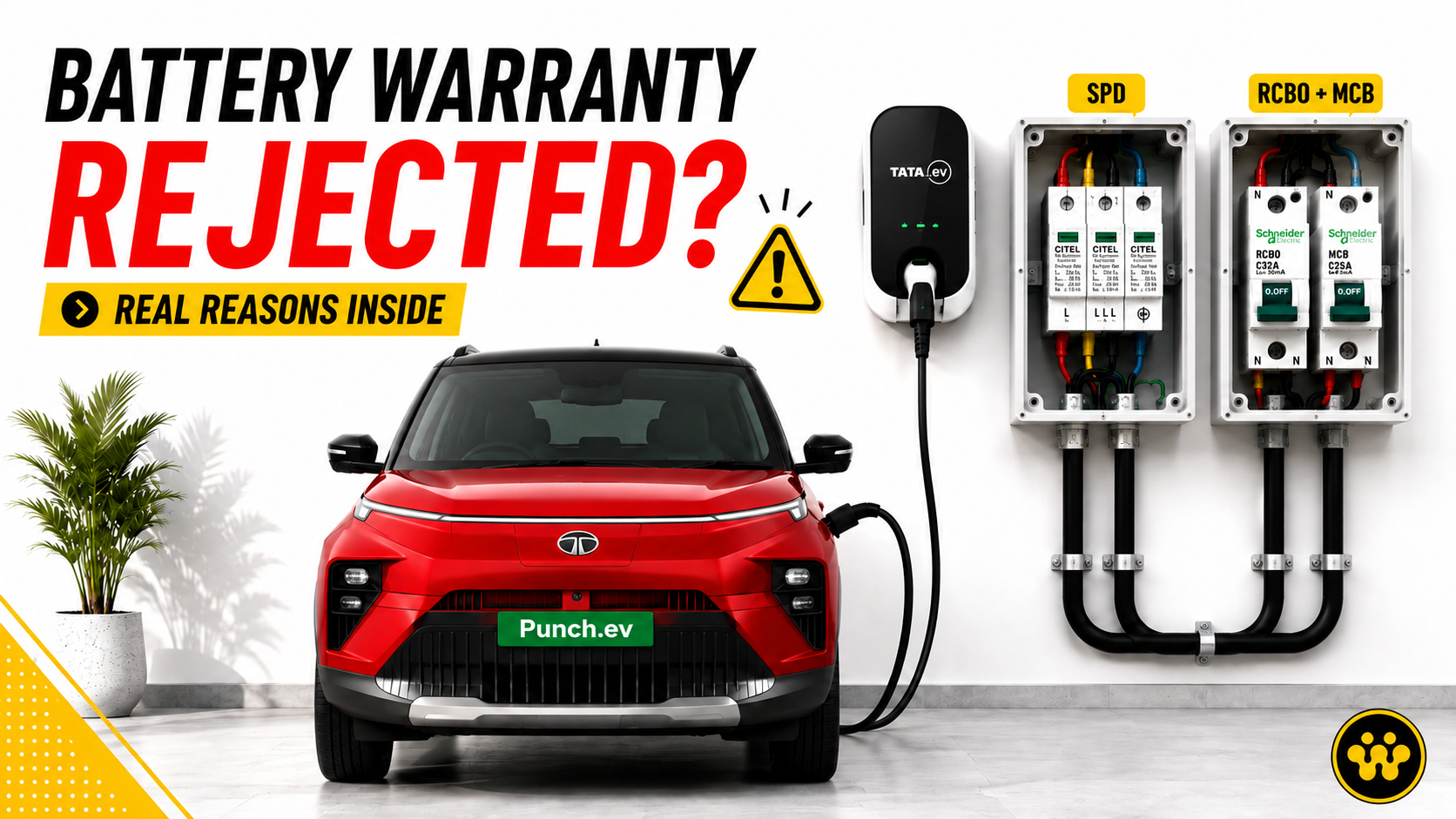
Fortunately, you do not have to leave your vehicle’s safety to chance. As outlined in below there are two highly effective, affordable ways to safeguard your home charging setup and preserve your warranty.
1. Install a Type 2 Surge Protection Device (SPD)
A Type 2 SPD is designed to protect your charger and vehicle from voltage spikes caused by lightning, grid switching, and utility disturbances. By diverting excess energy away from your equipment, it prevents surges from reaching your car's BMS.
-
Approximate Cost : ₹10,000–13,000 (including installation).
2. Use an RCBO with a Dedicated MCB
A Residual Current Breaker with Overcurrent (RCBO) is an essential safety component that prevents electric shocks and leakage faults. Pairing this with a dedicated Miniature Circuit Breaker (MCB) protects your charging setup from overloads and short circuits.
-
Approximate Cost : ₹3,000–6,500 (including installation).
Note : Costs may vary based on your brand preference, location, and specific installation requirements.

Warranty vs. Insurance – Do You Have Enough Coverage?
A common but dangerous mistake is confusing warranty with insurance.
-
Warranty covers manufacturing defects and capacity degradation.
-
Insurance covers accidents, theft, fire, and flood.
Standard comprehensive insurance often excludes specific charging-related electrical issues or water ingress damage unless you have the right add-ons. When renewing your policy, ensure you include:
-
Zero Depreciation : Essential for EVs due to the high cost of replacement parts.
-
Battery Protection Cover : This add-on is vital; it specifically extends cover to scenarios like water ingress and charging-related electrical issues where your warranty does not help.
-
Charger and Roadside Assistance Cover : Protects your home charging equipment and provides support if you are stranded.
Final Thoughts for EV Owners
The Indian EV market offers some of the strongest battery warranties in the world, but they are not unconditional. By adhering to the manufacturer's guidelines, using only approved charging infrastructure, and investing in basic home protection hardware like an SPD and RCBO, you can significantly reduce your risk.
Do not wait for a "surge" to test your warranty. A small, one-time investment today is a fraction of the cost of replacing an out-of-warranty battery pack tomorrow. Keep your service history clean, your charging setup safe, and your warranty active.
👉 Found this guide helpful? Stay tuned to EVINDIA for more deep dives into the Indian electric vehicle market, expert analysis, and tips to keep your EV running at peak performance.
Frequently Asked Questions
Q.1Does my EV battery warranty cover damage from voltage fluctuations?
Q.2How much does an EV battery replacement cost in India?
Q.3What common habits void an EV battery warranty?
Q.4How can I protect my EV battery from voltage spikes at home?
Q.5Does monsoon weather affect my EV battery warranty?
Q.6Is it safe to use public DC fast chargers frequently?
Q.7Is a Surge Protection Device (SPD) really necessary for EV home charging?
Q.8What is the standard EV battery warranty period in India?
Q.9Does my standard car insurance cover EV battery damage?
Q.10Can installing aftermarket audio accessories void my EV battery warranty?
Looking to buy an EV?
Compare, explore and find the perfect electric vehicle for you.
Explore EVs