Drive for Free : The Ultimate Guide to Solar EV Charging at Home in India (2025)


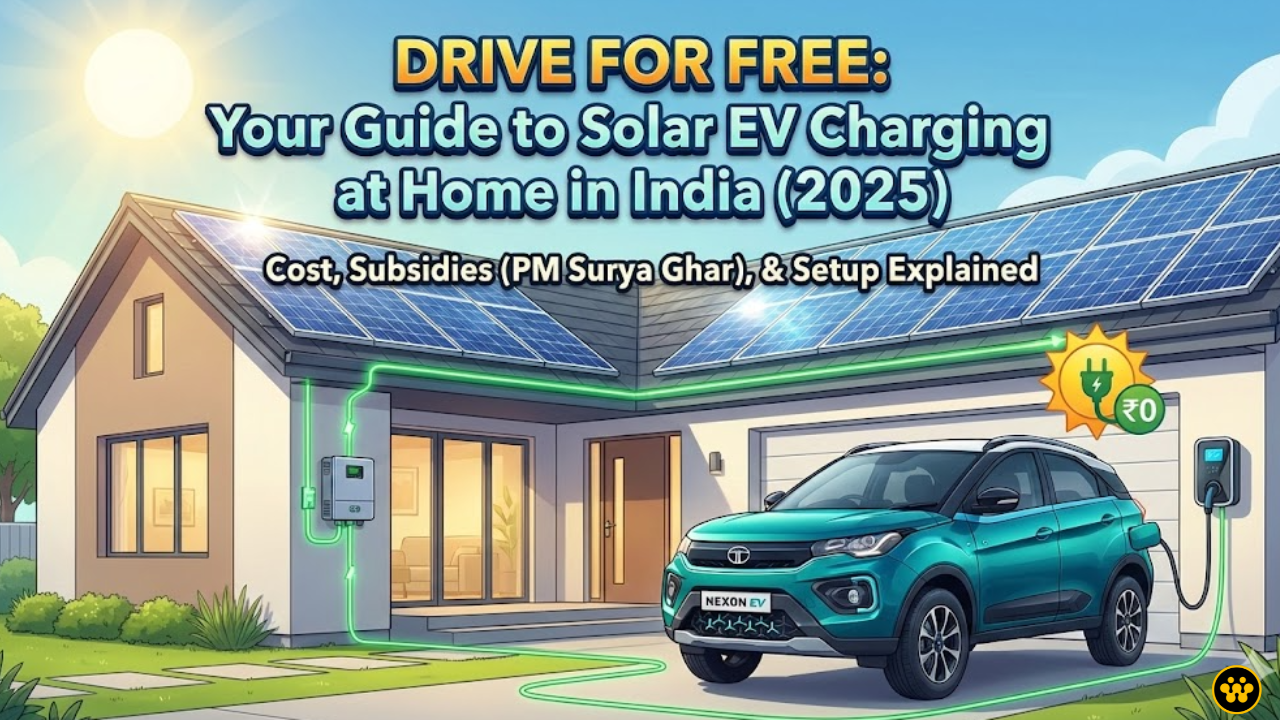
You bought an Electric Vehicle (EV) to escape rising petrol prices. But if you are watching your home electricity bill climb month after month, you might be asking yourself : "Is there a way to drive for free?"
The answer is Yes.
By combining your EV with a rooftop solar system, you stop paying the DISCOM (electricity board) to fuel your car. In sunny states like Gujarat, Maharashtra, and Rajasthan, your roof is effectively your own private oil well.
Analyzed by the industry experts, the latest data, costs, and government schemes to bring you this comprehensive guide on setting up solar charging for your EV at home. Here is everything you need to know about costs, the PM Surya Ghar Yojana, and the "Solar Math" behind it.
Why Solar + EV is the Perfect Marriage
Before we dive into the technicals, let’s look at the economics.
-
Petrol Car Cost : ₹7 – ₹10 per km.
-
EV (Grid Charging) Cost : ₹1 – ₹1.5 per km.
-
EV (Solar Charging) Cost : ₹0.50 – ₹0 per km.
When you install a solar EV charging station at home, you are essentially pre-paying for 25 years of fuel. Once the system pays for itself (usually in 3-4 years), every kilometer you drive is virtually free.
The "Solar Math": How Many Panels Do You Need?
This is the most common question - "Will a 1 kW system run my Tata Nexon EV?"
To answer this, we need to look at Generation vs. Consumption.
-
Solar Generation : In India, 1 kW of solar generates approx. 4–5 units (kWh) per day.
-
EV Consumption : A typical Indian EV consumes about 1 unit (kWh) for every 8–9 km.
Here is a cheat sheet to help you decide the right system size for your car :
|
Car Model |
Battery Size |
Daily Driving |
Electricity Needed |
Recommended Solar Capacity (EV Only) |
|
17 - 24 kWh |
30 km |
~4 Units |
1 kW | |
|
30 - 40 kWh |
50 km |
~7 Units |
2 kW | |
|
50 - 60 kWh |
60 km |
~9 Units |
2.5 kW |
Expert Recommendation : Don't install solar just for the car. Install a system that covers your home's AC, lights, and fans + the car. A 3 kW to 5 kW system is the "sweet spot" for most Indian households to achieve a ₹0 electricity bill.
How Does It Work at Night? (Net Metering Explained)
Most EV owners charge their cars at night when the sun is down. So, how does solar help?
The secret lies in Net Metering.
-
Daytime : Your solar panels generate electricity. Since your car isn't home, this power is exported to the grid. The electricity board (DISCOM) "banks" these units for you.
-
Nighttime : You plug in your EV. You draw power from the grid, but the billing meter subtracts the units you "banked" during the day.
This On-Grid System is the most cost-effective setup.
-
Pros : Lowest upfront cost; eligible for government subsidy.
-
Cons : If the grid fails, charging stops (safety requirement).
Note : If you live in an area with frequent power cuts, you might consider a Hybrid Solar System with battery backup, though this increases the cost significantly.
Cost Breakdown: Setting Up Solar Charging in 2025
Let's look at the real-world cost for a standard 3 kW On-Grid System in a city like Ahmedabad, paired with a fast EV charger.
|
Component |
Estimated Cost |
Notes |
|
3 kW Solar System |
₹1,50,000 – ₹1,80,000 |
Price after subsidy adjustments. |
|
7.2 kW Fast Charger |
₹35,000 – ₹65,000 |
Optional. You can use the portable charger provided with the car. |
|
Installation & Liasoning |
₹15,000 – ₹20,000 |
Includes Net Meter application fees & cabling. |
|
Total Investment |
₹2,00,000 – ₹2,65,000 |
The ROI (Return on Investment)
If you drive 40 km/day, you save roughly ₹60,000 per year in fuel/electricity costs.
-
Payback Period : ~3.5 Years.
-
After 3.5 Years : You enjoy 20+ years of free driving.
Government Support : PM Surya Ghar Muft Bijli Yojana
The Government of India is actively funding your transition. Under the PM Surya Ghar scheme, the subsidies are substantial :
-
1 kW System : ₹30,000 subsidy
-
2 kW System : ₹60,000 subsidy
-
3 kW System (and above) : ₹78,000 fixed subsidy
Pro Tip : To avail this, you must apply through the National Portal for Rooftop Solar and use a vendor registered with your local DISCOM (like GUVNL in Gujarat).
"Insider Tips" Before You Install
-
Watch the "Sanctioned Load" :
If you install a 7.2 kW fast charger, your home’s existing sanctioned load (usually 3-4 kW) might trip. You may need to apply to your electricity board to increase your load, which carries a small deposit fee. -
The "Shadow" Trap :
Solar panels are sensitive. Even a small shadow from a neighbor’s water tank can drop generation by 30%. Ensure your installer conducts a proper shadow analysis or uses "Half-Cut Mono PERC" panels which handle shade better. -
Future-Proofing with V2L :
Cars like the MG Windsor, Ioniq 5, and BYD Atto 3 support Vehicle-to-Load (V2L). This means in the future, your car could actually power your house during a blackout! Designing your system with this in mind adds long-term value.
Conclusion: Is Solar EV Charging Worth It?
If you have the roof space, the answer is a resounding yes. It protects you from inflation, stabilizes your monthly expenses, and maximizes the green potential of your EV.
Frequently Asked Questions (FAQs)
Q : Can I charge my EV directly from solar panels without the grid?
A : Technically yes, but it requires a very expensive "Off-Grid" inverter and battery setup. It is much cheaper and more reliable to use an On-Grid system with Net Metering.
Q : How much roof space do I need for a 3 kW solar system?
A : You generally need about 300 sq. ft. of shadow-free area for a 3 kW system.
Q : Does fast charging work on solar power?
A : Yes. Solar generates the "credits," and your fast charger (7.2 kW) draws power from the grid to charge the car quickly. As long as your total monthly generation matches your consumption, the cost remains zero.
Looking to buy an EV?
Compare, explore and find the perfect electric vehicle for you.
Explore EVs