Shell Unveils 'Triple 10' EV Concept: Is Immersion Cooling the Future of Fast Charging?


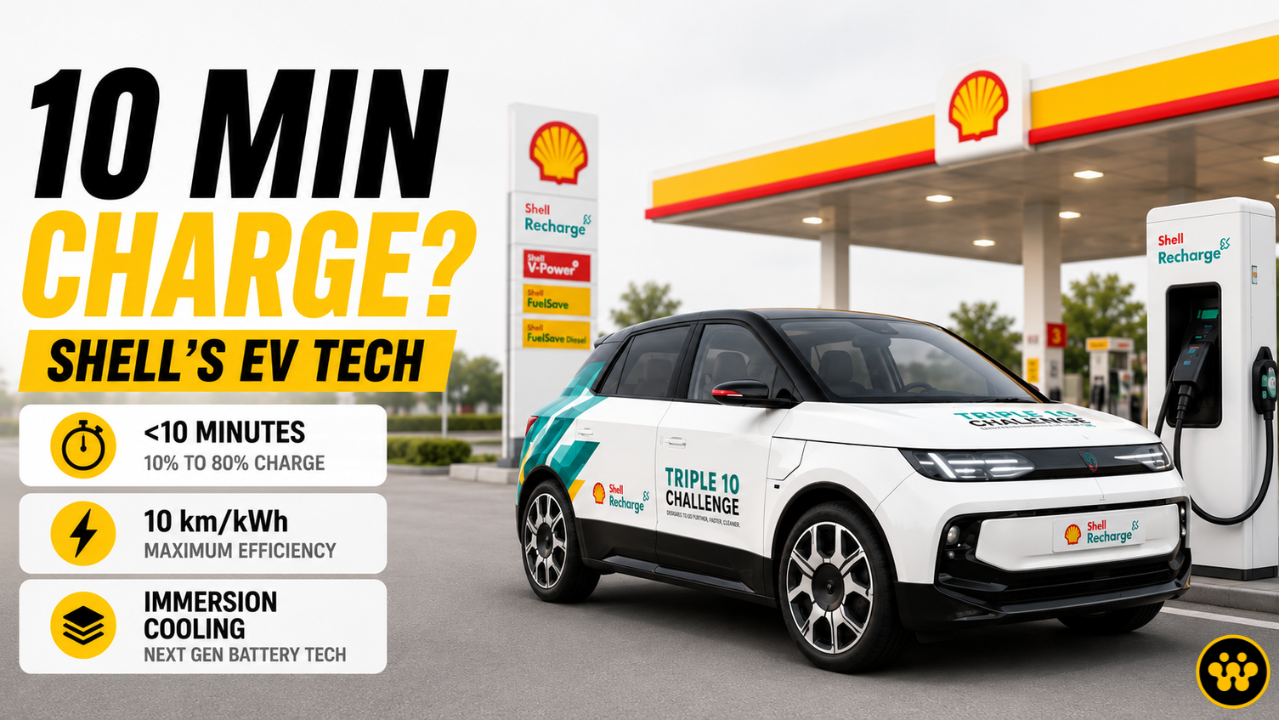
Global energy giant Shell has officially unveiled its new proof-of-concept electric vehicle, the Shell Triple 10 EV Concept. Rather than signaling a pivot to become a mass-market automaker, Shell engineered this vehicle to demonstrate a massive leap in EV battery thermal management.
At the heart of the concept is a shift away from traditional water-glycol cooling systems toward direct immersion cooling using the newly consolidated Shell Recharge thermal fluid. The result? A lighter, cheaper, and radically more efficient electric vehicle.
What is the Shell "Triple 10" Challenge?
The "Triple 10" nomenclature highlights three specific performance benchmarks Shell set out to achieve. The goal was to prove that range anxiety and charging bottlenecks can be solved through hyper-efficiency rather than simply installing heavier, larger battery packs.
|
Performance Metric |
The Target |
Real-World Impact |
|
Efficiency |
10 km per kWh |
~30% more energy-efficient than average current-generation EVs. |
|
Fast Charging |
< 10 Minutes |
10% to 80% charge in exactly 9.54 minutes using a standard 175 kW DC charger. |
|
Sustainability |
10-Tonne CO2e |
50% reduction in total lifecycle emissions compared to typical European EVs. |
Crucially, the rapid charging speed adds approximately 24 km of range per minute, nearly double the current industry average of 13 km/min.
The Secret Sauce: Direct Immersion Cooling
The true innovation behind the Triple 10 concept is its battery architecture. Current EVs rely on indirect cooling, utilizing heavy and complex pipe networks filled with water-glycol mixtures winding through the battery pack.
Shell's concept eliminates this plumbing entirely. Instead, the battery cells and powertrain components are completely bathed in a dielectric (non-conductive) liquid.
By switching to this single-circuit direct immersion architecture, automakers can unlock significant advantages:
-
Reduced Mass : Stripping out the cooling pipes shrinks the physical footprint of the battery pack.
-
Lower Manufacturing Costs : Shell estimates a 25% reduction in battery pack costs compared to conventional EV layouts.
-
Sustained Peak Charging : The fluid manages heat so effectively that the battery can maintain maximum charging intake without thermal throttling.
Co-Engineered with British Automotive Specialists
To validate the Shell Recharge thermal fluid in a real-world application, Shell partnered with leading British engineering firms
|
Engineering Partner |
Role in the Triple 10 Concept |
|
RML Group |
Designed the pipe-less, fluid-filled battery pack architecture. |
|
Empel Systems |
Engineered the high-efficiency electric motors and drive units. |
|
HORIBA MIRA |
Handled vehicle integration, thermal testing, and extreme weather simulation. |
Industry Impact: The Shell Recharge Era
Alongside the vehicle launch, Shell announced the retirement of the "Shell EV-Plus" brand. Moving forward, all of the company's B2B and B2C electric mobility products—from charging networks to advanced thermal fluids—will be consolidated under the Shell Recharge banner.
The Triple 10 concept serves as a rolling laboratory, proving to major automakers that immersion cooling is not just viable, but potentially necessary for the next generation of ultra-efficient, fast-charging electric vehicles.
Looking to buy an EV?
Compare, explore and find the perfect electric vehicle for you.
Explore EVs