Record Highs, Tech Lows: India’s Auto Boom Masks a Critical EV Crisis


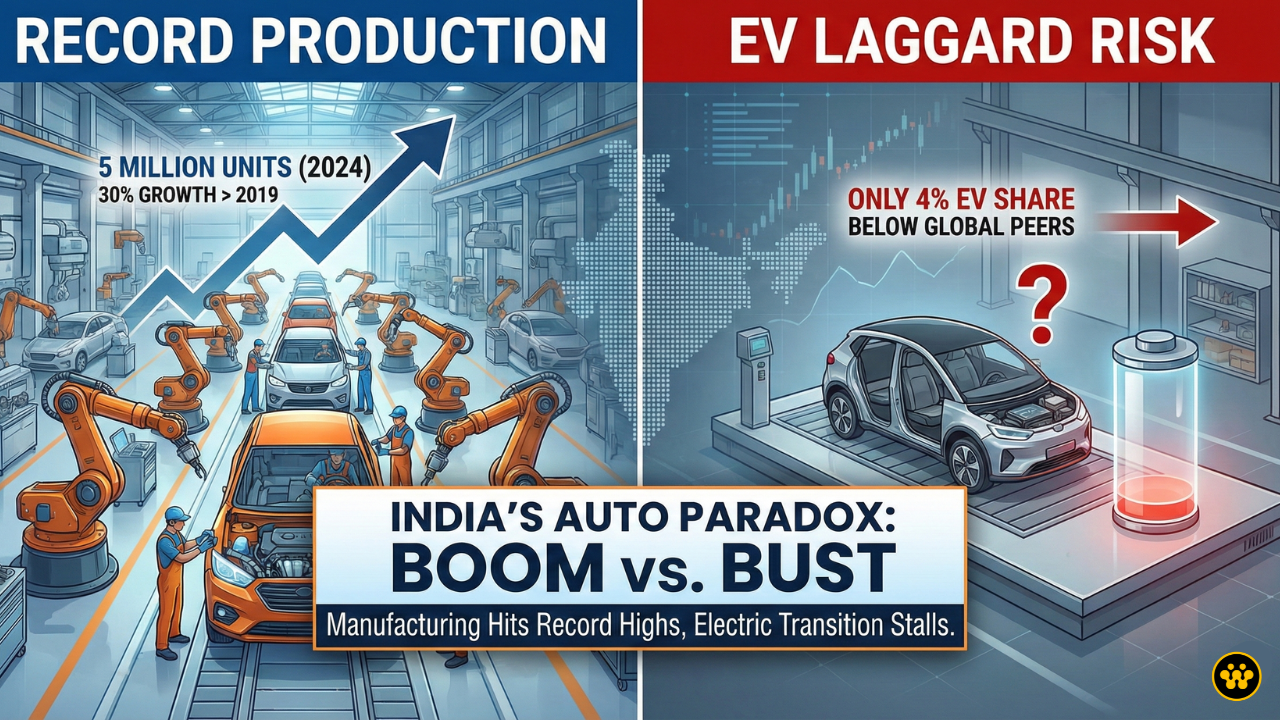
India has officially cemented its status as one of the world's fastest-growing automotive hubs, with passenger car output surging to record levels in 2024. However, a new report suggests this manufacturing boom hides a deeper structural vulnerability: India is falling dangerously behind in the global race for Electric Vehicle (EV) adoption.
According to the latest data analyzed by the International Energy Agency (IEA) and reported by Businessworld, while India’s factory lines are busier than ever, the country risks becoming a global "EV laggard."
The Numbers: A Manufacturing Powerhouse
The Indian automotive sector has showcased phenomenal resilience and growth post-pandemic.
-
Record Output : Passenger car production in India hit 5 million units in 2024.
-
Global Outlier : This represents a 30% increase over 2019 levels. In stark contrast, traditional auto giants like Europe and Japan have yet to recover to their pre-pandemic production figures.
However, this growth is almost exclusively driven by Internal Combustion Engine (ICE) vehicles. Japanese Original Equipment Manufacturers (OEMs) continue to dominate the market, anchoring the industry in petrol and hybrid technologies rather than pure electric solutions.
The EV Gap: Why India is Falling Behind
Despite the production spikes, the transition to green mobility has been sluggish. The report highlights that EVs made up only 4% of total car sales in India in 2024.
This figure places India below the average for the Emerging Markets and Developing Economies (EMDE) group. While the world pivots to battery-powered mobility, India’s domestic market is still fueling the "old guard" of automotive technology.
Global Comparison: The "Policy Stack" Deficit
Why are major economies like China, the EU, and the US succeeding where India is stalling? The report attributes their success to decades of "layered policy stacks"—a combination of industrial strategy, strict emissions regulations, and aggressive supply-side subsidies.
-
China : Treated EVs as a core industrial strategy since the early 2000s. By 2024, 48% of new car sales in China were electric.
-
European Union : Used strict CO2 regulations to force compliance, achieving a 22% EV market share.
-
United States : Leveraged the Inflation Reduction Act (IRA) to boost domestic battery manufacturing, hitting a 10% market share.
The Risk: A "Low-Value" Future?
The disparity in adoption rates presents a grim economic forecast for India’s auto future. Experts warn that without immediate, coordinated intervention in battery manufacturing, mineral security, and charging infrastructure, India’s automotive identity faces a downgrade.
The country risks cementing itself as a high-volume producer of legacy ICE vehicles while being forced to become a low-value importer of EV technology and batteries.
The Road Ahead
To shift gears, industry analysts suggest India must look beyond simple climate policies and view EVs as a critical industrial necessity. For the Indian auto sector to remain globally competitive, the focus must shift from merely "building more cars" to building the "cars of the future."
Key Takeaways for Investors & Industry Watchers :
-
Production : India is up 30% vs 2019, while EU/Japan lag.
-
Adoption : EV market share is stuck at 4%, lagging behind global peers.
-
Dominance : The market is currently controlled by Japanese ICE/Hybrid manufacturers.
-
Policy Needs : Urgent need for localized battery supply chains and mineral strategies.
Looking to buy an EV?
Compare, explore and find the perfect electric vehicle for you.
Explore EVs