Delhi Cabinet Approves EV Policy 2.0: ₹15,000 Crore Budget, Up to ₹50,000 Subsidy, and ₹1 Lakh Scrapping Incentive


Quick Summary
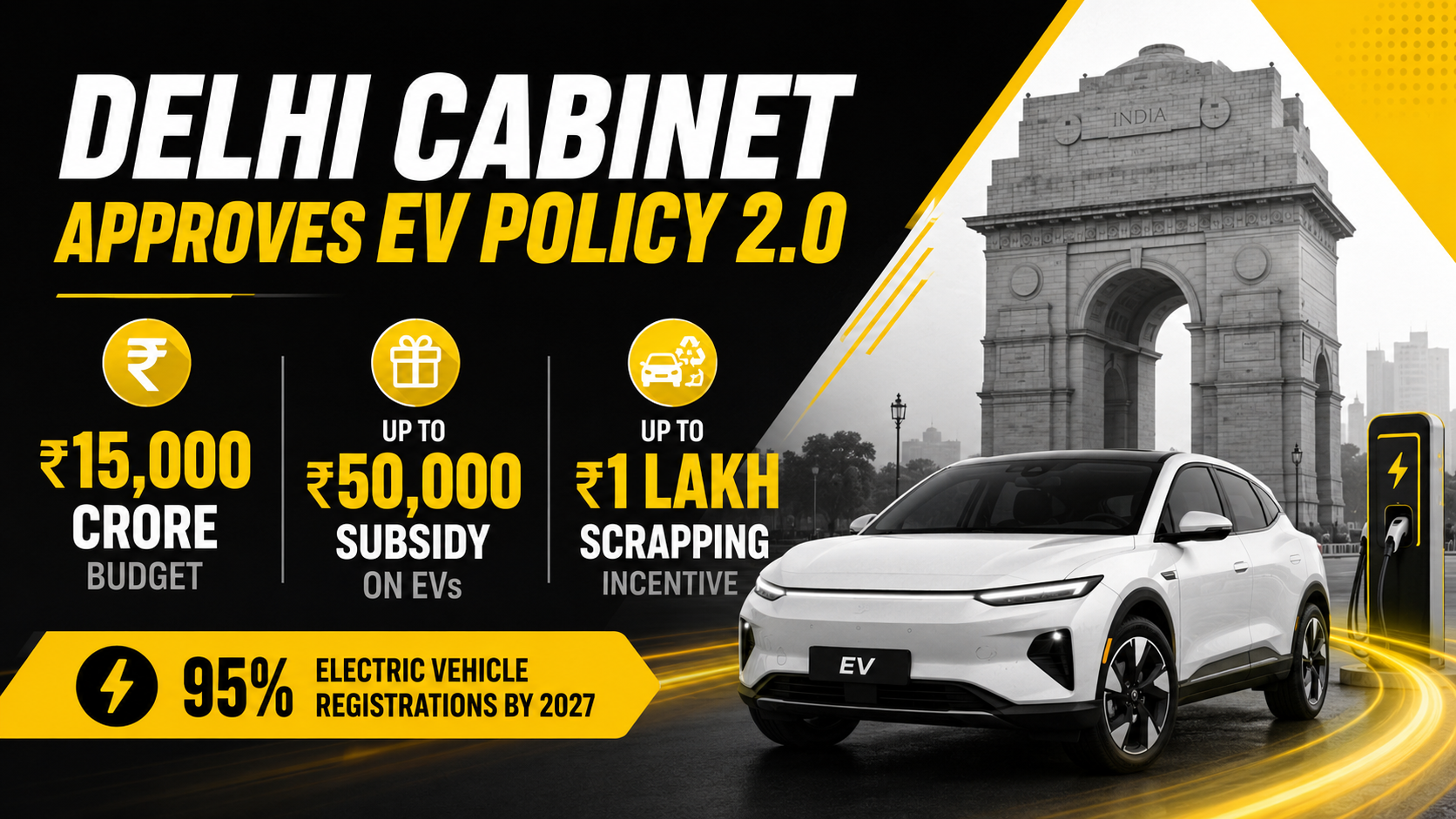
- Massive Budget: ₹15,000 crore allocated over four years (₹7,000 crore for promotional initiatives; ₹8,000 crore for charging infrastructure and direct subsidies).
- Aggressive Target: 95% of all new vehicle registrations in Delhi must be electric by 2027.
- Firm Registration Deadlines: Only electric auto-rickshaws will be registered starting January 1, 2027. Registration of new petrol and CNG two-wheelers will end on April 1, 2028.
- Tiered Subsidies: Direct purchase incentives up to ₹30,000 for two-wheelers and ₹50,000 for passenger three-wheelers during the first year, stepping down annually.
- Scrapping Incentives: Up to ₹1 lakh incentive for scrapping older BS-IV or lower four-wheelers before September 30, 2026.
- Pure EV Focus: 100% registration tax waiver on all pure electric vehicles; zero subsidies or benefits for hybrid vehicles.
Delhi Cabinet Clears EV Policy 2.0: A ₹15,000 Crore Roadmap
The Delhi Cabinet has officially approved the capital's new Electric Vehicle (EV) Policy, designated as Delhi EV Policy 2.0. Announced by Chief Minister Rekha Gupta, the landmark policy is scheduled to take effect on July 1, 2026, and will remain active until March 31, 2030.
To drive the transition, the government has projected a massive budget of ₹15,000 crore over the next four years. Out of this total, ₹7,000 crore will be utilized to promote the policy and transition legacy fleets, while ₹8,000 crore is dedicated directly to expanding charging infrastructure and providing buyer subsidies. The goal is to aggressively reduce vehicular emissions; current reports indicate that commercial fleets contribute to 33% of Delhi’s vehicular pollution, while two-wheelers and three-wheelers account for 46%.
Buying Subsidies: Lowering the EV Price in India
To lower the initial acquisition cost and bring down the overall EV price in India for Delhi buyers, the government is offering direct purchase incentives. The subsidies for electric two-wheelers and electric three-wheelers will follow a step-down structure, encouraging early adoption during the first year.
Additionally, buyers of M1 category light commercial trucks (goods vehicles up to 3.5 tons) will receive a flat ₹1 lakh purchase incentive in the first year to accelerate the greening of electric commercial vehicles.
Purchase Subsidy Structure by Year
| Vehicle Category | Year 1 Subsidy | Year 2 Subsidy | Year 3 Subsidy |
|---|---|---|---|
| Electric Two-Wheelers | ₹30,000 | ₹20,000 | ₹10,000 |
| Electric Three-Wheelers (Passenger) | ₹50,000 | ₹40,000 | ₹30,000 |
| M1 Category (Light Trucks < 3,500 kg) | ₹1,00,000 | - | - |
Scrapping Incentives: Offsetting the Cost of Transition
To phase out older, high emission internal combustion engine (ICE) vehicles, the Delhi EV Policy 2.0 introduces robust scrapping incentives. Owners who scrap their older vehicles built on BS-IV or lower emission standards can claim financial offsets when purchasing new electric models.
For passenger cars, the government has set aside a ₹1 lakh scrapping incentive, capped at the first 1 lakh vehicles scrapped before September 30, 2026.
Scrapping Incentives for Older Vehicles
| Old Vehicle Type | Emission Norms | Scrapping Incentive | Terms / Limit |
|---|---|---|---|
| Four-Wheelers (Cars) | BS-IV or lower | ₹1,00,000 | Limited to the first 1,00,000 cars scrapped before Sept 30, 2026 |
| Two-Wheelers | BS-IV or lower | Up to ₹10,000 | Standard terms apply |
| Three-Wheelers | BS-IV or lower | ₹25,000 | Standard terms apply |
| M1 Category (Light Trucks) | BS-IV or lower | ₹50,000 | Standard terms apply |
| Gramin Seva Vehicles | Life cycle completing in 2 years | ₹15,000 | Standard terms apply |
Registration Deadlines: Phasing Out New Petrol and CNG Models
Unlike voluntary incentive schemes, Delhi EV Policy 2.0 establishes strict, legally binding cut-off dates for registering new fossil-fuel vehicles in the city. The objective is to achieve 95% electric registrations by 2027.
- From January 1, 2027: Only electric auto-rickshaws will be registered in Delhi. New registration of petrol and CNG autos will be completely banned.
- From April 1, 2028: Only electric two-wheelers (scooters and motorcycles) will be registered. Registration for new petrol-powered two-wheelers will cease entirely.
The policy also provides a complete 100% registration tax waiver on all pure electric vehicles to incentivize immediate buying decisions.
Zero Subsidies for Hybrid Vehicles
While the initial draft of the policy proposed a 50% road tax waiver for hybrid vehicles priced up to ₹30 lakh, the finalized Delhi EV Policy 2.0 does not include any tax waivers, subsidies, or incentives for hybrid models. The Delhi administration clarified that public funds will be spent exclusively on zero-emission battery electric vehicles (BEVs). This decision obliges manufacturers to direct their investments toward pure battery range and localized charging solutions rather than transitional hybrid platforms.
Infrastructure: Eliminating Range and Charging Anxiety
To support the massive influx of electric two-wheelers and commercial fleets, the government plans to install 32,000 public charging points across the capital. Land has already been identified and allocated for this rollout.
By densifying the charging grid, the government aims to drastically reduce average charging time and eliminate range anxiety, ensuring that EV owners are never far from a high-speed charger.
Market Comparison: Delhi vs. Other State EV Policies
Delhi’s EV Policy 2.0 stands out as the most aggressive state-level initiative in India, primarily due to its combination of direct scrapping incentives and registration mandates.
| State | Direct Purchase Subsidy | Road Tax & Registration Waiver | Scrapping Incentive | Key Mandates |
|---|---|---|---|---|
| Delhi (Policy 2.0) | Yes (up to ₹30k for 2W, ₹50k for 3W, ₹1L for LCVs) | 100% waiver for pure EVs | Yes (up to ₹1L for cars, ₹10k for 2W) | 100% EV registrations for autos by 2027 and 2W by 2028 |
| Uttar Pradesh | Yes (restricted limits on 2W and cars) | 100% waiver (first 3 years of policy) | None | No binding registration bans |
| Kerala | None | Selective RTO tax reductions | None | Focus on public transit electrification |
| Maharashtra | Early bird subsidies (now phased out) | 100% waiver on road tax | None | Target-based greening of government fleets |
While states like Kerala and Uttar Pradesh focus on road tax reductions to lower the on-road cost, Delhi is the only territory to introduce legally binding registration deadlines that will actively force the market to go electric.
Frequently Asked Questions
Q.1Is there a subsidy for hybrid cars under the Delhi EV Policy 2.0?
Q.2What is the scrapping incentive for old petrol/diesel cars in Delhi?
Q.3Can I buy and register a petrol two-wheeler in Delhi after April 2028?
Q.4What are the purchase subsidies for electric two-wheelers under this policy?
Q.5How many public charging stations will Delhi install under the new policy?
Looking to buy an EV?
Compare, explore and find the perfect electric vehicle for you.
Explore EVs