Global EV Market Shift: BYD Reclaims Top Spot from Tesla in Q2 2026


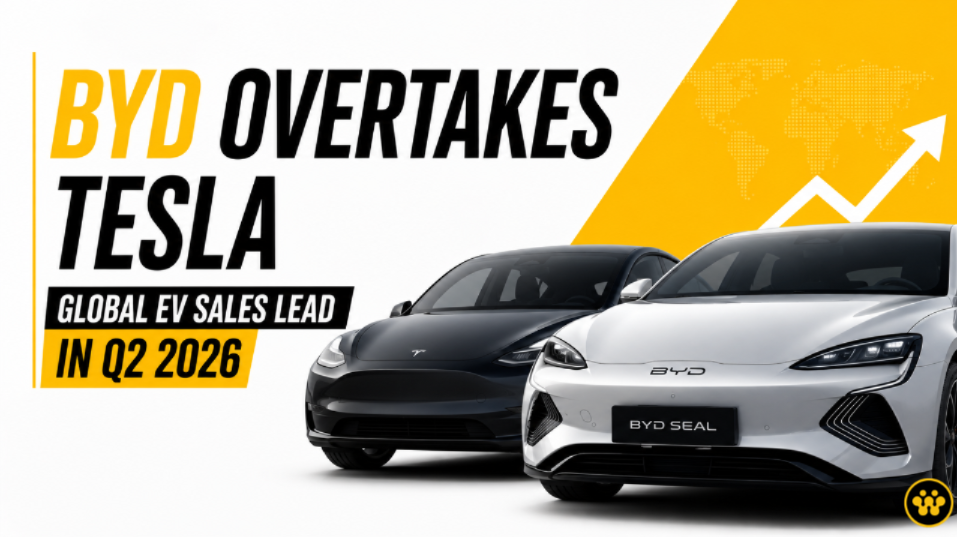
The global automotive landscape has shifted once again, with Chinese automaker BYD officially reclaiming its title as the world's leading seller of battery electric vehicles (BEVs) for the second quarter of 2026. With delivery figures reaching 557,090 units, BYD has moved decisively ahead of Tesla, which is projected to report approximately 396,500 deliveries for the same period.
A Tale of Two Strategies: Why the Gap is Widening
This change in leadership highlights a significant divergence in the growth trajectories of the two EV giants. While Tesla narrowly led the global market in the first quarter of 2026 largely due to a temporary lull in BYD’s domestic Chinese sales following tax policy adjustments the second quarter has seen a robust resurgence for the Chinese manufacturer.
1. The Power of Global Expansion
BYD’s success in Q2 is primarily driven by an aggressive international export strategy. The company has rapidly scaled its presence in Europe, Southeast Asia, and Latin America, with overseas deliveries now serving as a primary growth engine. In fact, BYD has revised its 2026 overseas sales target upward to 1.5 million vehicles, signaling immense confidence in its localized distribution networks.
2. Structural Cost Advantages
Industry analysts point to BYD’s vertical integration as a key competitive moat. By controlling the entire supply chain from raw lithium processing to the production of its proprietary Lithium Iron Phosphate (LFP) "Blade Battery" BYD maintains a structural cost advantage that is difficult for legacy automakers to replicate. These cost efficiencies allow the company to offer highly competitive pricing in both domestic and international markets.
3. Tesla’s Growth Plateau
Conversely, Tesla is navigating a period of stagnation in its core automotive business. While the company's Q2 consensus estimate of 406,000 units would mark a modest year over year increase, it reflects a broader trend of slowing growth for the brand. With its primary lineup consisting of the aging Model 3 and Model Y, Tesla’s reliance on a limited vehicle portfolio has created a challenge in maintaining the rapid growth rates seen in previous years.
Looking Ahead: The Future of the EV Race
The disparity between BYD’s 557,090 deliveries and Tesla’s projected figures represents a gap of more than 160,000 units. For market observers, this is not merely a one quarter fluctuation but a reflection of a structural shift in the global EV segment.
As BYD continues to ramp up production at its new manufacturing facilities in regions like Hungary and Brazil, the company is effectively bypassing traditional trade barriers to compete directly on a global scale. While Tesla continues to pivot its focus toward future technologies like robotics and AI, the immediate volume lead held by BYD suggests that the battle for dominance in the mass market EV sector is tilting increasingly in favor of Chinese manufacturers.
Looking to buy an EV?
Compare, explore and find the perfect electric vehicle for you.
Explore EVs