LICO Materials and Ather Energy Join Forces to Tackle India’s EV Battery Waste


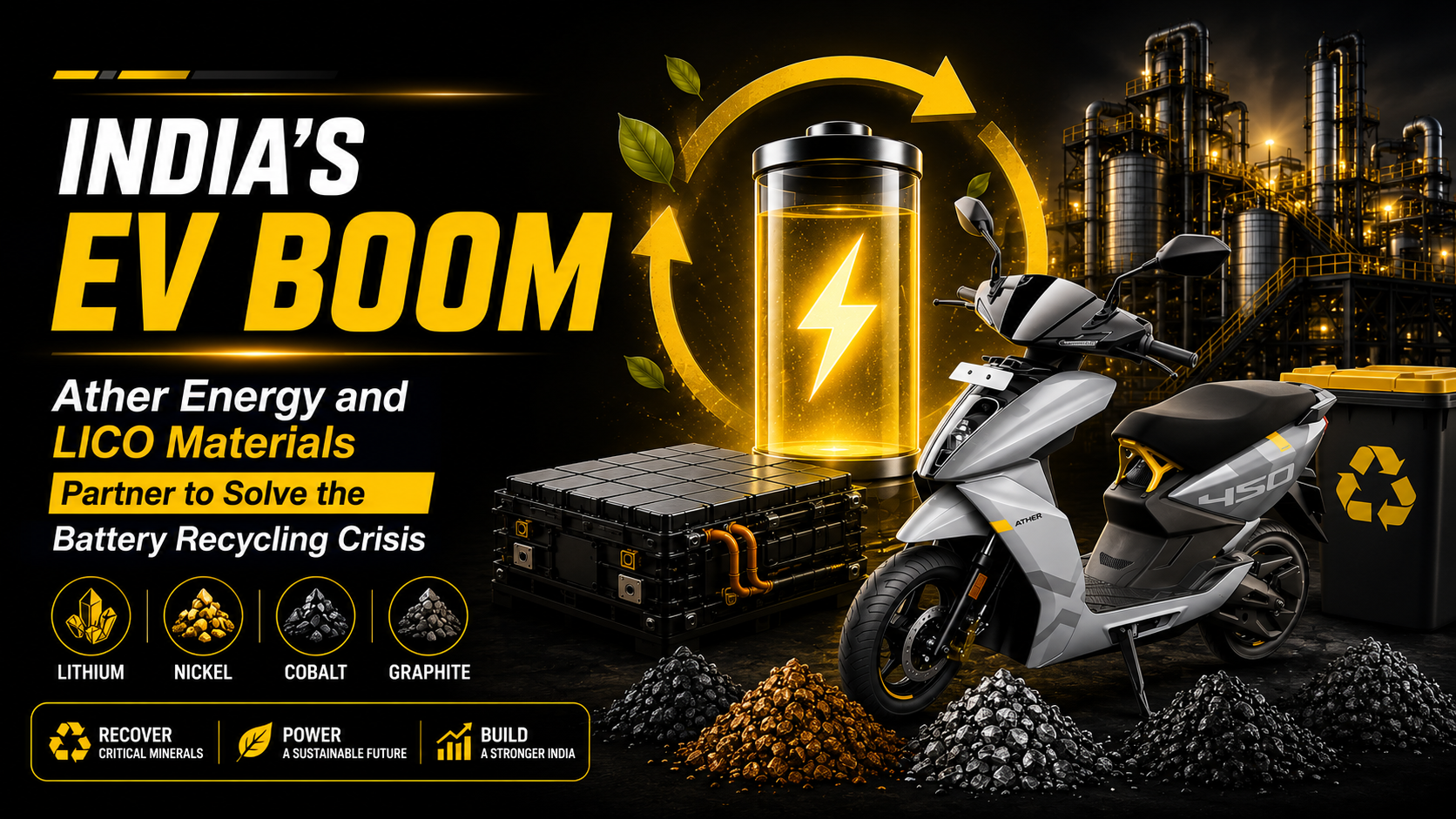
A major step toward battery circularity, recovering up to 95% of critical minerals from end-of-life electric two-wheeler batteries.
LICO Materials, an integrated battery circularity company, and Ather Energy, one of India’s leading electric two-wheeler manufacturers, have officially announced a strategic partnership. The collaboration aims to design and implement a robust system for collecting end-of-life lithium-ion batteries and recovering critical battery materials.
Under this new agreement, end-of-life lithium-ion batteries from Ather's growing fleet will be sent to LICO’s advanced processing facility in Karnataka. The critical materials recovered from these packs will be refined and reintroduced directly back into the battery supply chain, making them available for cell manufacturers and original equipment manufacturers (OEMs) building next-generation electric vehicles.
Overcoming India's Critical Mineral Vulnerability
India’s transition to electric mobility is moving at an unprecedented pace, yet the nation faces a stark reality: it completely lacks domestic reserves of the critical minerals required to manufacture EV battery cells. Currently, India relies entirely on geographically concentrated global supply chains, leaving the market highly exposed to severe price volatility, geopolitical risks, and the heavy environmental costs associated with primary mining extraction.
Gaurav Dolwani, CEO of LICO Materials, highlighted the urgency of the situation:
"India is building one of the world's largest EV fleets and it is doing without domestic reserves of the minerals that power it. That is a structural vulnerability, and battery circularity is the only answer. This partnership means those batteries can be recycled & recovered minerals can be fed into the battery supply chain. We believe this is how India can reduce its dependence on imported critical materials."
By establishing a closed-loop system, every single kilogram of battery material that LICO recovers from an old Ather battery pack represents a kilogram that does not need to be mined, processed overseas, and imported at unpredictable costs.
High-Efficiency Recycling and Long-Term Impact
Ather Energy entered the market in 2018 as one of India's earliest electric two-wheeler manufacturers. As adoption continues to skyrocket, managing the inevitable influx of aging batteries is becoming a paramount priority.
LICO Materials is uniquely equipped to handle this demand. Its state-of-the-art recycling and refurbishing facility in Bengaluru, Karnataka, boasts an annual input capacity of 4 GWh. More importantly, the facility achieves material recovery rates of up to 95%, successfully reclaiming high-purity, battery-grade materials including:
-
Lithium
-
Nickel
-
Cobalt
-
Graphite
-
Copper
-
Manganese
The 2050 Vision: Direct Green Benefits
The long-term economic and environmental projections for India's battery recycling ecosystem are massive. By the year 2050, the recycling sector aims to achieve the following milestones:
-
Supply Allocation: Caters to over 40% of India’s total lithium, nickel, and cobalt demands.
-
Employment: Generates more than 106,000 direct green jobs.
-
Carbon Reduction: Prevents over 2.9 million tons of CO₂ emissions, which is equivalent to removing roughly 700,000 fossil fuel vehicles from the road for an entire year.
This green alliance directly aligns with India's broader Net Zero 2070 commitments. Furthermore, it ensures strict compliance with the government's Battery Waste Management Rules (BWMR) 2022, which legally mandates extended producer responsibility across the entire EV value chain.
About the Partners
-
LICO Materials: Founded in 2021, LICO Materials specializes in end-of-life battery recycling and repurposing. Beyond recovering battery-grade minerals, the company focuses on giving batteries a "second life" by creating battery energy storage systems (BESS) designed to power residential, commercial, industrial, and charging infrastructures.
-
Ather Energy: As one of India's pioneering electric two-wheeler manufacturers, Ather Energy launched its first electric scooter in 2018 and continues to be a driving force in the country's sustainable transition.
Frequently Asked Questions
Q.1What is the main objective of the partnership between LICO Materials and Ather Energy?
Q.2Where will the batteries be recycled, and what is the plant's capacity?
Q.3Why is domestic battery recycling so important for India?
Q.4How does this initiative support environmental regulations in India?
Looking to buy an EV?
Compare, explore and find the perfect electric vehicle for you.
Explore EVs