Ultraviolette F77 Mach 2 Sets Ultimate Record: Clocks 1.46 Lakh KM in Just 2 Years With 95% Battery Health


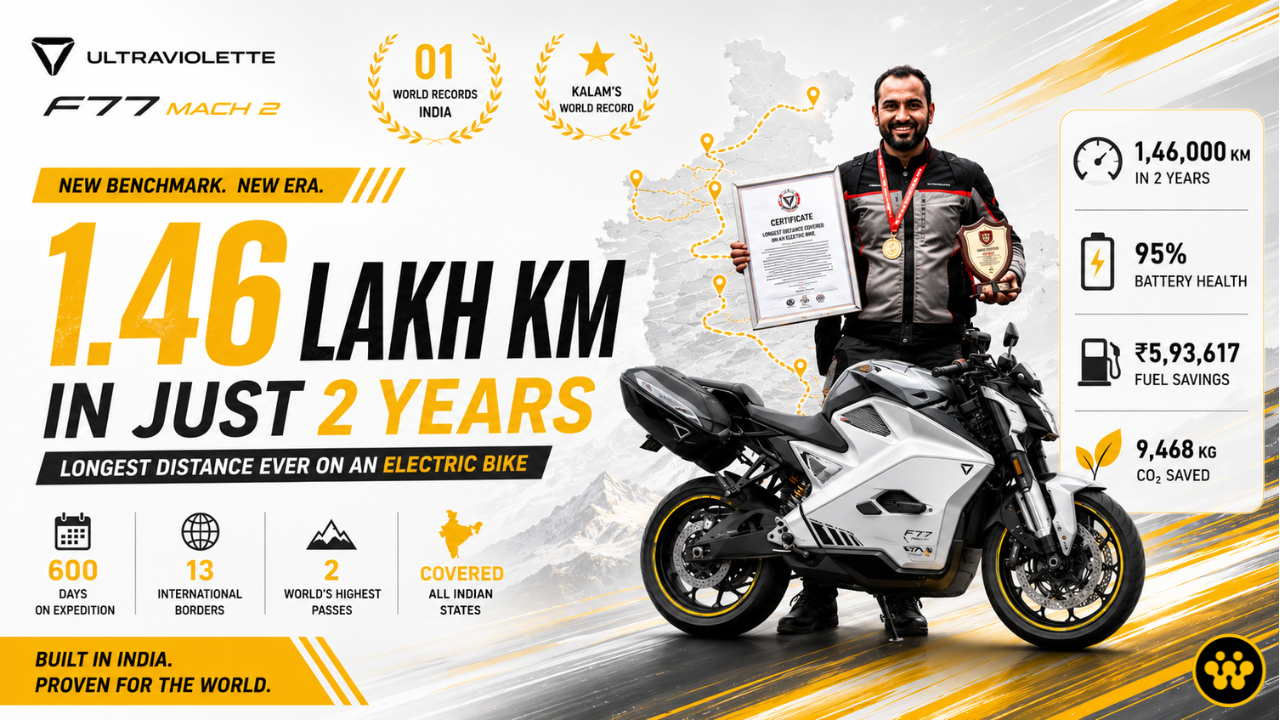
In a monumental milestone that redefines the endurance and long term viability benchmarks for electric vehicles worldwide, an Ultraviolette F77 Mach 2 customer has clocked an unprecedented 146,000 kilometers in just two years. The record-breaking feat, achieved by passionate rider Harish Surampade, marks the longest distance ever covered on an electric motorcycle, soundly answering structural questions regarding electric bike battery life and thermal reliability under extreme conditions.
Riding India's flagship high-performance electric motorcycle, Surampade navigated through every single Indian state, scaled the world's highest motorable passes, and touched 13 international borders. The journey has entered the annals of motoring history, earning two prominent world records while highlighting the disruptive engineering backend of modern Indian electric two-wheelers.
Two World Records: Conquering Borders and Extreme Altitudes
The 146,000 km journey was anchored by two historic cross-country expeditions that pushed the commercial EV architecture into uncharted territories
-
Kalam’s World Records : Surampade completed the first electric bike expedition across six international borders—including Panitanki, Korala, Jaigaon, Nathu La, Batang La Tri-Junction, and Fulbari—in just 19 days. Spanning over 3,000 km, this expedition marked the first time an EV was officially granted a permit to scale the hostile, high-altitude terrain of the Nathu La Pass, enduring temperatures as low as −10°C in the Upper Mustang region.
-
World Records India : Over a grueling 600 days, the rider completed the longest distance cross-country expedition starting and concluding in Bengaluru. Covering 120,000 km, this leg saw the F77 Mach 2 conquer both Khardung La and Umling La under punishing climatic conditions ranging from intense freezing dips of −15°C up to scorching peaks of +48°C.
The 95% Battery Health Phenomenon : Real-World EV Reliability
While the geographical footprint of the journey is staggering, the primary engineering breakthrough lies within the powertrain's health metrics. After enduring 146,000 km of sustained rapid fast-charging, continuous high-stress operations, and massive thermal fluctuations, the battery health of the Ultraviolette F77 Mach 2 remains at an astonishing 95%.
This exceptional retention rate provides definitive consumer proof that localized advanced thermal management systems and intelligent battery management systems (BMS) can mitigate long term degradation. The real-world data debunks persistent market apprehensions surrounding electric motorcycle longevity and ongoing ownership costs in the high-performance electric bike segment.
Sustainability and Total Economic Impact
Beyond proving technical resilience, the two-year transcontinental expedition outlines the massive environmental and fiscal benefits of accelerating the transition to sustainable mobility in India. According to telemetry validated by Ultraviolette, the continuous deployment of the F77 Mach 2 yielded major resource optimization parameters:
-
Fossil Fuel Abatement : Saved a total of 5,763 liters of conventional fuel, translating directly to a massive financial saving of ₹593,617 in running costs.
-
Energy Footprint & Regeneration : The motorcycle consumed a total of 6,999 kWh of electric energy over two years, while successfully recovering 97 kWh purely through its advanced regenerative braking framework.
-
Carbon Mitigation : Prevented over 9,468 kg of harmful carbon dioxide (CO2) emissions from entering the atmosphere.
A New Era for High-Performance Electric Motorcycles
Harish Surampade's extraordinary cross-border achievement changes the narrative for the global EV industry. It shifts the perception of electric two-wheelers from mere urban commuter tools to robust, extreme-endurance touring platforms capable of matching or exceeding internal combustion engines.
As state policies and national programs look to reinforce EV infrastructure across India, this definitive milestone stands as a testament to homegrown engineering, indicating that performance, long range capability, and uncompromised structural durability can seamlessly converge in the next generation of electric mobility.
Looking to buy an EV?
Compare, explore and find the perfect electric vehicle for you.
Explore EVs