TVS Crosses 10 Lakh Electric Scooter Sales Milestone in India


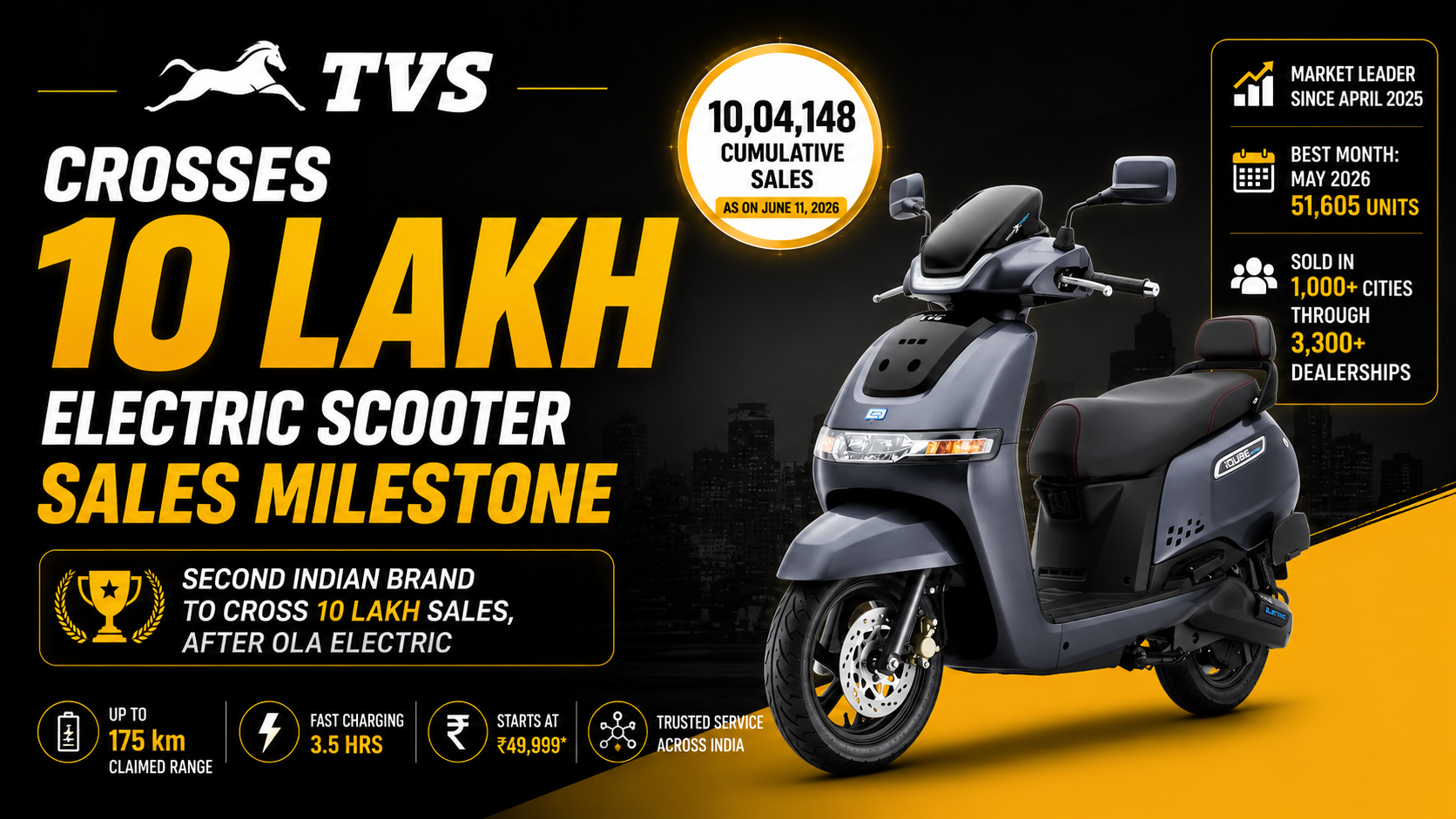
TVS Motor Company has retailed over 10 lakh electric scooters in India. The exact number — 10,04,148 units — was recorded on the Vahan registration portal on June 11, 2026, making TVS the second Indian electric two-wheeler manufacturer to reach this landmark after Ola Electric, which crossed the same mark in late March 2026.
The milestone combines cumulative sales of the TVS iQube (launched January 2020) and the TVS Orbiter (launched August 2025). TVS closed the gap with Ola Electric in roughly two-and-a-half months — and given its current daily sales trajectory, it is likely to overtake Ola in cumulative numbers within 2026.
How TVS Reached 10 Lakh — The Sales Timeline
The growth curve tells the story better than anything else. TVS started slow, became steady, and then accelerated hard.
| Milestone | Time Taken | Period |
|---|---|---|
| 0 to 1 lakh units | ~3 years | Jan 2020 – Early 2023 |
| 1 lakh to 2 lakh units | ~10 months | 2023 |
| 3 lakh cumulative | 4 years 4 months | By April 2024 |
| 3 lakh to 7 lakh units | ~17 months | April 2024 – Sept 2025 |
| 7 lakh to 8 lakh units | ~3 months | Oct – Dec 2025 |
| 9 lakh to 10 lakh units | 75 days | Mar 28 – Jun 10, 2026 |
The last 1 lakh units were sold at a pace of approximately 1,333 scooters per day. That is not a festive season spike — it is sustained, daily demand.
Market Share Growth
TVS's EV market share trajectory is just as striking:
| Year | Market Share | Units Sold |
|---|---|---|
| 2020 | ~1% | Limited (select cities only) |
| 2022 | ~8% | Growing distribution |
| 2023 | ~20% | 1,77,024 units |
| 2025 | Segment #1 | 3,15,083 units |
| 2026 (YTD) | ~26% | 2,19,232 units (Jan 1 – Jun 11) |
TVS has held the number-one position in the electric two-wheeler segment since April 2025. Its best-ever single month was May 2026 with 51,605 units — the second-highest monthly figure recorded by any Indian electric two-wheeler maker, trailing only Ola Electric's 53,647 units in May 2024.
What Made This Possible
Three factors drove the acceleration:
1. Product expansion and pricing. The iQube today spans multiple variants covering ₹90,000 to ₹1.80 lakh (ex-showroom). Price cuts of up to ₹26,000 from GST revisions and larger battery options across variants expanded the buyer pool significantly. The latest iQube S 4.7 kWh variant launched at ₹1.37 lakh adds a mid-range sweet spot.
2. The Orbiter effect. Launched in August 2025, and followed by the Orbiter V1 on March 12, 2026, TVS created an aggressive entry point. The Orbiter V1 starts at just ₹49,999 on a Battery-as-a-Service (BaaS) model, with monthly battery subscriptions as low as ₹862. This opened up the electric scooter market to first-time EV buyers and budget-conscious commuters in a way no other brand has matched.
3. Distribution muscle. The iQube is available in over 1,000 cities through 3,300+ dealerships. No EV startup comes close to this reach. For buyers in Tier-2 and Tier-3 cities, proximity to a trusted service centre is often the deciding factor — and TVS dominates on this front.
TVS Electric Scooter Lineup — Key Specifications
| Model | Battery | Range (Claimed IDC) | Top Speed | Price (Ex-showroom) |
|---|---|---|---|---|
| TVS iQube (2.2 kWh) | 2.2 kWh Li-ion | 94 km | 75 km/h | ~₹1.07 lakh |
| TVS iQube S (3.4 kWh) | 3.4 kWh Li-ion | 100 km | 78 km/h | ~₹1.40 lakh |
| TVS iQube S (4.7 kWh) | 4.7 kWh Li-ion | 175 km | 78 km/h | ₹1.37 lakh |
| TVS iQube ST (5.1 kWh) | 5.1 kWh Li-ion | 150 km | 82 km/h | ~₹1.85 lakh |
| TVS Orbiter V2 (3.1 kWh) | 3.1 kWh Li-ion | 158 km | 75 km/h | ~₹88,250 – ₹1.05 lakh |
| TVS Orbiter V1 (BaaS) | 1.8 kWh Li-ion | 86 km | 65 km/h | ₹49,999 + ₹862/month |
Note: Prices and range are approximate and vary by city, variant, and applicable subsidies (PM e-Drive / state incentives).
Market Comparison: TVS vs Key Competitors
TVS does not operate in a vacuum. Here is how it stacks up against major rivals in the electric scooter space.
| Parameter | TVS (iQube & Orbiter) | Ola (S1 Portfolio) | Bajaj (Chetak) | Ather (450 & Rizta) |
|---|---|---|---|---|
| Cumulative Sales (Jun 2026) | 10+ lakh | 10+ lakh (Mar 2026) | 7+ lakh (May 2026) | ~6 lakh+ |
| Current Market Position | #1 since Apr 2025 | Declining monthly share | #2 by volume | #4 |
| Price Range | ₹90K – ₹1.85L | ₹80K – ₹1.50L | ₹1.00L – ₹1.30L | ₹1.10L – ₹1.70L |
| Max Claimed Range | ~175 km (iQube S 4.7) | ~170 km | ~140 km | ~160 km |
| Dealership Network | 3,300+ across 1,000+ cities | ~1,000 | ~800+ | ~600+ |
| Key Strength | Distribution + trust | Features + aggressive pricing | Build quality + low maintenance | Tech + longest warranty |
| Key Weakness | Conservative design | After-sales concerns | Limited variants | Limited dealer reach |
Ola Electric was the first to hit 10 lakh cumulative sales (across its entire S1 portfolio) but has seen a sharp decline in monthly volumes — recording just 7,512 units in January 2026, a 69% year-on-year drop — largely due to well-documented service and quality issues.
Bajaj Chetak has crossed the 7 lakh cumulative sales milestone in early May 2026, solidifying its position as a strong second-place player by volume YTD. It competes on durability and the lowest maintenance costs in the segment, appealing to buyers who prioritise long-term ownership economics over flashy features.
Ather Energy targets families and enthusiasts with its 450 series and the newer Rizta. It has crossed 6 lakh cumulative sales, with the Rizta serving as a key volume driver. Ather focuses on offering the best tech, longest warranty, and high practical range (~140 km real-world). However, its dealer network remains significantly smaller than TVS's.
TVS wins by being the broadest option — decent range, competitive pricing, massive service network, and a brand that Indian families already trust.
What's Next for TVS Electric
TVS is not done. The company has committed ₹1,800 crore toward new EV product development, technology, and manufacturing capacity. Key upcoming moves:
- Jupiter Electric: Expected by August 2026, priced between ₹1.10 lakh and ₹1.30 lakh. Given the Jupiter's dominance as a petrol scooter, the electric variant could unlock an entirely new customer base.
- In-house battery cell manufacturing: TVS plans to localise battery cell production at its own facilities, targeting reduced input costs and better supply chain control.
- 5 lakh annual sales target: With 2,19,232 units already sold in the first five months of 2026 (70% of full-year 2025 volume), and the festive season still ahead, TVS is on track to cross 5 lakh EV sales in a single calendar year for the first time.
The broader Indian electric two-wheeler segment — averaging over 1,55,000 units per month in 2026 — is itself on course to approach the 20 lakh (2 million) annual sales mark for the first time. Rising petrol prices driven by geopolitical tensions in West Asia continue to push more buyers toward EVs.
Challenges Ahead
The 10 lakh milestone is significant, but TVS faces headwinds:
- Intensifying competition: Honda has launched the Activa Electric. Hero MotoCorp's Vida brand has been selling 10,000+ units/month consistently since early 2026. Every legacy OEM now wants a piece of the EV market.
- Subsidy dependence: The PM e-Drive scheme has been critical in making models like the Orbiter V1 affordable at ₹49,999. Any subsidy reduction could stall demand among price-sensitive buyers.
- Rural penetration: The vast majority of TVS electric scooter sales come from urban and semi-urban India. Rural areas lack charging infrastructure, limiting growth potential.
- Battery cost and localisation: Until in-house cell manufacturing is operational, TVS shares the same battery import cost pressures as every other Indian EV maker.
Frequently Asked Questions
Q.1How many electric scooters has TVS sold in India?
Q.2Is TVS the number one electric scooter brand in India?
Q.3Which TVS electric scooter sells the most?
Q.4How does TVS compare with Ola Electric in sales?
Q.5What is the cheapest TVS electric scooter?
Q.6What are TVS's upcoming electric vehicles?
Q.7Will TVS sell 5 lakh electric scooters in 2026?
Looking to buy an EV?
Compare, explore and find the perfect electric vehicle for you.
Explore EVs