Ather Stock Storms Past ₹1,000: Why the Market is Ignoring Big Losses and a PLI Lockdown


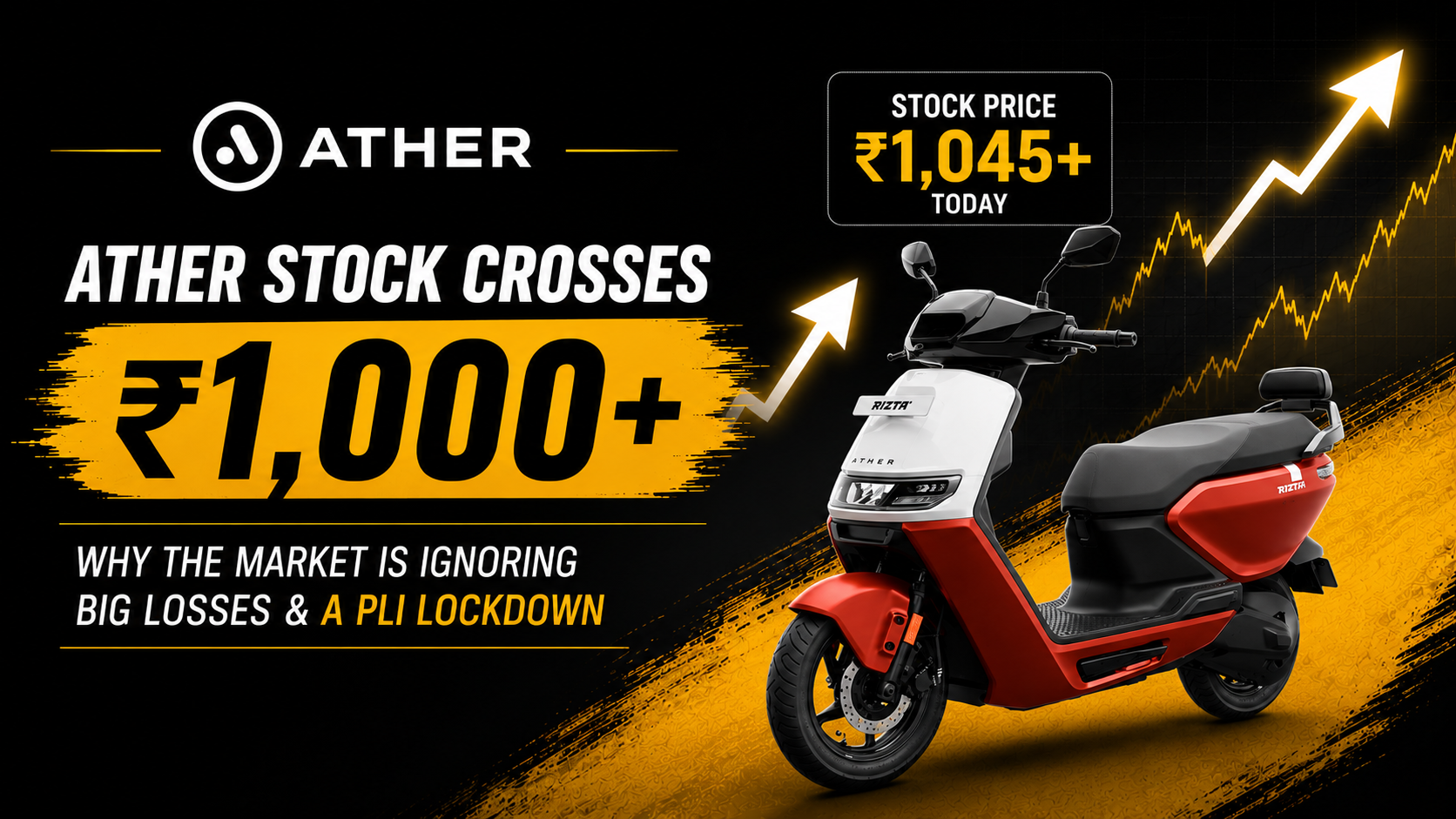
Ather Energy is making a major strategic pivot to secure low cost capital for its upcoming electric motorcycles and new "EL" vehicle platform. Excluded from the government's lucrative Auto Production Linked Incentive (PLI) scheme due to strict legacy focused eligibility thresholds, the electric vehicle (EV) maker is finalizing its participation in the government’s ₹1 trillion Research, Development, and Innovation (RDI) scheme.
While the markets have reacted aggressively to this development, on ground retail realities paint a complex picture of surging consumer demand colliding with maxed out production capacities and an unexpected supply chain crunch.
EVINDIA reached out to Ather Energy for an official statement regarding their participation in the RDI scheme, but we have not yet received an official confirmation or denial.
The Policy Pivot: Bypassing the PLI Bottleneck
According to a recent LiveMint report and market analysis by Multibagg.ai, Ather is finalizing a term sheet under the ₹1 trillion RDI programme. This route will provide long term debt funding at exceptionally low interest rates of 2–3%, featuring milestone linked disbursements.
For an EV manufacturer, this low interest debt reduces financing pressure during periods of heavy product development and investment. In Ather's case, the RDI line is positioned as a way to bankroll its upcoming electric motorcycle and EL platforms.
The move is significant because Ather's inclusion under the ₹25,938 crore PLI auto scheme remains stalled. Rivals such as TVS Motor, Bajaj Auto, and Ola Electric continue to benefit from these PLI linked incentives, intensifying competition.
The "Startup Penalty" Thresholds
The PLI scheme is described in government explanations as being designed for "global champions" rather than startups. The financial eligibility conditions are rigid. Ather Energy CEO Tarun Mehta has criticized this framework for excluding EV first startups, arguing that these design choices leave emerging EV makers at a distinct cost disadvantage.
Below is a breakdown of the key schemes and the rigid PLI thresholds locking startups out:
| Item | Figure | Notes |
| RDI scheme size | ₹100,000 crore |
Stated as ₹1 trillion RDI scheme |
| RDI loan interest rate | 2–3% |
Milestone-linked disbursements |
| Auto PLI scheme size | ₹25,938 crore |
Rivals cited as benefiting |
| PLI eligibility (revenue) | ₹10,000 crore |
Threshold mentioned for auto companies |
| PLI eligibility (net worth) | ₹1,000 crore |
Threshold mentioned for non-auto firms |
| PLI eligibility (fixed assets) | ₹3,000 crore |
Threshold referenced in government explanation |
| Estimated cost gap | 13–16% |
Between PLI beneficiaries and non-beneficiaries |
(Data Source : Multibagg.ai)
Margin Defense and Financial Strategy
While the company continues to log operational losses, Ather is visibly shifting its focus toward financial sustainability. In a clear move to defend its bottom line against rising input pressures, Ather has consciously chosen to increase the prices across its Rizta lineup.
When questioned about the exact timeline for turning a profit, Ather declined to comment on when they will officially hit the net break even. However, this strategic price hike offers strong market confidence that the leadership is highly margin conscious. Rather than chasing raw volumes through unsustainable discounting, the brand is actively laying down the margin architecture needed to achieve operational break even in the quarters to come.
To balance this margin protection with consumer affordability, Ather continues to lean heavily on ecosystem engineering:
-
Battery as a Service (BaaS): A decoupled model where customers drop upfront acquisition costs by roughly 30%, instead paying a usage fee of ₹1 per kilometre (subject to a 1,000 km monthly minimum).
-
Risk Mitigation: Offering a 3 year assured 60% buyback programme alongside an extended 5 year or 60,000 km warranty to offset cheaper, PLI subsidized competition.
EVINDIA Data Analysis: The Unanticipated Q1 Retail Reality
While the boardroom addresses macro policy, an evaluation of the retail landscape reveals why the company is facing an acute operational crunch.
Historically, the final month of the fiscal year (March) triggers a massive consumer rush driven by the "Fear Of Missing Out" (FOMO) as existing government subsidies expire. March 2026 followed this cyclical trend perfectly. Every major OEM, including Ather, completely emptied their raw material pipelines and vehicle inventory to satisfy the subsidy driven demand spike.
However, the industry heavily miscalculated the post-March market sentiment. Anticipating a steep retail crash in April similar to previous subsidy transition cycles, manufacturers adjusted production downward. Instead, demand sustained. Driven by continuous traditional fuel price hikes and shifting consumer sentiment tied to the broader economic impacts of the Hormuz crisis, retail buyers kept flocking to EV showrooms.
Official government Vahan registration data highlights the exact scale of this holding pattern for Ather Energy:
| Month (2026) | Vahan Vehicle Registrations |
| January | 23,083 units |
| February | 21,260 units |
| March | 36,345 units (Subsidy Peak) |
| April | 28,496 units |
| May | 28,295 units |
| June (Partial Data) | 6,637 units |
| Total (YTD) | 144,116 units |
The Impact on Q1 FY26-27
Because Ather and its primary component suppliers did not anticipate April and May demand holding strong at over 28,000 units per month, the entire manufacturing pipeline has hit a hard bottleneck. This data, drawn from and summarized in, indicates that demand remained robust long after the typical post subsidy drop off.
Ather and other top tier OEMs have reached their maximum production capacities due to this overwhelming, unforecasted demand. Coupled with the fact that raw material buffers were completely depleted in March, a sharp supply chain crisis has emerged. Showroom waiting periods are lengthening for customers across major hubs.
The EVINDIA Bottom Line: While the first quarter of FY26-27 will technically register as a volume growth period compared to standard historical baselines, it is highly likely to manifest as a low growth quarter when compared sequentially to previous peak quarters. The slowdown is entirely a supply side limitation, not a demand deficit. As low interest RDI capital begins flowing into working capital lines over the coming months, the speed at which Ather can resolve this component crunch and scale its new EL platform will determine whether it can capitalize on its surging market valuation.
Ather's access to PLI could boost India's e2w exports
This video features Ather CEO Tarun Mehta discussing how current eligibility rules have kept pure electric startups out of a policy designed to accelerate electrification, and how adjusting the PLI scheme could unlock massive export opportunities.
Frequently Asked Questions
Q.1
Looking to buy an EV?
Compare, explore and find the perfect electric vehicle for you.
Explore EVs