EV Loan Showdown: Traditional Banks vs. Fintech Lenders (2025)


Introduction
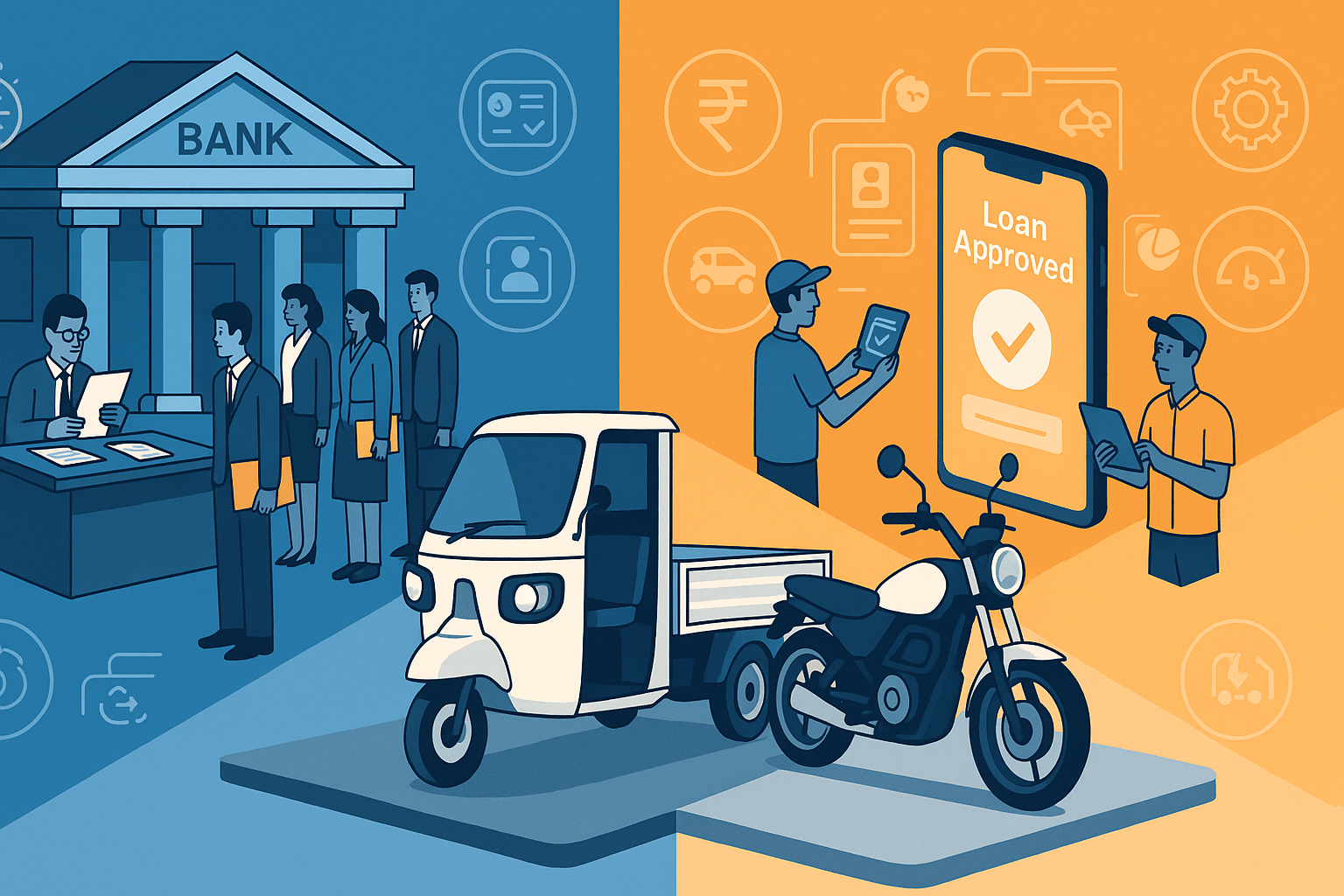
Securing a loan for your new electric vehicle in 2025 involves a strategic choice that goes far beyond simply comparing interest rates. You are choosing between two fundamentally different philosophies: the established stability of traditional banks and the specialised agility of new-age fintech lenders. This head-to-head showdown breaks down the comparison across four key factors: Speed, Eligibility, Cost, and Ecosystem Value, helping you decide which path is right for you.
1. Speed of Disbursement: The High Value of Time
-
Traditional Banks (SBI, HDFC, etc.): The loan approval and disbursal process is thorough but can be slow, typically taking between 7 and 15 days due to extensive verification and paperwork requirements.
-
Fintech Lenders (Turno, Revfin): These platforms are built for velocity. Turno promises loan disbursement within a remarkable 48 hours, while Revfin boasts an approval time of just.
16 minutes through its digital platform.
-
The Verdict: For a salaried individual, a week's delay might be a minor inconvenience. For a commercial driver, two weeks off the road is two weeks of lost income. In the commercial space, speed is not just a feature; it's a critical financial variable.
2. Eligibility & Underwriting: Who Can Get a Loan?
-
Traditional Banks: Rely heavily on conventional credit assessment. A strong CIBIL score, stable income proof, and a comprehensive document trail are essential. This model can often exclude first-time borrowers or those in the informal economy.
-
Fintech Lenders: Innovate to expand access. Revfin utilises alternative data, such as psychometrics and biometrics, to underwrite loans for individuals with no formal credit history, a game-changer for many aspiring entrepreneurs. Turno also explicitly states it can help customers secure financing even if they are unaware of their credit score.
-
The Verdict: Banks are best suited for those who are financially established. Fintechs are actively creating pathways to financial inclusion, significantly expanding the addressable market for EVs.
3. The True Cost: Rates, Down Payments, and Fees
-
Interest Rates: For prime borrowers with high credit scores, banks often offer lower headline interest rates, starting in the 8.15% to 9.20% p.a. range. Fintechs catering to higher-risk segments, like Revfin, may have rates up to 29% (annualised, reducing) to compensate for the risk, while specialised players like Turno offer competitive fixed rates around 10.5%.
-
Down Payment: This is a key differentiator. Fintechs excel at lowering the entry barrier. Turno, for example, enables customers to acquire a commercial EV with a down payment as low as ₹49,999, a fraction of what many traditional lenders might require.
-
The Verdict: While banks may offer lower rates to ideal candidates, fintechs provide greater accessibility through lower upfront costs.
4. The "X-Factor": Beyond the Loan Amount
-
Traditional Banks: Typically offer a standalone financial product. The relationship often concludes once the loan is disbursed.
-
Fintech Lenders Are increasingly building an integrated ownership ecosystem. Turno offers a Vehicle Lifecycle Management app and its revolutionary guaranteed buy-back program, which mitigates the risk associated with the asset's future value. Revfin's mission extends to empowering entrepreneurs, viewing the loan as a tool for sustainable economic growth.
-
The Verdict: Banks sell a financial product. Fintechs are selling a complete business and ownership solution.
Final Recommendation
Choose a traditional bank if you are a salaried individual with a strong credit history, can afford a higher down payment, and are willing to wait to secure the absolute lowest interest rate.
Choose a specialised fintech lender if you are a commercial operator for whom speed is critical, if you have a non-traditional credit profile, or if you value an integrated solution that de-risks the entire lifecycle of your EV asset.
For a complete overview of all current financing options, read our Ultimate Guide to EV Loans in India.
Looking to buy an EV?
Compare, explore and find the perfect electric vehicle for you.
Explore EVs